

72
P. Lecoq
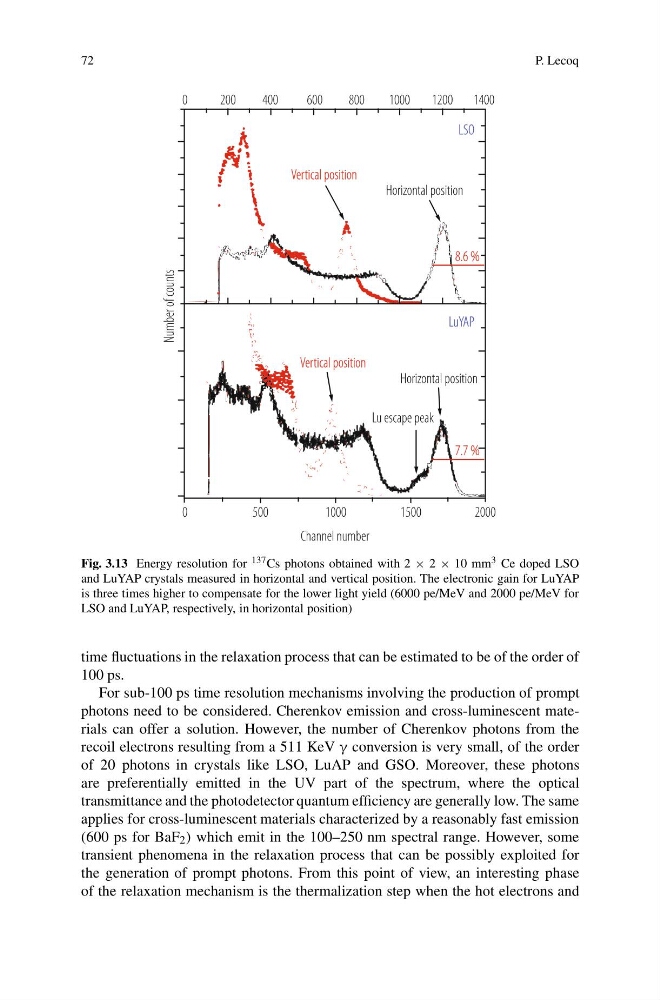
Fig. 3.13 Energy resolution for 137 Cs photons obtained with 2 × 2 × 10 mm 3 Ce doped LSO
and LuYAP crystals measured in horizontal and vertical position. The electronic gain for LuYAP
is three times higher to compensate for the lower light yield (6000 pe/MeV and 2000 pe/MeV for
LSO and LuYAP, respectively, in horizontal position)
time fluctuations in the relaxation process that can be estimated to be of the order of
100 ps.
For sub-100 ps time resolution mechanisms involving the production of prompt
photons need to be considered. Cherenkov emission and cross-luminescent materials can offer a solution. However, the number of Cherenkov photons from the
recoil electrons resulting from a 511 KeV γ conversion is very small, of the order
of 20 photons in crystals like LSO, LuAP and GSO. Moreover, these photons
are preferentially emitted in the UV part of the spectrum, where the optical
transmittance and the photodetector quantum efficiency are generally low. The same
applies for cross-luminescent materials characterized by a reasonably fast emission
(600 ps for BaF 2 ) which emit in the 100–250 nm spectral range. However, some
transient phenomena in the relaxation process that can be possibly exploited for
the generation of prompt photons. From this point of view, an interesting phase
of the relaxation mechanism is the thermalization step when the hot electrons and
P. Lecoq
Fig. 3.13 Energy resolution for 137 Cs photons obtained with 2 × 2 × 10 mm 3 Ce doped LSO
and LuYAP crystals measured in horizontal and vertical position. The electronic gain for LuYAP
is three times higher to compensate for the lower light yield (6000 pe/MeV and 2000 pe/MeV for
LSO and LuYAP, respectively, in horizontal position)
time fluctuations in the relaxation process that can be estimated to be of the order of
100 ps.
For sub-100 ps time resolution mechanisms involving the production of prompt
photons need to be considered. Cherenkov emission and cross-luminescent materials can offer a solution. However, the number of Cherenkov photons from the
recoil electrons resulting from a 511 KeV γ conversion is very small, of the order
of 20 photons in crystals like LSO, LuAP and GSO. Moreover, these photons
are preferentially emitted in the UV part of the spectrum, where the optical
transmittance and the photodetector quantum efficiency are generally low. The same
applies for cross-luminescent materials characterized by a reasonably fast emission
(600 ps for BaF 2 ) which emit in the 100–250 nm spectral range. However, some
transient phenomena in the relaxation process that can be possibly exploited for
the generation of prompt photons. From this point of view, an interesting phase
of the relaxation mechanism is the thermalization step when the hot electrons and