

3 Scintillation Detectors for Charged Particles and Photons
73
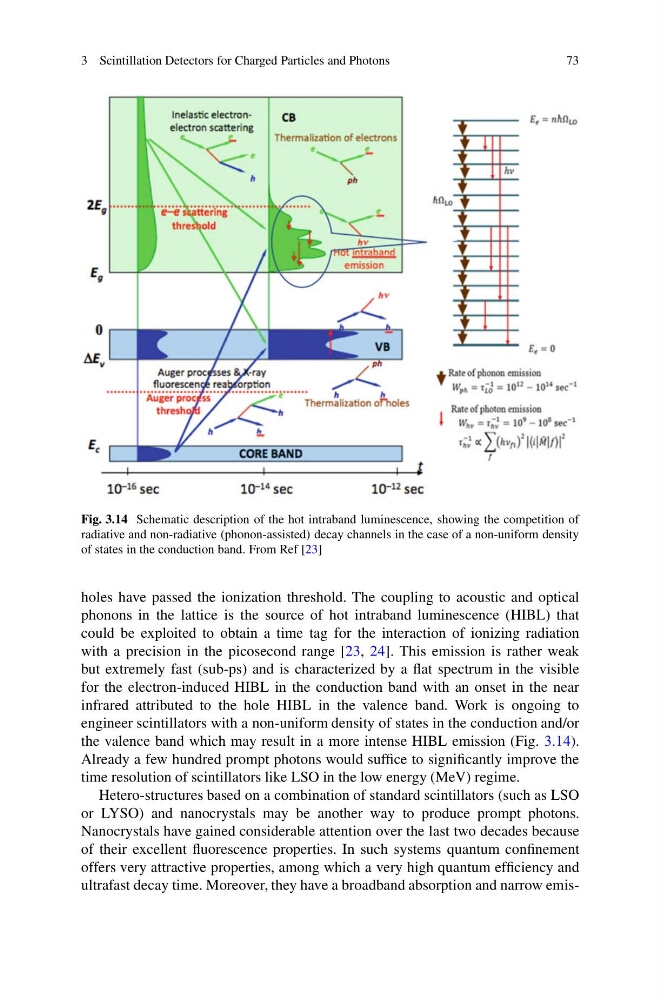
Fig. 3.14 Schematic description of the hot intraband luminescence, showing the competition of
radiative and non-radiative (phonon-assisted) decay channels in the case of a non-uniform density
of states in the conduction band. From Ref [23]
holes have passed the ionization threshold. The coupling to acoustic and optical
phonons in the lattice is the source of hot intraband luminescence (HIBL) that
could be exploited to obtain a time tag for the interaction of ionizing radiation
with a precision in the picosecond range [23, 24]. This emission is rather weak
but extremely fast (sub-ps) and is characterized by a flat spectrum in the visible
for the electron-induced HIBL in the conduction band with an onset in the near
infrared attributed to the hole HIBL in the valence band. Work is ongoing to
engineer scintillators with a non-uniform density of states in the conduction and/or
the valence band which may result in a more intense HIBL emission (Fig. 3.14).
Already a few hundred prompt photons would suffice to significantly improve the
time resolution of scintillators like LSO in the low energy (MeV) regime.
Hetero-structures based on a combination of standard scintillators (such as LSO
or LYSO) and nanocrystals may be another way to produce prompt photons.
Nanocrystals have gained considerable attention over the last two decades because
of their excellent fluorescence properties. In such systems quantum confinement
offers very attractive properties, among which a very high quantum efficiency and
ultrafast decay time. Moreover, they have a broadband absorption and narrow emis-
73
Fig. 3.14 Schematic description of the hot intraband luminescence, showing the competition of
radiative and non-radiative (phonon-assisted) decay channels in the case of a non-uniform density
of states in the conduction band. From Ref [23]
holes have passed the ionization threshold. The coupling to acoustic and optical
phonons in the lattice is the source of hot intraband luminescence (HIBL) that
could be exploited to obtain a time tag for the interaction of ionizing radiation
with a precision in the picosecond range [23, 24]. This emission is rather weak
but extremely fast (sub-ps) and is characterized by a flat spectrum in the visible
for the electron-induced HIBL in the conduction band with an onset in the near
infrared attributed to the hole HIBL in the valence band. Work is ongoing to
engineer scintillators with a non-uniform density of states in the conduction and/or
the valence band which may result in a more intense HIBL emission (Fig. 3.14).
Already a few hundred prompt photons would suffice to significantly improve the
time resolution of scintillators like LSO in the low energy (MeV) regime.
Hetero-structures based on a combination of standard scintillators (such as LSO
or LYSO) and nanocrystals may be another way to produce prompt photons.
Nanocrystals have gained considerable attention over the last two decades because
of their excellent fluorescence properties. In such systems quantum confinement
offers very attractive properties, among which a very high quantum efficiency and
ultrafast decay time. Moreover, they have a broadband absorption and narrow emis-