

3 Scintillation Detectors for Charged Particles and Photons
71
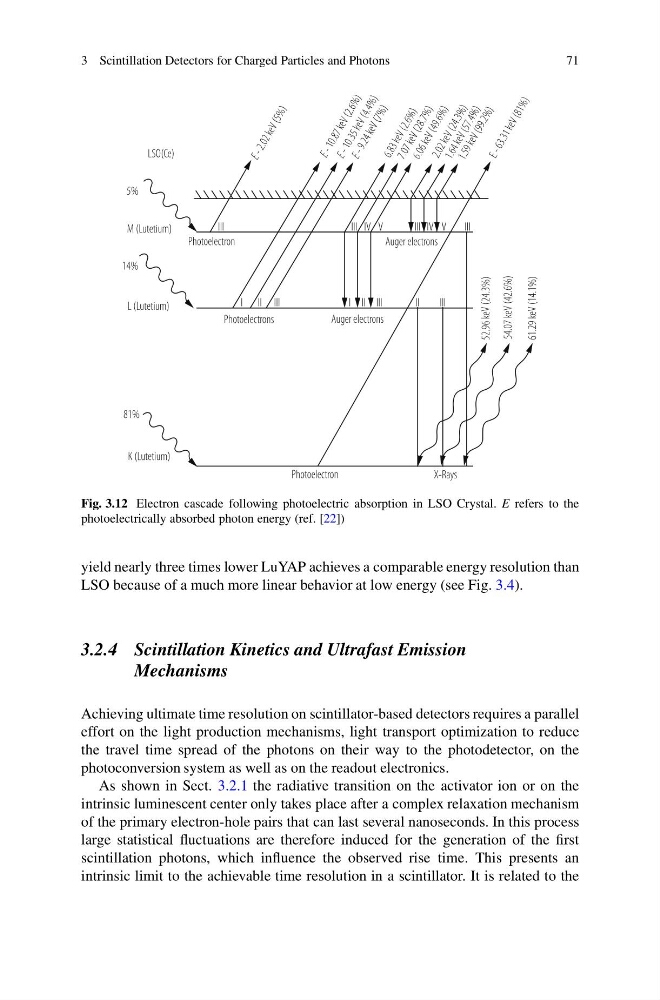
Fig. 3.12 Electron cascade following photoelectric absorption in LSO Crystal. E refers to the
photoelectrically absorbed photon energy (ref. [22])
yield nearly three times lower LuYAP achieves a comparable energy resolution than
LSO because of a much more linear behavior at low energy (see Fig. 3.4).
3.2.4 Scintillation Kinetics and Ultrafast Emission
Mechanisms
Achieving ultimate time resolution on scintillator-based detectors requires a parallel
effort on the light production mechanisms, light transport optimization to reduce
the travel time spread of the photons on their way to the photodetector, on the
photoconversion system as well as on the readout electronics.
As shown in Sect. 3.2.1 the radiative transition on the activator ion or on the
intrinsic luminescent center only takes place after a complex relaxation mechanism
of the primary electron-hole pairs that can last several nanoseconds. In this process
large statistical fluctuations are therefore induced for the generation of the first
scintillation photons, which influence the observed rise time. This presents an
intrinsic limit to the achievable time resolution in a scintillator. It is related to the
71
Fig. 3.12 Electron cascade following photoelectric absorption in LSO Crystal. E refers to the
photoelectrically absorbed photon energy (ref. [22])
yield nearly three times lower LuYAP achieves a comparable energy resolution than
LSO because of a much more linear behavior at low energy (see Fig. 3.4).
3.2.4 Scintillation Kinetics and Ultrafast Emission
Mechanisms
Achieving ultimate time resolution on scintillator-based detectors requires a parallel
effort on the light production mechanisms, light transport optimization to reduce
the travel time spread of the photons on their way to the photodetector, on the
photoconversion system as well as on the readout electronics.
As shown in Sect. 3.2.1 the radiative transition on the activator ion or on the
intrinsic luminescent center only takes place after a complex relaxation mechanism
of the primary electron-hole pairs that can last several nanoseconds. In this process
large statistical fluctuations are therefore induced for the generation of the first
scintillation photons, which influence the observed rise time. This presents an
intrinsic limit to the achievable time resolution in a scintillator. It is related to the