

16 Integration of Detectors into a Large Experiment: Examples from ATLAS. . .
769
[GeV]
T
E
10
15
20
25
30
35
40
45
50
Uncertainties in %
-2
10
-1
10
1
10
Loose
Medium
Tight
ATLAS
Total
Statistical
Systematic
-1
L dt = 4.7 fb
∫
= 7 TeV,
s
2011 Data,
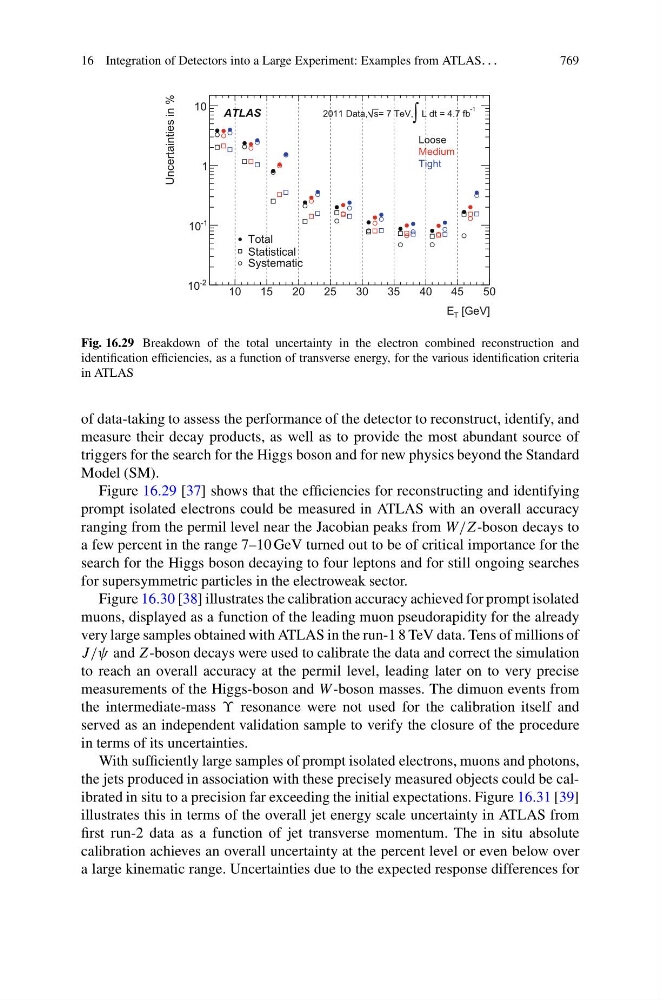
Fig. 16.29 Breakdown of the total uncertainty in the electron combined reconstruction and
identification efficiencies, as a function of transverse energy, for the various identification criteria
in ATLAS
of data-taking to assess the performance of the detector to reconstruct, identify, and
measure their decay products, as well as to provide the most abundant source of
triggers for the search for the Higgs boson and for new physics beyond the Standard
Model (SM).
Figure 16.29 [37] shows that the efficiencies for reconstructing and identifying
prompt isolated electrons could be measured in ATLAS with an overall accuracy
ranging from the permil level near the Jacobian peaks from W/Z-boson decays to
a few percent in the range 7–10 GeV turned out to be of critical importance for the
search for the Higgs boson decaying to four leptons and for still ongoing searches
for supersymmetric particles in the electroweak sector.
Figure 16.30 [38] illustrates the calibration accuracy achieved for prompt isolated
muons, displayed as a function of the leading muon pseudorapidity for the already
very large samples obtained with ATLAS in the run-1 8 TeV data. Tens of millions of
J/ψ and Z-boson decays were used to calibrate the data and correct the simulation
to reach an overall accuracy at the permil level, leading later on to very precise
measurements of the Higgs-boson and W -boson masses. The dimuon events from
the intermediate-mass ϒ resonance were not used for the calibration itself and
served as an independent validation sample to verify the closure of the procedure
in terms of its uncertainties.
With sufficiently large samples of prompt isolated electrons, muons and photons,
the jets produced in association with these precisely measured objects could be calibrated in situ to a precision far exceeding the initial expectations. Figure 16.31 [39]
illustrates this in terms of the overall jet energy scale uncertainty in ATLAS from
first run-2 data as a function of jet transverse momentum. The in situ absolute
calibration achieves an overall uncertainty at the percent level or even below over
a large kinematic range. Uncertainties due to the expected response differences for