

768
D. Froidevaux
s
]
V
e
T
[
1
10
) [nb]
ν
l
Br(W
×
W
σ
-1
10
1
10
p)
W (p
W (pp)
(pp)
+
W
(pp)
-
W
s
)
V
e
T
7
=
Data 2010 (
-1
L dt = 310-315 nb
∫
ν
l
W
ν
+
l
+
W
ν
-
l
-
W
ν
(l/e)
CDF W
/
ν
)
μ
(e/
/
W
0
D
ν
l
UA1 W
ν
e
UA2 W
ν
)
-
/e
+
(e
±
Phenix W
/
NNLO QCD
ATLAS
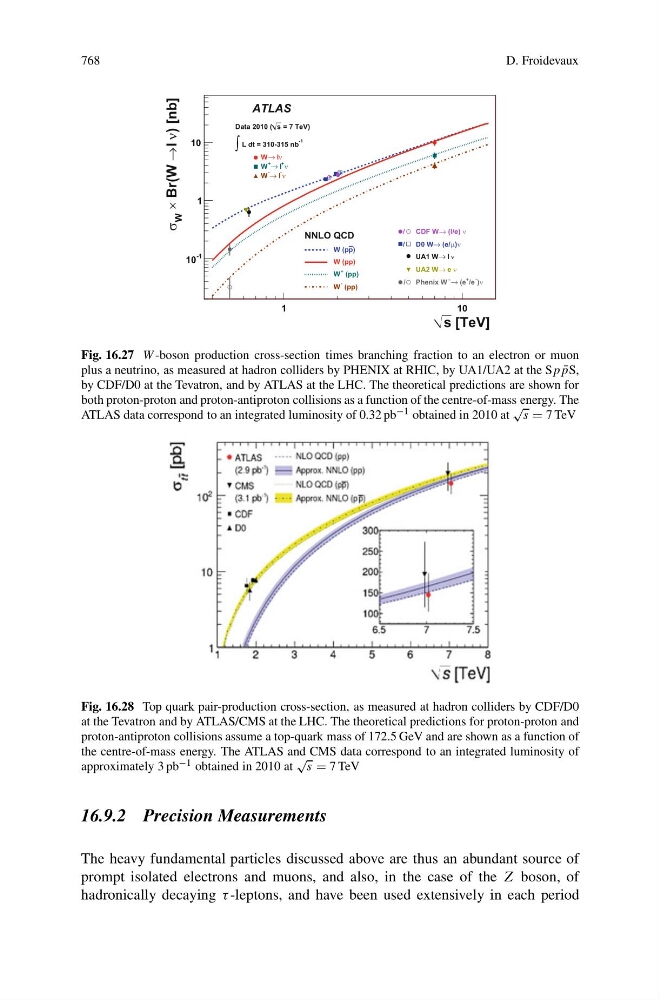
Fig. 16.27 W -boson production cross-section times branching fraction to an electron or muon
plus a neutrino, as measured at hadron colliders by PHENIX at RHIC, by UA1/UA2 at the Sp ¯
pS,
by CDF/D0 at the Tevatron, and by ATLAS at the LHC. The theoretical predictions are shown for
both proton-proton and proton-antiproton collisions as a function of the centre-of-mass energy. The
ATLAS data correspond to an integrated luminosity of 0.32 pb −1 obtained in 2010 at
√
s = 7 TeV
Fig. 16.28 Top quark pair-production cross-section, as measured at hadron colliders by CDF/D0
at the Tevatron and by ATLAS/CMS at the LHC. The theoretical predictions for proton-proton and
proton-antiproton collisions assume a top-quark mass of 172.5 GeV and are shown as a function of
the centre-of-mass energy. The ATLAS and CMS data correspond to an integrated luminosity of
approximately 3 pb −1 obtained in 2010 at
√
s = 7 TeV
16.9.2 Precision Measurements
The heavy fundamental particles discussed above are thus an abundant source of
prompt isolated electrons and muons, and also, in the case of the Z boson, of
hadronically decaying τ -leptons, and have been used extensively in each period