

16 Integration of Detectors into a Large Experiment: Examples from ATLAS. . .
767
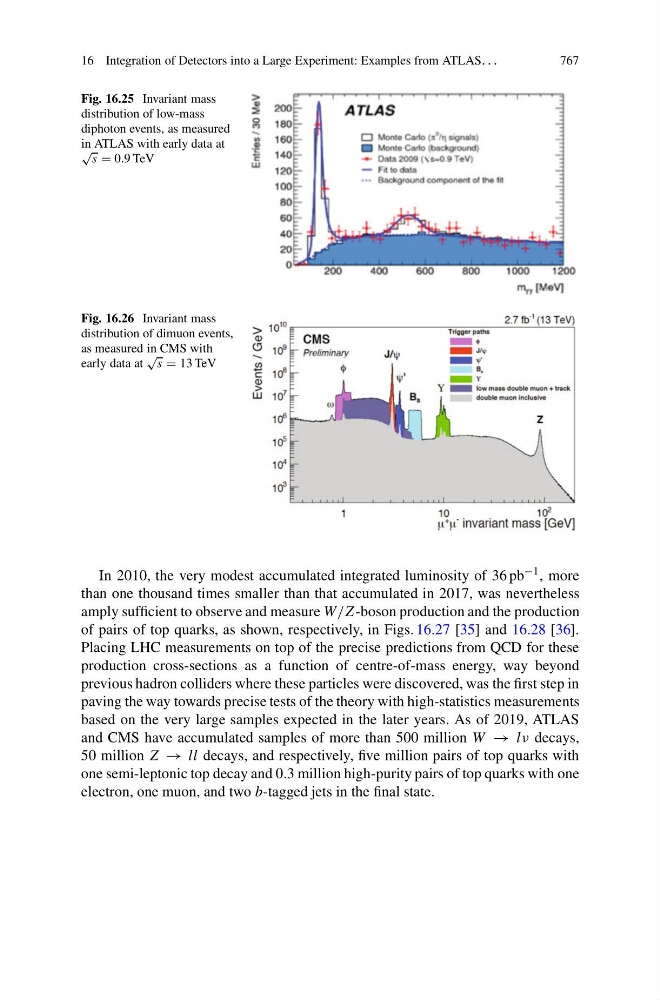
Fig. 16.25 Invariant mass
distribution of low-mass
diphoton events, as measured
in ATLAS with early data at
√
s = 0.9 TeV
Fig. 16.26 Invariant mass
distribution of dimuon events,
as measured in CMS with
early data at
√
s = 13 TeV
In 2010, the very modest accumulated integrated luminosity of 36 pb −1 , more
than one thousand times smaller than that accumulated in 2017, was nevertheless
amply sufficient to observe and measure W/Z-boson production and the production
of pairs of top quarks, as shown, respectively, in Figs. 16.27 [35] and 16.28 [36].
Placing LHC measurements on top of the precise predictions from QCD for these
production cross-sections as a function of centre-of-mass energy, way beyond
previous hadron colliders where these particles were discovered, was the first step in
paving the way towards precise tests of the theory with high-statistics measurements
based on the very large samples expected in the later years. As of 2019, ATLAS
and CMS have accumulated samples of more than 500 million W → lν decays,
50 million Z → ll decays, and respectively, five million pairs of top quarks with
one semi-leptonic top decay and 0.3 million high-purity pairs of top quarks with one
electron, one muon, and two b-tagged jets in the final state.