

766
D. Froidevaux
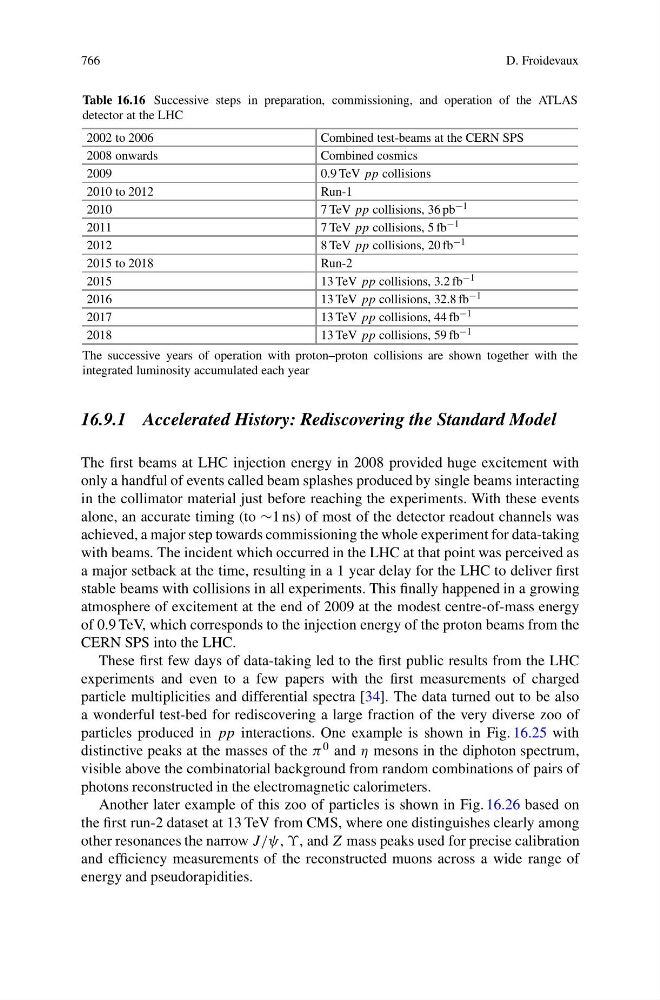
Table 16.16 Successive steps in preparation, commissioning, and operation of the ATLAS
detector at the LHC
2002 to 2006
Combined test-beams at the CERN SPS
2008 onwards
Combined cosmics
2009
0.9 TeV pp collisions
2010 to 2012
Run-1
2010
7 TeV pp collisions, 36 pb −1
2011
7 TeV pp collisions, 5 fb −1
2012
8 TeV pp collisions, 20 fb −1
2015 to 2018
Run-2
2015
13 TeV pp collisions, 3.2 fb −1
2016
13 TeV pp collisions, 32.8 fb −1
2017
13 TeV pp collisions, 44 fb −1
2018
13 TeV pp collisions, 59 fb −1
The successive years of operation with proton–proton collisions are shown together with the
integrated luminosity accumulated each year
16.9.1 Accelerated History: Rediscovering the Standard Model
The first beams at LHC injection energy in 2008 provided huge excitement with
only a handful of events called beam splashes produced by single beams interacting
in the collimator material just before reaching the experiments. With these events
alone, an accurate timing (to ∼1 ns) of most of the detector readout channels was
achieved, a major step towards commissioning the whole experiment for data-taking
with beams. The incident which occurred in the LHC at that point was perceived as
a major setback at the time, resulting in a 1 year delay for the LHC to deliver first
stable beams with collisions in all experiments. This finally happened in a growing
atmosphere of excitement at the end of 2009 at the modest centre-of-mass energy
of 0.9 TeV, which corresponds to the injection energy of the proton beams from the
CERN SPS into the LHC.
These first few days of data-taking led to the first public results from the LHC
experiments and even to a few papers with the first measurements of charged
particle multiplicities and differential spectra [34]. The data turned out to be also
a wonderful test-bed for rediscovering a large fraction of the very diverse zoo of
particles produced in pp interactions. One example is shown in Fig. 16.25 with
distinctive peaks at the masses of the π 0 and η mesons in the diphoton spectrum,
visible above the combinatorial background from random combinations of pairs of
photons reconstructed in the electromagnetic calorimeters.
Another later example of this zoo of particles is shown in Fig. 16.26 based on
the first run-2 dataset at 13 TeV from CMS, where one distinguishes clearly among
other resonances the narrow J/ψ, ϒ, and Z mass peaks used for precise calibration
and efficiency measurements of the reconstructed muons across a wide range of
energy and pseudorapidities.