

16 Integration of Detectors into a Large Experiment: Examples from ATLAS. . .
765
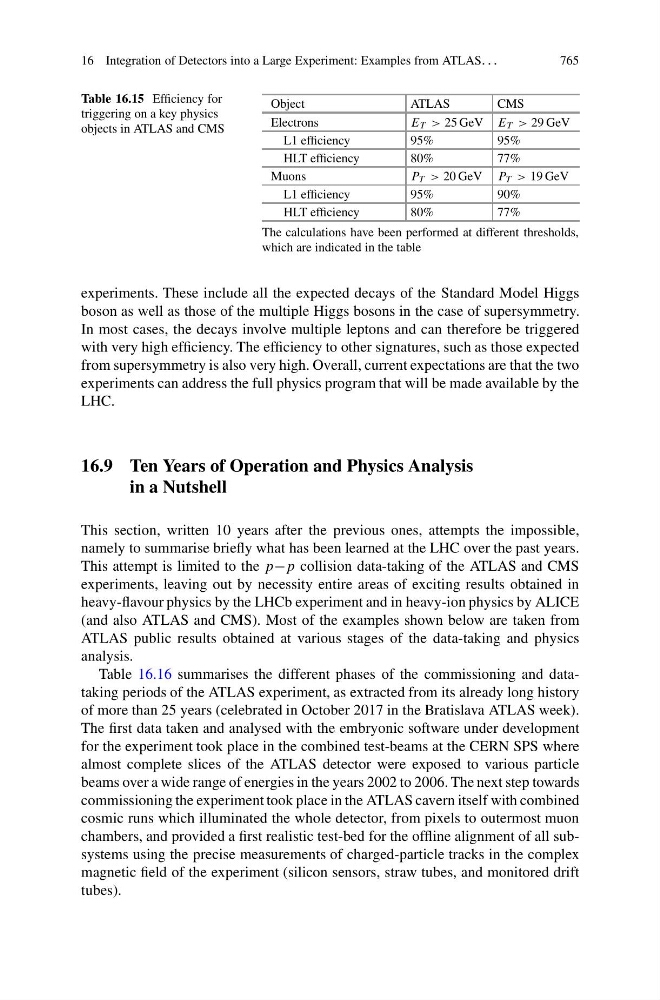
Table 16.15 Efficiency for
triggering on a key physics
objects in ATLAS and CMS
Object
ATLAS
CMS
Electrons
E T > 25 GeV E T > 29 GeV
L1 efficiency
95%
95%
HLT efficiency
80%
77%
Muons
P T > 20 GeV P T > 19 GeV
L1 efficiency
95%
90%
HLT efficiency
80%
77%
The calculations have been performed at different thresholds,
which are indicated in the table
experiments. These include all the expected decays of the Standard Model Higgs
boson as well as those of the multiple Higgs bosons in the case of supersymmetry.
In most cases, the decays involve multiple leptons and can therefore be triggered
with very high efficiency. The efficiency to other signatures, such as those expected
from supersymmetry is also very high. Overall, current expectations are that the two
experiments can address the full physics program that will be made available by the
LHC.
16.9 Ten Years of Operation and Physics Analysis
in a Nutshell
This section, written 10 years after the previous ones, attempts the impossible,
namely to summarise briefly what has been learned at the LHC over the past years.
This attempt is limited to the p−p collision data-taking of the ATLAS and CMS
experiments, leaving out by necessity entire areas of exciting results obtained in
heavy-flavour physics by the LHCb experiment and in heavy-ion physics by ALICE
(and also ATLAS and CMS). Most of the examples shown below are taken from
ATLAS public results obtained at various stages of the data-taking and physics
analysis.
Table 16.16 summarises the different phases of the commissioning and datataking periods of the ATLAS experiment, as extracted from its already long history
of more than 25 years (celebrated in October 2017 in the Bratislava ATLAS week).
The first data taken and analysed with the embryonic software under development
for the experiment took place in the combined test-beams at the CERN SPS where
almost complete slices of the ATLAS detector were exposed to various particle
beams over a wide range of energies in the years 2002 to 2006. The next step towards
commissioning the experiment took place in the ATLAS cavern itself with combined
cosmic runs which illuminated the whole detector, from pixels to outermost muon
chambers, and provided a first realistic test-bed for the offline alignment of all subsystems using the precise measurements of charged-particle tracks in the complex
magnetic field of the experiment (silicon sensors, straw tubes, and monitored drift
tubes).