

764
D. Froidevaux
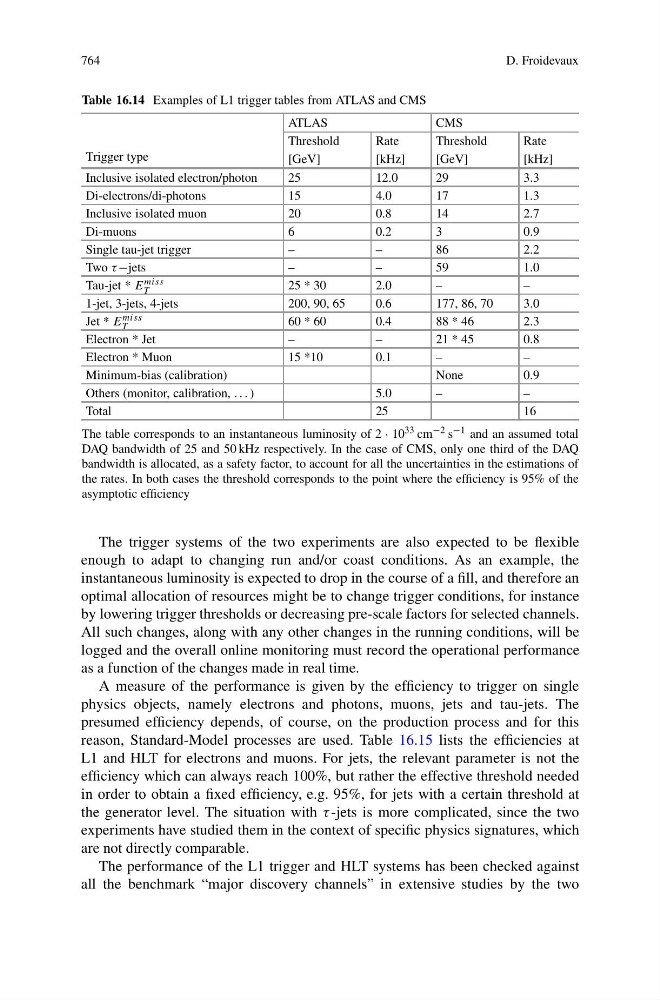
Table 16.14 Examples of L1 trigger tables from ATLAS and CMS
Trigger type
ATLAS
CMS
Threshold
Rate
Threshold
Rate
[GeV]
[kHz]
[GeV]
[kHz]
Inclusive isolated electron/photon
25
12.0
29
3.3
Di-electrons/di-photons
15
4.0
17
1.3
Inclusive isolated muon
20
0.8
14
2.7
Di-muons
6
0.2
3
0.9
Single tau-jet trigger
–
–
86
2.2
Two τ −jets
–
–
59
1.0
Tau-jet * E
miss
T
25 * 30
2.0
–
–
1-jet, 3-jets, 4-jets
200, 90, 65
0.6
177, 86, 70
3.0
Jet * E
miss
T
60 * 60
0.4
88 * 46
2.3
Electron * Jet
–
–
21 * 45
0.8
Electron * Muon
15 *10
0.1
–
–
Minimum-bias (calibration)
None
0.9
Others (monitor, calibration, . . . )
5.0
–
–
Total
25
16
The table corresponds to an instantaneous luminosity of 2 · 10 33 cm −2 s −1 and an assumed total
DAQ bandwidth of 25 and 50 kHz respectively. In the case of CMS, only one third of the DAQ
bandwidth is allocated, as a safety factor, to account for all the uncertainties in the estimations of
the rates. In both cases the threshold corresponds to the point where the efficiency is 95% of the
asymptotic efficiency
The trigger systems of the two experiments are also expected to be flexible
enough to adapt to changing run and/or coast conditions. As an example, the
instantaneous luminosity is expected to drop in the course of a fill, and therefore an
optimal allocation of resources might be to change trigger conditions, for instance
by lowering trigger thresholds or decreasing pre-scale factors for selected channels.
All such changes, along with any other changes in the running conditions, will be
logged and the overall online monitoring must record the operational performance
as a function of the changes made in real time.
A measure of the performance is given by the efficiency to trigger on single
physics objects, namely electrons and photons, muons, jets and tau-jets. The
presumed efficiency depends, of course, on the production process and for this
reason, Standard-Model processes are used. Table 16.15 lists the efficiencies at
L1 and HLT for electrons and muons. For jets, the relevant parameter is not the
efficiency which can always reach 100%, but rather the effective threshold needed
in order to obtain a fixed efficiency, e.g. 95%, for jets with a certain threshold at
the generator level. The situation with τ -jets is more complicated, since the two
experiments have studied them in the context of specific physics signatures, which
are not directly comparable.
The performance of the L1 trigger and HLT systems has been checked against
all the benchmark “major discovery channels” in extensive studies by the two