

16 Integration of Detectors into a Large Experiment: Examples from ATLAS. . .
761
detail from the real geometries of all the chambers and support structures have been
refined repeatedly over the years.
In ATLAS, the quality of the stand-alone muon measurement relies on detailed
knowledge of the material distribution in the muon spectrometer, especially for
intermediate-momentum muons. Reconstruction of these with high accuracy and
without introducing a high rate for fake tracks, has to take into account multiple
scattering of the muons and thus the details of the material distribution in the
spectrometer. This necessitates a very detailed mapping of the detector and the
storage of this map for use by the offline simulation and reconstruction programs.
The corresponding effect in CMS is much smaller, since the amount of iron in
between the muon stations dominates by far and the details of the material are
necessary only in the boundaries between the iron blocks.
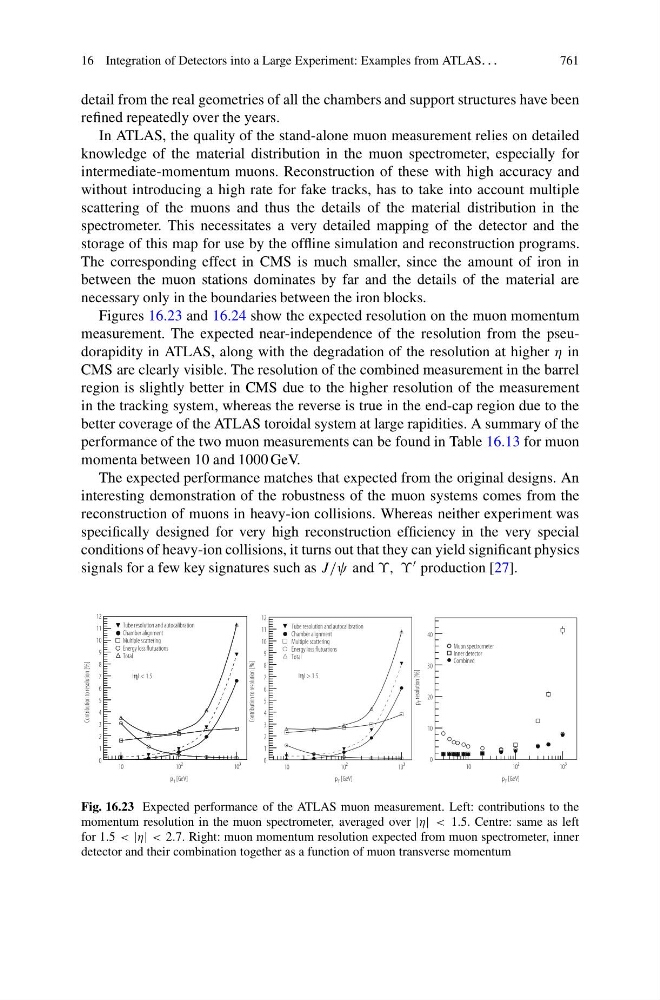
Figures 16.23 and 16.24 show the expected resolution on the muon momentum
measurement. The expected near-independence of the resolution from the pseudorapidity in ATLAS, along with the degradation of the resolution at higher η in
CMS are clearly visible. The resolution of the combined measurement in the barrel
region is slightly better in CMS due to the higher resolution of the measurement
in the tracking system, whereas the reverse is true in the end-cap region due to the
better coverage of the ATLAS toroidal system at large rapidities. A summary of the
performance of the two muon measurements can be found in Table 16.13 for muon
momenta between 10 and 1000 GeV.
The expected performance matches that expected from the original designs. An
interesting demonstration of the robustness of the muon systems comes from the
reconstruction of muons in heavy-ion collisions. Whereas neither experiment was
specifically designed for very high reconstruction efficiency in the very special
conditions of heavy-ion collisions, it turns out that they can yield significant physics
signals for a few key signatures such as J/ψ and ϒ, ϒ production [27].
12
11
10
9
8
7
6
5
4
3
2
1
0
Contribution to resolution [%]
p T [GeV]
10
10 2
10 3
Tube resolution and autocalibration
Chamber alignment
Multiple scattering
Energy loss flutuations
Total
Iηl < 1.5
12
11
10
9
8
7
6
5
4
3
2
1
0
Contribution to resolution [%]
p T [GeV]
10
10
2
10 3
Tube resolution and autocalibration
Chamber alignment
Multiple scattering
Energy loss flutuations
Total
Iηl > 1.5
p
T resolution [%]
p T [GeV]
10
10 2
10 3
40
30
20
10
0
Muon spectrometer
Inner detector
Combined
Fig. 16.23 Expected performance of the ATLAS muon measurement. Left: contributions to the
momentum resolution in the muon spectrometer, averaged over |η| < 1.5. Centre: same as left
for 1.5 < |η| < 2.7. Right: muon momentum resolution expected from muon spectrometer, inner
detector and their combination together as a function of muon transverse momentum