

760
D. Froidevaux
Resolution [GeV]
[GeV]
4
8
0
0
70
60
50
40
30
20
10
0
35
0 200 400 600
QCD jets
Susy
tt
A → ττ
800 1000 1200
ATLAS
CMS
Curve: 0.57 √ΣE T
Curve: 0.97 √ΣE T
1400
Σ E T [GeV]
1600 1800 2000
Σ E T [GeV]
4000
3500
3000
2500
2000
1500
1000
500
30
25
20
15
10
5
0
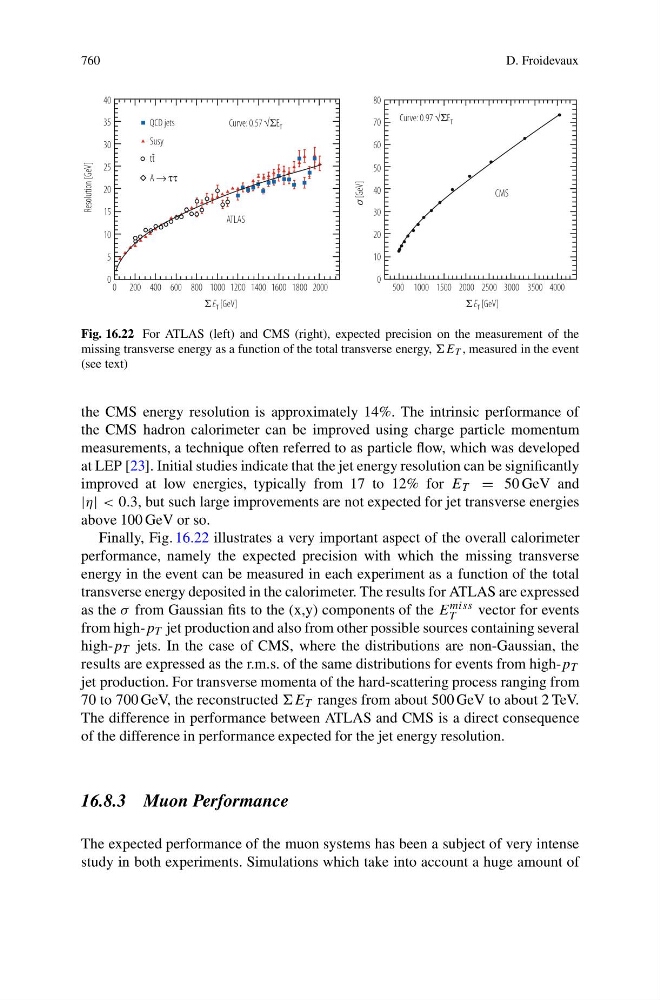
Fig. 16.22 For ATLAS (left) and CMS (right), expected precision on the measurement of the
missing transverse energy as a function of the total transverse energy, E T , measured in the event
(see text)
the CMS energy resolution is approximately 14%. The intrinsic performance of
the CMS hadron calorimeter can be improved using charge particle momentum
measurements, a technique often referred to as particle flow, which was developed
at LEP [23]. Initial studies indicate that the jet energy resolution can be significantly
improved at low energies, typically from 17 to 12% for E T = 50 GeV and
|η| < 0.3, but such large improvements are not expected for jet transverse energies
above 100 GeV or so.
Finally, Fig. 16.22 illustrates a very important aspect of the overall calorimeter
performance, namely the expected precision with which the missing transverse
energy in the event can be measured in each experiment as a function of the total
transverse energy deposited in the calorimeter. The results for ATLAS are expressed
as the σ from Gaussian fits to the (x,y) components of the E miss
T
vector for events
from high-p T jet production and also from other possible sources containing several
high-p T jets. In the case of CMS, where the distributions are non-Gaussian, the
results are expressed as the r.m.s. of the same distributions for events from high-p T
jet production. For transverse momenta of the hard-scattering process ranging from
70 to 700 GeV, the reconstructed E T ranges from about 500 GeV to about 2 TeV.
The difference in performance between ATLAS and CMS is a direct consequence
of the difference in performance expected for the jet energy resolution.
16.8.3 Muon Performance
The expected performance of the muon systems has been a subject of very intense
study in both experiments. Simulations which take into account a huge amount of