

3 Scintillation Detectors for Charged Particles and Photons
67
different optical defects in the bulk of the crystal, the surface state and wrapping
conditions of the faces of the crystal, the coupling face to the photodetector, the
surface matching between the coupling face and the photodetector, the crystal index
of refraction. Heavy scintillators generally have a high index of refraction (larger
than 2 in many cases) and the light collection efficiency is limited to 10–30% for the
majority of existing detectors. New approaches based on nanostructured surfaces,
in particular photonic crystals, are presently being explored [18]. Significant light
extraction gains of more than 50% have been obtained as well as a strong reduction
of the photon transit time spread in the crystal associated to the higher extraction
probability of the photons at their first hit on the coupling face to the photodetector
(reduction of multiple bouncing) [19].
The fact that some self-activated scintillators, like PbWO 4 , exhibit fast room
temperature scintillation in the ns-range is only the consequence of a luminescence
quenching mechanism competing with the radiative relaxation of the excitation. In
this case the decay is non-exponential, which is a common signature of temperature
quenched scintillators.
3.2.3 Response Linearity and Energy Resolution
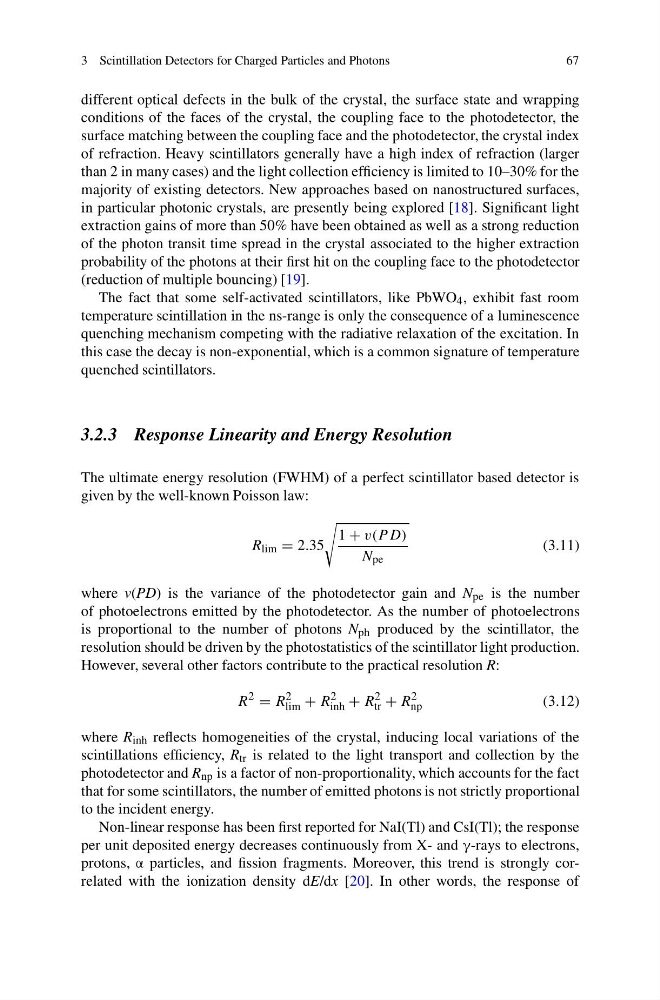
The ultimate energy resolution (FWHM) of a perfect scintillator based detector is
given by the well-known Poisson law:
R lim = 2.35
1 + v(P D)
N pe
(3.11)
where v(PD) is the variance of the photodetector gain and N pe is the number
of photoelectrons emitted by the photodetector. As the number of photoelectrons
is proportional to the number of photons N ph produced by the scintillator, the
resolution should be driven by the photostatistics of the scintillator light production.
However, several other factors contribute to the practical resolution R:
R
2
= R
2
lim + R
2
inh + R
2
tr + R
2
np
(3.12)
where R inh reflects homogeneities of the crystal, inducing local variations of the
scintillations efficiency, R tr is related to the light transport and collection by the
photodetector and R np is a factor of non-proportionality, which accounts for the fact
that for some scintillators, the number of emitted photons is not strictly proportional
to the incident energy.
Non-linear response has been first reported for NaI(Tl) and CsI(Tl); the response
per unit deposited energy decreases continuously from X- and γ-rays to electrons,
protons, α particles, and fission fragments. Moreover, this trend is strongly correlated with the ionization density dE/dx [20]. In other words, the response of
67
different optical defects in the bulk of the crystal, the surface state and wrapping
conditions of the faces of the crystal, the coupling face to the photodetector, the
surface matching between the coupling face and the photodetector, the crystal index
of refraction. Heavy scintillators generally have a high index of refraction (larger
than 2 in many cases) and the light collection efficiency is limited to 10–30% for the
majority of existing detectors. New approaches based on nanostructured surfaces,
in particular photonic crystals, are presently being explored [18]. Significant light
extraction gains of more than 50% have been obtained as well as a strong reduction
of the photon transit time spread in the crystal associated to the higher extraction
probability of the photons at their first hit on the coupling face to the photodetector
(reduction of multiple bouncing) [19].
The fact that some self-activated scintillators, like PbWO 4 , exhibit fast room
temperature scintillation in the ns-range is only the consequence of a luminescence
quenching mechanism competing with the radiative relaxation of the excitation. In
this case the decay is non-exponential, which is a common signature of temperature
quenched scintillators.
3.2.3 Response Linearity and Energy Resolution
The ultimate energy resolution (FWHM) of a perfect scintillator based detector is
given by the well-known Poisson law:
R lim = 2.35
1 + v(P D)
N pe
(3.11)
where v(PD) is the variance of the photodetector gain and N pe is the number
of photoelectrons emitted by the photodetector. As the number of photoelectrons
is proportional to the number of photons N ph produced by the scintillator, the
resolution should be driven by the photostatistics of the scintillator light production.
However, several other factors contribute to the practical resolution R:
R
2
= R
2
lim + R
2
inh + R
2
tr + R
2
np
(3.12)
where R inh reflects homogeneities of the crystal, inducing local variations of the
scintillations efficiency, R tr is related to the light transport and collection by the
photodetector and R np is a factor of non-proportionality, which accounts for the fact
that for some scintillators, the number of emitted photons is not strictly proportional
to the incident energy.
Non-linear response has been first reported for NaI(Tl) and CsI(Tl); the response
per unit deposited energy decreases continuously from X- and γ-rays to electrons,
protons, α particles, and fission fragments. Moreover, this trend is strongly correlated with the ionization density dE/dx [20]. In other words, the response of