

68
P. Lecoq
a scintillator depends not only on the total amount of energy but also on the
mechanisms of the energy deposit. There is common agreement that this is related
to the saturation of response of the luminescent centres in the presence of a high
density of charge carriers. This is parameterized by Birks law, which postulates a
non-radiative relaxation of excitons interacting with each others in the case of high
ionization density:
N ph
dE
dx
=
N
0
ph
1 + a B
dE
dx
(3.13)
where N ◦ ph is the light yield in the absence of saturation, N ph is the actual light yield
and a B is the Birks parameter.
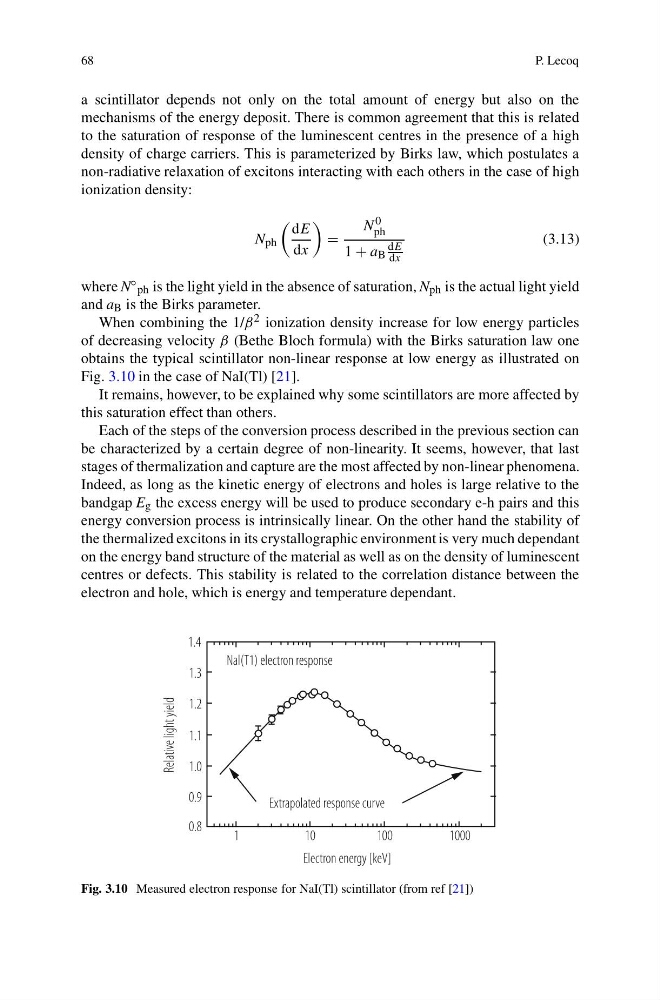
When combining the 1/β 2 ionization density increase for low energy particles
of decreasing velocity β (Bethe Bloch formula) with the Birks saturation law one
obtains the typical scintillator non-linear response at low energy as illustrated on
Fig. 3.10 in the case of NaI(Tl) [21].
It remains, however, to be explained why some scintillators are more affected by
this saturation effect than others.
Each of the steps of the conversion process described in the previous section can
be characterized by a certain degree of non-linearity. It seems, however, that last
stages of thermalization and capture are the most affected by non-linear phenomena.
Indeed, as long as the kinetic energy of electrons and holes is large relative to the
bandgap E g the excess energy will be used to produce secondary e-h pairs and this
energy conversion process is intrinsically linear. On the other hand the stability of
the thermalized excitons in its crystallographic environment is very much dependant
on the energy band structure of the material as well as on the density of luminescent
centres or defects. This stability is related to the correlation distance between the
electron and hole, which is energy and temperature dependant.
Fig. 3.10 Measured electron response for NaI(Tl) scintillator (from ref [21])
P. Lecoq
a scintillator depends not only on the total amount of energy but also on the
mechanisms of the energy deposit. There is common agreement that this is related
to the saturation of response of the luminescent centres in the presence of a high
density of charge carriers. This is parameterized by Birks law, which postulates a
non-radiative relaxation of excitons interacting with each others in the case of high
ionization density:
N ph
dE
dx
=
N
0
ph
1 + a B
dE
dx
(3.13)
where N ◦ ph is the light yield in the absence of saturation, N ph is the actual light yield
and a B is the Birks parameter.
When combining the 1/β 2 ionization density increase for low energy particles
of decreasing velocity β (Bethe Bloch formula) with the Birks saturation law one
obtains the typical scintillator non-linear response at low energy as illustrated on
Fig. 3.10 in the case of NaI(Tl) [21].
It remains, however, to be explained why some scintillators are more affected by
this saturation effect than others.
Each of the steps of the conversion process described in the previous section can
be characterized by a certain degree of non-linearity. It seems, however, that last
stages of thermalization and capture are the most affected by non-linear phenomena.
Indeed, as long as the kinetic energy of electrons and holes is large relative to the
bandgap E g the excess energy will be used to produce secondary e-h pairs and this
energy conversion process is intrinsically linear. On the other hand the stability of
the thermalized excitons in its crystallographic environment is very much dependant
on the energy band structure of the material as well as on the density of luminescent
centres or defects. This stability is related to the correlation distance between the
electron and hole, which is energy and temperature dependant.
Fig. 3.10 Measured electron response for NaI(Tl) scintillator (from ref [21])