

66
P. Lecoq
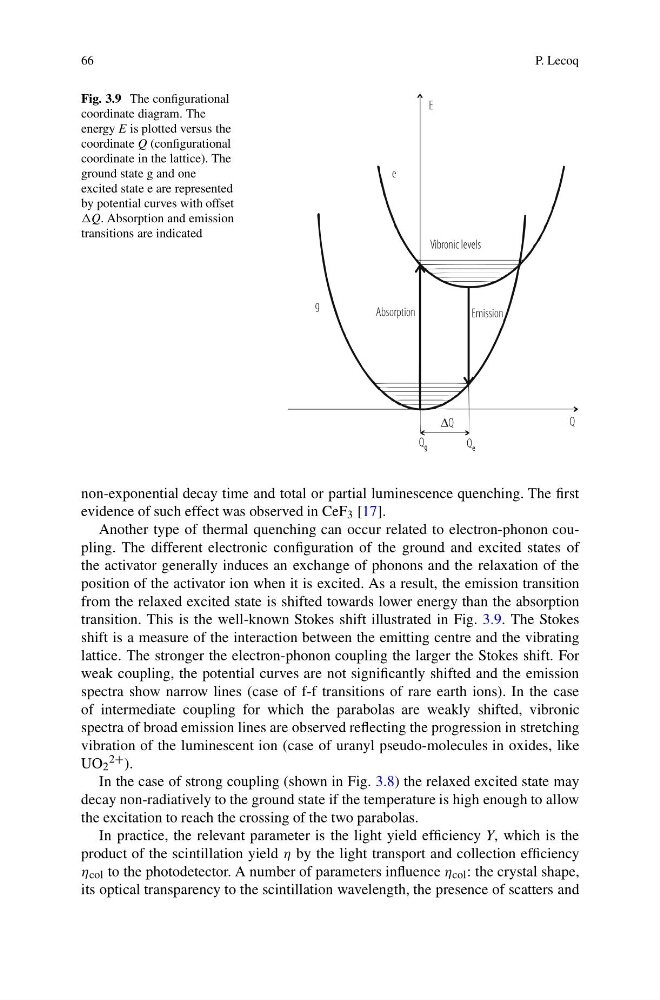
Fig. 3.9 The configurational
coordinate diagram. The
energy E is plotted versus the
coordinate Q (configurational
coordinate in the lattice). The
ground state g and one
excited state e are represented
by potential curves with offset
Q. Absorption and emission
transitions are indicated
non-exponential decay time and total or partial luminescence quenching. The first
evidence of such effect was observed in CeF 3 [17].
Another type of thermal quenching can occur related to electron-phonon coupling. The different electronic configuration of the ground and excited states of
the activator generally induces an exchange of phonons and the relaxation of the
position of the activator ion when it is excited. As a result, the emission transition
from the relaxed excited state is shifted towards lower energy than the absorption
transition. This is the well-known Stokes shift illustrated in Fig. 3.9. The Stokes
shift is a measure of the interaction between the emitting centre and the vibrating
lattice. The stronger the electron-phonon coupling the larger the Stokes shift. For
weak coupling, the potential curves are not significantly shifted and the emission
spectra show narrow lines (case of f-f transitions of rare earth ions). In the case
of intermediate coupling for which the parabolas are weakly shifted, vibronic
spectra of broad emission lines are observed reflecting the progression in stretching
vibration of the luminescent ion (case of uranyl pseudo-molecules in oxides, like
UO 2
2+ ).
In the case of strong coupling (shown in Fig. 3.8) the relaxed excited state may
decay non-radiatively to the ground state if the temperature is high enough to allow
the excitation to reach the crossing of the two parabolas.
In practice, the relevant parameter is the light yield efficiency Y, which is the
product of the scintillation yield η by the light transport and collection efficiency
η col to the photodetector. A number of parameters influence η col : the crystal shape,
its optical transparency to the scintillation wavelength, the presence of scatters and
P. Lecoq
Fig. 3.9 The configurational
coordinate diagram. The
energy E is plotted versus the
coordinate Q (configurational
coordinate in the lattice). The
ground state g and one
excited state e are represented
by potential curves with offset
Q. Absorption and emission
transitions are indicated
non-exponential decay time and total or partial luminescence quenching. The first
evidence of such effect was observed in CeF 3 [17].
Another type of thermal quenching can occur related to electron-phonon coupling. The different electronic configuration of the ground and excited states of
the activator generally induces an exchange of phonons and the relaxation of the
position of the activator ion when it is excited. As a result, the emission transition
from the relaxed excited state is shifted towards lower energy than the absorption
transition. This is the well-known Stokes shift illustrated in Fig. 3.9. The Stokes
shift is a measure of the interaction between the emitting centre and the vibrating
lattice. The stronger the electron-phonon coupling the larger the Stokes shift. For
weak coupling, the potential curves are not significantly shifted and the emission
spectra show narrow lines (case of f-f transitions of rare earth ions). In the case
of intermediate coupling for which the parabolas are weakly shifted, vibronic
spectra of broad emission lines are observed reflecting the progression in stretching
vibration of the luminescent ion (case of uranyl pseudo-molecules in oxides, like
UO 2
2+ ).
In the case of strong coupling (shown in Fig. 3.8) the relaxed excited state may
decay non-radiatively to the ground state if the temperature is high enough to allow
the excitation to reach the crossing of the two parabolas.
In practice, the relevant parameter is the light yield efficiency Y, which is the
product of the scintillation yield η by the light transport and collection efficiency
η col to the photodetector. A number of parameters influence η col : the crystal shape,
its optical transparency to the scintillation wavelength, the presence of scatters and