

730
D. Froidevaux
Absorption length
20
15
10
5
0 0
1
2
3
Pseudorapidity
Material in front of muon system
End of active
hadronic
Hadronic endcap
Tile barrel
EM barrel
EM endcap
Cryostat walls
Tile
extended
barrel
Forward calorimeter
4
5
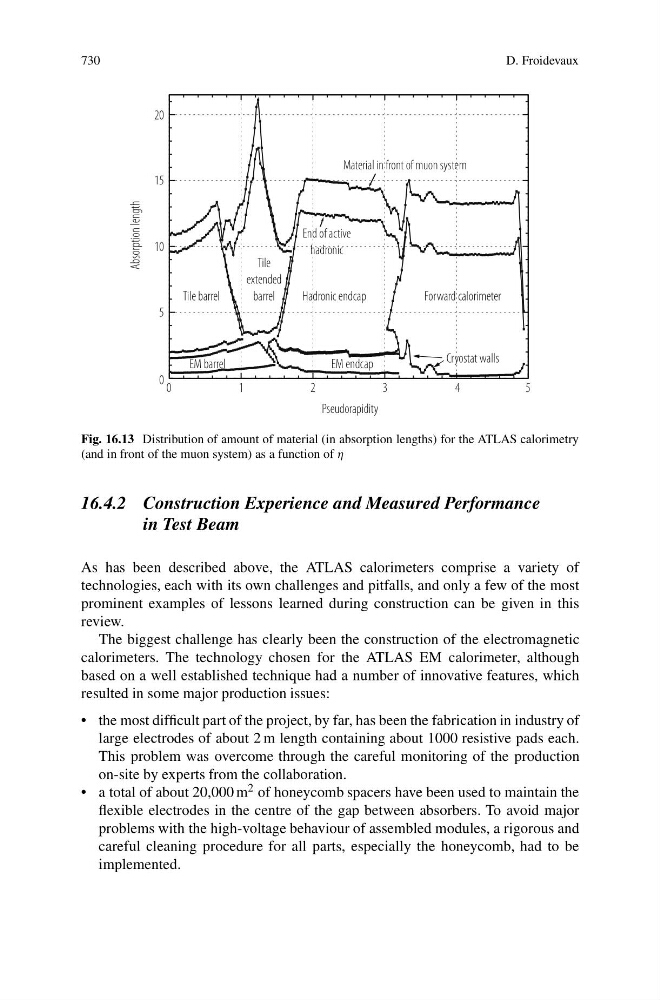
Fig. 16.13 Distribution of amount of material (in absorption lengths) for the ATLAS calorimetry
(and in front of the muon system) as a function of η
16.4.2 Construction Experience and Measured Performance
in Test Beam
As has been described above, the ATLAS calorimeters comprise a variety of
technologies, each with its own challenges and pitfalls, and only a few of the most
prominent examples of lessons learned during construction can be given in this
review.
The biggest challenge has clearly been the construction of the electromagnetic
calorimeters. The technology chosen for the ATLAS EM calorimeter, although
based on a well established technique had a number of innovative features, which
resulted in some major production issues:
• the most difficult part of the project, by far, has been the fabrication in industry of
large electrodes of about 2 m length containing about 1000 resistive pads each.
This problem was overcome through the careful monitoring of the production
on-site by experts from the collaboration.
• a total of about 20,000 m 2 of honeycomb spacers have been used to maintain the
flexible electrodes in the centre of the gap between absorbers. To avoid major
problems with the high-voltage behaviour of assembled modules, a rigorous and
careful cleaning procedure for all parts, especially the honeycomb, had to be
implemented.