

16 Integration of Detectors into a Large Experiment: Examples from ATLAS. . .
729
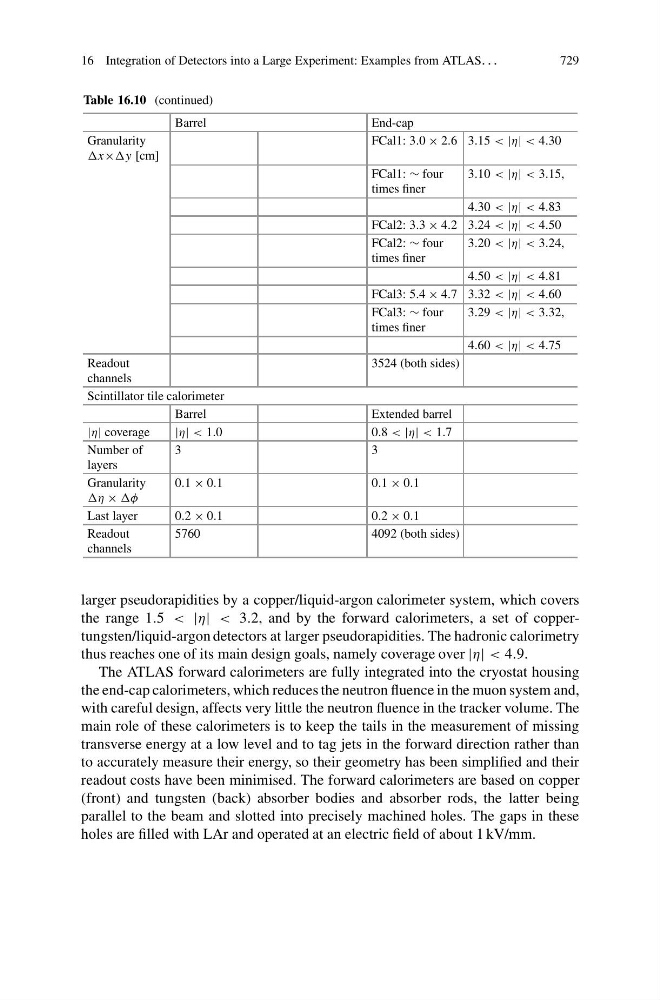
Table 16.10 (continued)
Barrel
End-cap
Granularity
x×y [cm]
FCal1: 3.0 × 2.6 3.15 < |η| < 4.30
FCal1: ∼ four
times finer
3.10 < |η| < 3.15,
4.30 < |η| < 4.83
FCal2: 3.3 × 4.2 3.24 < |η| < 4.50
FCal2: ∼ four
times finer
3.20 < |η| < 3.24,
4.50 < |η| < 4.81
FCal3: 5.4 × 4.7 3.32 < |η| < 4.60
FCal3: ∼ four
times finer
3.29 < |η| < 3.32,
4.60 < |η| < 4.75
Readout
channels
3524 (both sides)
Scintillator tile calorimeter
Barrel
Extended barrel
|η| coverage
|η| < 1.0
0.8 < |η| < 1.7
Number of
layers
3
3
Granularity
× φ
0.1 × 0.1
0.1 × 0.1
Last layer
0.2 × 0.1
0.2 × 0.1
Readout
channels
5760
4092 (both sides)
larger pseudorapidities by a copper/liquid-argon calorimeter system, which covers
the range 1.5 < |η| < 3.2, and by the forward calorimeters, a set of coppertungsten/liquid-argon detectors at larger pseudorapidities. The hadronic calorimetry
thus reaches one of its main design goals, namely coverage over |η| < 4.9.
The ATLAS forward calorimeters are fully integrated into the cryostat housing
the end-cap calorimeters, which reduces the neutron fluence in the muon system and,
with careful design, affects very little the neutron fluence in the tracker volume. The
main role of these calorimeters is to keep the tails in the measurement of missing
transverse energy at a low level and to tag jets in the forward direction rather than
to accurately measure their energy, so their geometry has been simplified and their
readout costs have been minimised. The forward calorimeters are based on copper
(front) and tungsten (back) absorber bodies and absorber rods, the latter being
parallel to the beam and slotted into precisely machined holes. The gaps in these
holes are filled with LAr and operated at an electric field of about 1 kV/mm.