

16 Integration of Detectors into a Large Experiment: Examples from ATLAS. . .
731
E
rec /E
beam
E beam [GeV]
E beam [GeV]
1.006
1.004
1.002
1
0.998
0.996
0.994
0.992
0.99
0
50
100
150
200
0.05
0.045
0.04
0.035
0.03
0.025
0.02
0.015
0.01
0.005
σ
E /E
0
100
200
Data
beam energy uncertainty uncorrelated
beam energy uncertainty correlated
± 1.0‰
Sampl.
Const. Term
Data
Data noise substracted
Noise
[%/√(GeV)] [%]
10.1 ± 0.1 0.17 ± 0.04
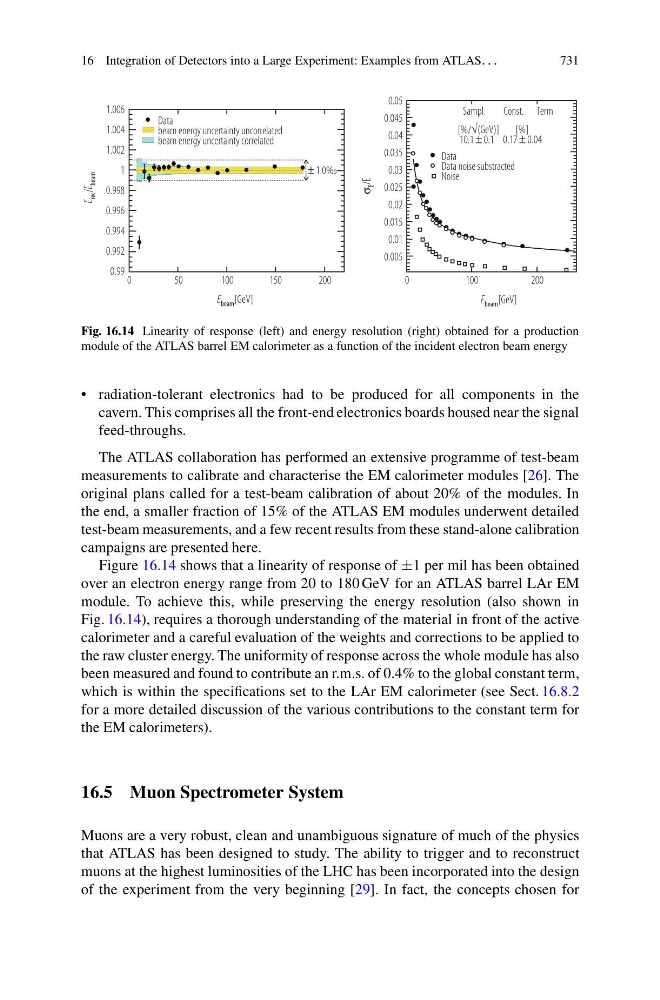
Fig. 16.14 Linearity of response (left) and energy resolution (right) obtained for a production
module of the ATLAS barrel EM calorimeter as a function of the incident electron beam energy
• radiation-tolerant electronics had to be produced for all components in the
cavern. This comprises all the front-end electronics boards housed near the signal
feed-throughs.
The ATLAS collaboration has performed an extensive programme of test-beam
measurements to calibrate and characterise the EM calorimeter modules [26]. The
original plans called for a test-beam calibration of about 20% of the modules. In
the end, a smaller fraction of 15% of the ATLAS EM modules underwent detailed
test-beam measurements, and a few recent results from these stand-alone calibration
campaigns are presented here.
Figure 16.14 shows that a linearity of response of ±1 per mil has been obtained
over an electron energy range from 20 to 180 GeV for an ATLAS barrel LAr EM
module. To achieve this, while preserving the energy resolution (also shown in
Fig. 16.14), requires a thorough understanding of the material in front of the active
calorimeter and a careful evaluation of the weights and corrections to be applied to
the raw cluster energy. The uniformity of response across the whole module has also
been measured and found to contribute an r.m.s. of 0.4% to the global constant term,
which is within the specifications set to the LAr EM calorimeter (see Sect. 16.8.2
for a more detailed discussion of the various contributions to the constant term for
the EM calorimeters).
16.5 Muon Spectrometer System
Muons are a very robust, clean and unambiguous signature of much of the physics
that ATLAS has been designed to study. The ability to trigger and to reconstruct
muons at the highest luminosities of the LHC has been incorporated into the design
of the experiment from the very beginning [29]. In fact, the concepts chosen for