

16 Integration of Detectors into a Large Experiment: Examples from ATLAS. . .
697
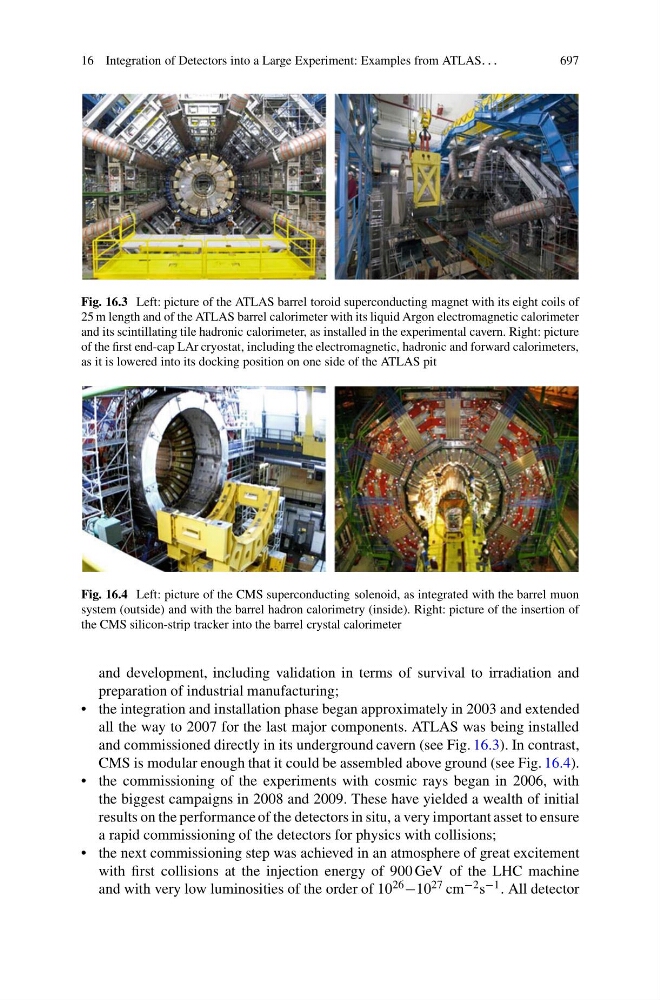
Fig. 16.3 Left: picture of the ATLAS barrel toroid superconducting magnet with its eight coils of
25 m length and of the ATLAS barrel calorimeter with its liquid Argon electromagnetic calorimeter
and its scintillating tile hadronic calorimeter, as installed in the experimental cavern. Right: picture
of the first end-cap LAr cryostat, including the electromagnetic, hadronic and forward calorimeters,
as it is lowered into its docking position on one side of the ATLAS pit
Fig. 16.4 Left: picture of the CMS superconducting solenoid, as integrated with the barrel muon
system (outside) and with the barrel hadron calorimetry (inside). Right: picture of the insertion of
the CMS silicon-strip tracker into the barrel crystal calorimeter
and development, including validation in terms of survival to irradiation and
preparation of industrial manufacturing;
• the integration and installation phase began approximately in 2003 and extended
all the way to 2007 for the last major components. ATLAS was being installed
and commissioned directly in its underground cavern (see Fig. 16.3). In contrast,
CMS is modular enough that it could be assembled above ground (see Fig. 16.4).
• the commissioning of the experiments with cosmic rays began in 2006, with
the biggest campaigns in 2008 and 2009. These have yielded a wealth of initial
results on the performance of the detectors in situ, a very important asset to ensure
a rapid commissioning of the detectors for physics with collisions;
• the next commissioning step was achieved in an atmosphere of great excitement
with first collisions at the injection energy of 900 GeV of the LHC machine
and with very low luminosities of the order of 10 26 −10 27 cm −2 s −1 . All detector