

696
D. Froidevaux
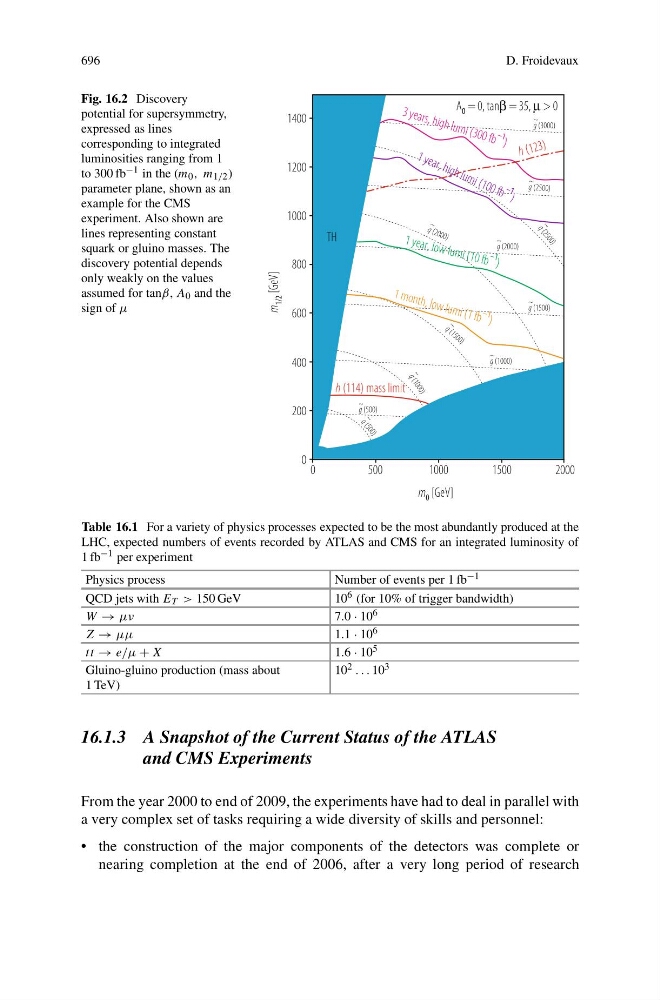
Fig. 16.2 Discovery
potential for supersymmetry,
expressed as lines
corresponding to integrated
luminosities ranging from 1
to 300 fb −1 in the (m 0 , m 1/2 )
parameter plane, shown as an
example for the CMS
experiment. Also shown are
lines representing constant
squark or gluino masses. The
discovery potential depends
only weakly on the values
assumed for tanβ, A 0 and the
sign of μ
h (1 23 )
m
1/2 [GeV]
2000
1500
1000
m 0 [GeV]
A 0 = 0, tanβ = 35, μ > 0
g (3000)
~
g (1500)
~
g (1000)
~
g (500)
~
g (2000)
~
q (2 00 0)
~
q ( 1 5 0 0 )
~
q
(5
0
0
)
~
q (1 0 0 0 )
~
q (2 5 0 0 )
~
g (2500)
~
500
0
1400
1200
1000
800
600
h (114) mass limit
400
200
0
TH
3 ye ar s, hi gh lu m i (3 00 fb –1
)
1 y e a r, h ig h lu m i (1 0 0 fb – 1
)
1 ye ar , lo w lu m i (1 0 fb
–1
)
1 m on th , lo w lu m i (1 fb –1
)
Table 16.1 For a variety of physics processes expected to be the most abundantly produced at the
LHC, expected numbers of events recorded by ATLAS and CMS for an integrated luminosity of
1 fb −1 per experiment
Physics process
Number of events per 1 fb −1
QCD jets with E T > 150 GeV
10 6 (for 10% of trigger bandwidth)
W → μν
7.0 · 10 6
Z → μμ
1.1 · 10 6
tt → e/μ + X
1.6 · 10 5
Gluino-gluino production (mass about
1 TeV)
10 2 . . . 10 3
16.1.3 A Snapshot of the Current Status of the ATLAS
and CMS Experiments
From the year 2000 to end of 2009, the experiments have had to deal in parallel with
a very complex set of tasks requiring a wide diversity of skills and personnel:
• the construction of the major components of the detectors was complete or
nearing completion at the end of 2006, after a very long period of research