

16 Integration of Detectors into a Large Experiment: Examples from ATLAS. . .
695
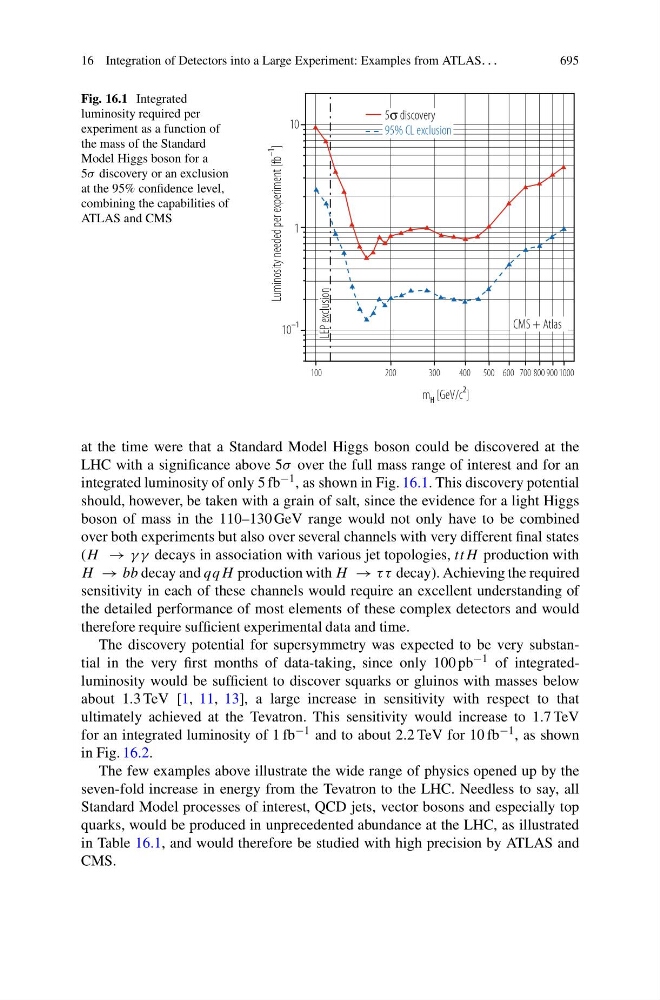
Fig. 16.1 Integrated
luminosity required per
experiment as a function of
the mass of the Standard
Model Higgs boson for a
5σ discovery or an exclusion
at the 95% confidence level,
combining the capabilities of
ATLAS and CMS
Luminosity needed per experiment [fb
–1
]
10
0
0
3
0
0
4
0
0
5
0
0
6
0
0
7
0
0
8
0
0
9
0
0
0
1
100
200
1
m H [GeV/c
2
]
10
–1
CMS + Atlas
5σ discovery
95% CL exclusion
LEP exclusion
at the time were that a Standard Model Higgs boson could be discovered at the
LHC with a significance above 5σ over the full mass range of interest and for an
integrated luminosity of only 5 fb −1 , as shown in Fig. 16.1. This discovery potential
should, however, be taken with a grain of salt, since the evidence for a light Higgs
boson of mass in the 110–130 GeV range would not only have to be combined
over both experiments but also over several channels with very different final states
(H → γ γ decays in association with various jet topologies, ttH production with
H → bb decay and qqH production with H → τ τ decay). Achieving the required
sensitivity in each of these channels would require an excellent understanding of
the detailed performance of most elements of these complex detectors and would
therefore require sufficient experimental data and time.
The discovery potential for supersymmetry was expected to be very substantial in the very first months of data-taking, since only 100 pb −1 of integratedluminosity would be sufficient to discover squarks or gluinos with masses below
about 1.3 TeV [1, 11, 13], a large increase in sensitivity with respect to that
ultimately achieved at the Tevatron. This sensitivity would increase to 1.7 TeV
for an integrated luminosity of 1 fb −1 and to about 2.2 TeV for 10 fb −1 , as shown
in Fig. 16.2.
The few examples above illustrate the wide range of physics opened up by the
seven-fold increase in energy from the Tevatron to the LHC. Needless to say, all
Standard Model processes of interest, QCD jets, vector bosons and especially top
quarks, would be produced in unprecedented abundance at the LHC, as illustrated
in Table 16.1, and would therefore be studied with high precision by ATLAS and
CMS.