

596
R. Frühwirth et al.
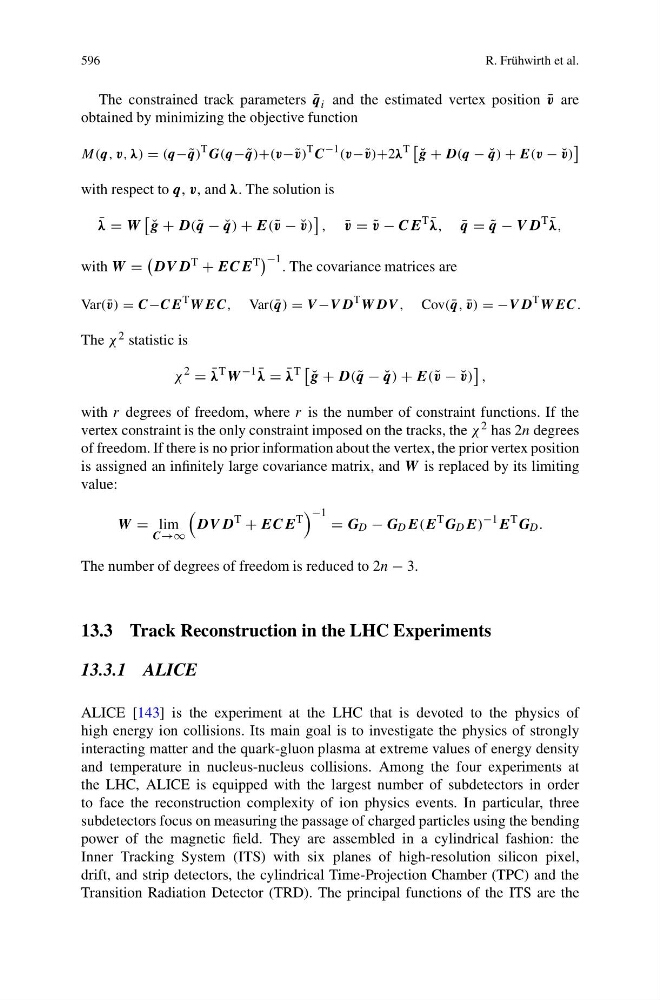
The constrained track parameters ¯
q i and the estimated vertex position ¯
v are
obtained by minimizing the objective function
M(q, v, λ) = (q− ˜
q)
T G(q− ˜
q)+(v−˜ v)
T C
−1 (v−˜ v)+2λ
T
˘
g + D(q − ˘
q) + E(v − ˘
v)
with respect to q, v, and λ. The solution is
¯
λ = W
˘
g + D( ˜
q − ˘
q) + E(˜ v − ˘
v)
, ¯
v = ˜
v − CE
T ¯
λ, ¯
q = ˜
q − V D
T ¯
λ,
with W =
DV D T + ECE T −1 . The covariance matrices are
Var(¯ v) = C−CE
T W EC, Var( ¯
q) = V −V D
T W DV , Cov( ¯
q, ¯
v) = −V D
T W EC.
The χ 2 statistic is
χ
2
= ¯
λ
T W
−1 ¯
λ = ¯
λ
T
˘
g + D( ˜
q − ˘
q) + E(˜ v − ˘
v)
,
with r degrees of freedom, where r is the number of constraint functions. If the
vertex constraint is the only constraint imposed on the tracks, the χ 2 has 2n degrees
of freedom. If there is no prior information about the vertex, the prior vertex position
is assigned an infinitely large covariance matrix, and W is replaced by its limiting
value:
W = lim
C→∞
DV D
T
+ ECE
T
−1 = G D − G D E(E
T G D E)
−1 E
T G D .
The number of degrees of freedom is reduced to 2n − 3.
13.3 Track Reconstruction in the LHC Experiments
13.3.1 ALICE
ALICE [143] is the experiment at the LHC that is devoted to the physics of
high energy ion collisions. Its main goal is to investigate the physics of strongly
interacting matter and the quark-gluon plasma at extreme values of energy density
and temperature in nucleus-nucleus collisions. Among the four experiments at
the LHC, ALICE is equipped with the largest number of subdetectors in order
to face the reconstruction complexity of ion physics events. In particular, three
subdetectors focus on measuring the passage of charged particles using the bending
power of the magnetic field. They are assembled in a cylindrical fashion: the
Inner Tracking System (ITS) with six planes of high-resolution silicon pixel,
drift, and strip detectors, the cylindrical Time-Projection Chamber (TPC) and the
Transition Radiation Detector (TRD). The principal functions of the ITS are the
R. Frühwirth et al.
The constrained track parameters ¯
q i and the estimated vertex position ¯
v are
obtained by minimizing the objective function
M(q, v, λ) = (q− ˜
q)
T G(q− ˜
q)+(v−˜ v)
T C
−1 (v−˜ v)+2λ
T
˘
g + D(q − ˘
q) + E(v − ˘
v)
with respect to q, v, and λ. The solution is
¯
λ = W
˘
g + D( ˜
q − ˘
q) + E(˜ v − ˘
v)
, ¯
v = ˜
v − CE
T ¯
λ, ¯
q = ˜
q − V D
T ¯
λ,
with W =
DV D T + ECE T −1 . The covariance matrices are
Var(¯ v) = C−CE
T W EC, Var( ¯
q) = V −V D
T W DV , Cov( ¯
q, ¯
v) = −V D
T W EC.
The χ 2 statistic is
χ
2
= ¯
λ
T W
−1 ¯
λ = ¯
λ
T
˘
g + D( ˜
q − ˘
q) + E(˜ v − ˘
v)
,
with r degrees of freedom, where r is the number of constraint functions. If the
vertex constraint is the only constraint imposed on the tracks, the χ 2 has 2n degrees
of freedom. If there is no prior information about the vertex, the prior vertex position
is assigned an infinitely large covariance matrix, and W is replaced by its limiting
value:
W = lim
C→∞
DV D
T
+ ECE
T
−1 = G D − G D E(E
T G D E)
−1 E
T G D .
The number of degrees of freedom is reduced to 2n − 3.
13.3 Track Reconstruction in the LHC Experiments
13.3.1 ALICE
ALICE [143] is the experiment at the LHC that is devoted to the physics of
high energy ion collisions. Its main goal is to investigate the physics of strongly
interacting matter and the quark-gluon plasma at extreme values of energy density
and temperature in nucleus-nucleus collisions. Among the four experiments at
the LHC, ALICE is equipped with the largest number of subdetectors in order
to face the reconstruction complexity of ion physics events. In particular, three
subdetectors focus on measuring the passage of charged particles using the bending
power of the magnetic field. They are assembled in a cylindrical fashion: the
Inner Tracking System (ITS) with six planes of high-resolution silicon pixel,
drift, and strip detectors, the cylindrical Time-Projection Chamber (TPC) and the
Transition Radiation Detector (TRD). The principal functions of the ITS are the