

13 Pattern Recognition and Reconstruction
597
identification and reconstruction of secondary vertices, the track reconstruction of
low-p T particles and the improvement of the impact parameter and momentum
resolution. The TPC is the most important tracking sub-detector. Thanks to its
time information, it can provide an efficient and robust tracking also in a very
high multiplicity environments (in the order of 10,000 charged particles). Finally,
the TRD is also used for tracking in the central region and for improving the p T
resolution at high momentum.
The first step in the track reconstruction in ALICE is the clusterization, which
is performed separately for each of the three subdetectors [144]. Tracking then
proceeds by determining the preliminary interaction vertex using tracklets defined
as lines built with pairs of clusters in the first two layers of the ITS. The preliminary
interaction vertex is thus found as a space point to which a maximum number of
tracklets converge. In the next step, track finding and fitting is performed in three
stages using a inward-outward-inward strategy:
• Initially, tracks in the TPC are searched for using the Kalman filter technique and
the outermost layers of the TPC for the seed. A preliminary particle identification
is also possible at this stage based on the specific energy loss in the TPC gas.
Then, the reconstructed TPC tracks are propagated to the outermost ITS layer
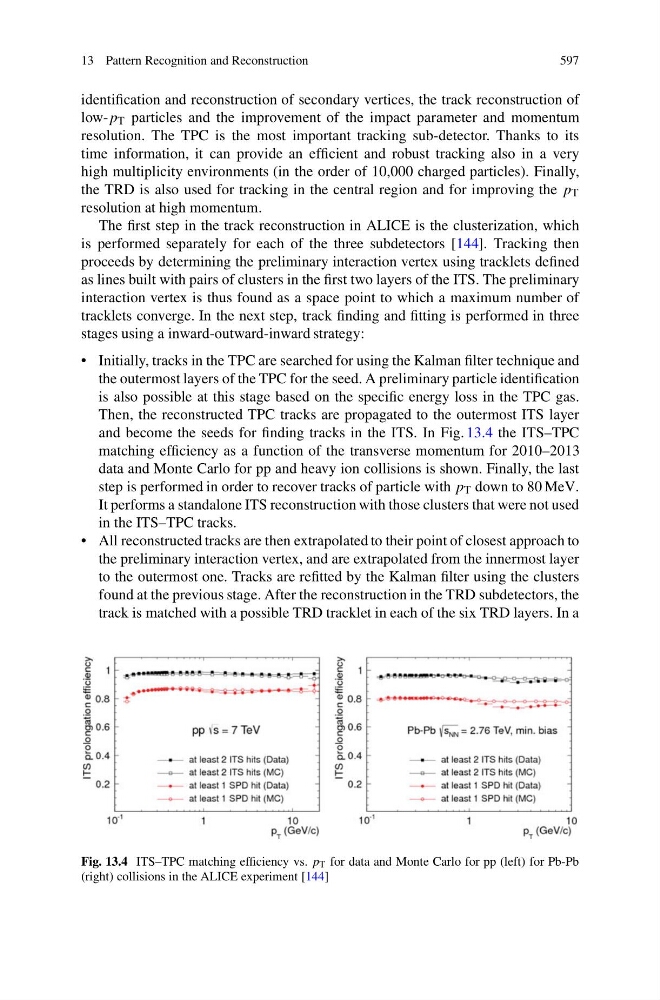
and become the seeds for finding tracks in the ITS. In Fig. 13.4 the ITS–TPC
matching efficiency as a function of the transverse momentum for 2010–2013
data and Monte Carlo for pp and heavy ion collisions is shown. Finally, the last
step is performed in order to recover tracks of particle with p T down to 80 MeV.
It performs a standalone ITS reconstruction with those clusters that were not used
in the ITS–TPC tracks.
• All reconstructed tracks are then extrapolated to their point of closest approach to
the preliminary interaction vertex, and are extrapolated from the innermost layer
to the outermost one. Tracks are refitted by the Kalman filter using the clusters
found at the previous stage. After the reconstruction in the TRD subdetectors, the
track is matched with a possible TRD tracklet in each of the six TRD layers. In a
Fig. 13.4 ITS–TPC matching efficiency vs. p T for data and Monte Carlo for pp (left) for Pb-Pb
(right) collisions in the ALICE experiment [144]
597
identification and reconstruction of secondary vertices, the track reconstruction of
low-p T particles and the improvement of the impact parameter and momentum
resolution. The TPC is the most important tracking sub-detector. Thanks to its
time information, it can provide an efficient and robust tracking also in a very
high multiplicity environments (in the order of 10,000 charged particles). Finally,
the TRD is also used for tracking in the central region and for improving the p T
resolution at high momentum.
The first step in the track reconstruction in ALICE is the clusterization, which
is performed separately for each of the three subdetectors [144]. Tracking then
proceeds by determining the preliminary interaction vertex using tracklets defined
as lines built with pairs of clusters in the first two layers of the ITS. The preliminary
interaction vertex is thus found as a space point to which a maximum number of
tracklets converge. In the next step, track finding and fitting is performed in three
stages using a inward-outward-inward strategy:
• Initially, tracks in the TPC are searched for using the Kalman filter technique and
the outermost layers of the TPC for the seed. A preliminary particle identification
is also possible at this stage based on the specific energy loss in the TPC gas.
Then, the reconstructed TPC tracks are propagated to the outermost ITS layer
and become the seeds for finding tracks in the ITS. In Fig. 13.4 the ITS–TPC
matching efficiency as a function of the transverse momentum for 2010–2013
data and Monte Carlo for pp and heavy ion collisions is shown. Finally, the last
step is performed in order to recover tracks of particle with p T down to 80 MeV.
It performs a standalone ITS reconstruction with those clusters that were not used
in the ITS–TPC tracks.
• All reconstructed tracks are then extrapolated to their point of closest approach to
the preliminary interaction vertex, and are extrapolated from the innermost layer
to the outermost one. Tracks are refitted by the Kalman filter using the clusters
found at the previous stage. After the reconstruction in the TRD subdetectors, the
track is matched with a possible TRD tracklet in each of the six TRD layers. In a
Fig. 13.4 ITS–TPC matching efficiency vs. p T for data and Monte Carlo for pp (left) for Pb-Pb
(right) collisions in the ALICE experiment [144]