

13 Pattern Recognition and Reconstruction
595
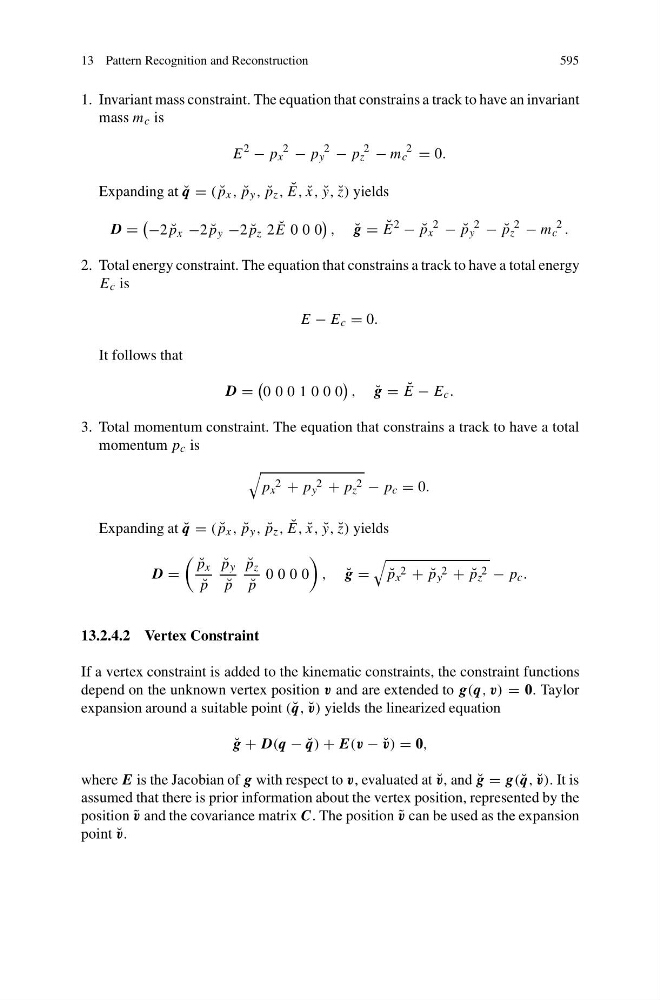
1. Invariant mass constraint. The equation that constrains a track to have an invariant
mass m c is
E
2
− p x
2
− p y
2
− p z
2
− m c
2
= 0.
Expanding at ˘
q = ( ˘
p x , ˘
p y , ˘
p z , ˘
E, ˘
x, ˘
y, ˘
z) yields
D =
−2 ˘
p x −2 ˘
p y −2 ˘
p z 2 ˘
E 0 0 0
, ˘
g = ˘
E
2
− ˘
p x
2
− ˘
p y
2
− ˘
p z
2
− m c
2 .
2. Total energy constraint. The equation that constrains a track to have a total energy
E c is
E − E c = 0.
It follows that
D =
0 0 0 1 0 0 0
, ˘
g = ˘
E − E c .
3. Total momentum constraint. The equation that constrains a track to have a total
momentum p c is
p x
2 + p y
2 + p z
2 − p c = 0.
Expanding at ˘
q = ( ˘
p x , ˘
p y , ˘
p z , ˘
E, ˘
x, ˘
y, ˘
z) yields
D =
˘
p x
˘
p
˘
p y
˘
p
˘
p z
˘
p
0 0 0 0
, ˘
g =
˘
p x
2 + ˘
p y
2 + ˘
p z
2 − p c .
13.2.4.2 Vertex Constraint
If a vertex constraint is added to the kinematic constraints, the constraint functions
depend on the unknown vertex position v and are extended to g(q, v) = 0. Taylor
expansion around a suitable point ( ˘
q, ˘
v) yields the linearized equation
˘
g + D(q − ˘
q) + E(v − ˘
v) = 0,
where E is the Jacobian of g with respect to v, evaluated at ˘
v, and ˘
g = g( ˘
q, ˘
v). It is
assumed that there is prior information about the vertex position, represented by the
position ˜
v and the covariance matrix C. The position ˜
v can be used as the expansion
point ˘
v.
595
1. Invariant mass constraint. The equation that constrains a track to have an invariant
mass m c is
E
2
− p x
2
− p y
2
− p z
2
− m c
2
= 0.
Expanding at ˘
q = ( ˘
p x , ˘
p y , ˘
p z , ˘
E, ˘
x, ˘
y, ˘
z) yields
D =
−2 ˘
p x −2 ˘
p y −2 ˘
p z 2 ˘
E 0 0 0
, ˘
g = ˘
E
2
− ˘
p x
2
− ˘
p y
2
− ˘
p z
2
− m c
2 .
2. Total energy constraint. The equation that constrains a track to have a total energy
E c is
E − E c = 0.
It follows that
D =
0 0 0 1 0 0 0
, ˘
g = ˘
E − E c .
3. Total momentum constraint. The equation that constrains a track to have a total
momentum p c is
p x
2 + p y
2 + p z
2 − p c = 0.
Expanding at ˘
q = ( ˘
p x , ˘
p y , ˘
p z , ˘
E, ˘
x, ˘
y, ˘
z) yields
D =
˘
p x
˘
p
˘
p y
˘
p
˘
p z
˘
p
0 0 0 0
, ˘
g =
˘
p x
2 + ˘
p y
2 + ˘
p z
2 − p c .
13.2.4.2 Vertex Constraint
If a vertex constraint is added to the kinematic constraints, the constraint functions
depend on the unknown vertex position v and are extended to g(q, v) = 0. Taylor
expansion around a suitable point ( ˘
q, ˘
v) yields the linearized equation
˘
g + D(q − ˘
q) + E(v − ˘
v) = 0,
where E is the Jacobian of g with respect to v, evaluated at ˘
v, and ˘
g = g( ˘
q, ˘
v). It is
assumed that there is prior information about the vertex position, represented by the
position ˜
v and the covariance matrix C. The position ˜
v can be used as the expansion
point ˘
v.