

580
R. Frühwirth et al.
13.1.5.1 Two-arm Spectrometer
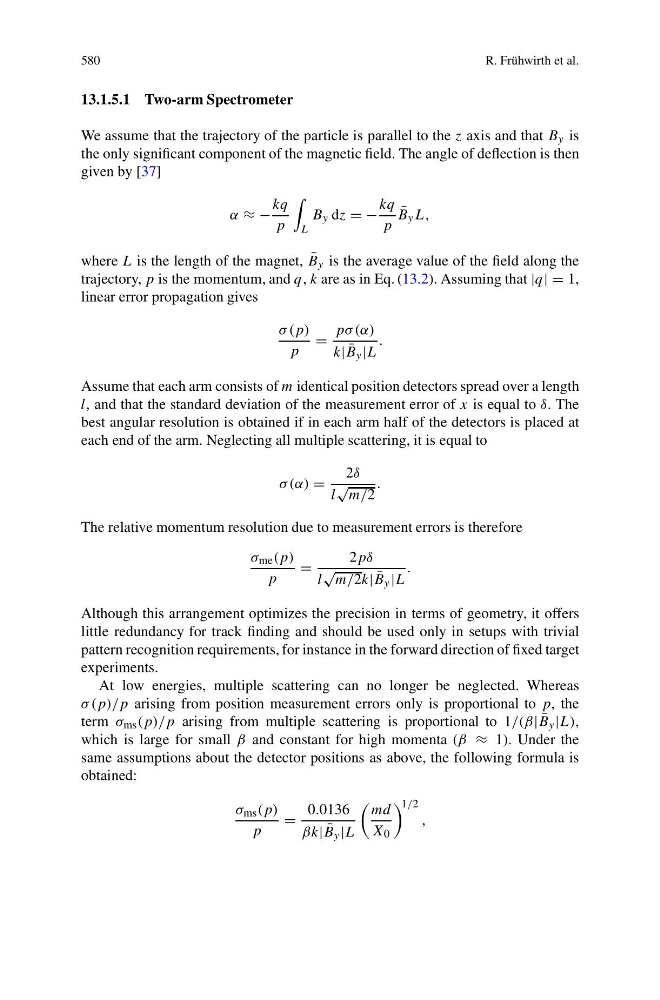
We assume that the trajectory of the particle is parallel to the z axis and that B y is
the only significant component of the magnetic field. The angle of deflection is then
given by [37]
α ≈ −
kq
p
L
B y dz = −
kq
p
¯
B y L,
where L is the length of the magnet, ¯
B y is the average value of the field along the
trajectory, p is the momentum, and q, k are as in Eq. (13.2). Assuming that |q| = 1,
linear error propagation gives
σ (p)
p
=
pσ (α)
k| ¯
B y |L
.
Assume that each arm consists of m identical position detectors spread over a length
l, and that the standard deviation of the measurement error of x is equal to δ. The
best angular resolution is obtained if in each arm half of the detectors is placed at
each end of the arm. Neglecting all multiple scattering, it is equal to
σ (α) =
2δ
l
√
m/2
.
The relative momentum resolution due to measurement errors is therefore
σ me (p)
p
=
2pδ
l
√
m/2k| ¯
B y |L
.
Although this arrangement optimizes the precision in terms of geometry, it offers
little redundancy for track finding and should be used only in setups with trivial
pattern recognition requirements, for instance in the forward direction of fixed target
experiments.
At low energies, multiple scattering can no longer be neglected. Whereas
σ (p)/p arising from position measurement errors only is proportional to p, the
term σ ms (p)/p arising from multiple scattering is proportional to 1/(β| ¯
B y |L),
which is large for small β and constant for high momenta (β ≈ 1). Under the
same assumptions about the detector positions as above, the following formula is
obtained:
σ ms (p)
p
=
0.0136
βk| ¯
B y |L
md
X 0
1/2
,
R. Frühwirth et al.
13.1.5.1 Two-arm Spectrometer
We assume that the trajectory of the particle is parallel to the z axis and that B y is
the only significant component of the magnetic field. The angle of deflection is then
given by [37]
α ≈ −
kq
p
L
B y dz = −
kq
p
¯
B y L,
where L is the length of the magnet, ¯
B y is the average value of the field along the
trajectory, p is the momentum, and q, k are as in Eq. (13.2). Assuming that |q| = 1,
linear error propagation gives
σ (p)
p
=
pσ (α)
k| ¯
B y |L
.
Assume that each arm consists of m identical position detectors spread over a length
l, and that the standard deviation of the measurement error of x is equal to δ. The
best angular resolution is obtained if in each arm half of the detectors is placed at
each end of the arm. Neglecting all multiple scattering, it is equal to
σ (α) =
2δ
l
√
m/2
.
The relative momentum resolution due to measurement errors is therefore
σ me (p)
p
=
2pδ
l
√
m/2k| ¯
B y |L
.
Although this arrangement optimizes the precision in terms of geometry, it offers
little redundancy for track finding and should be used only in setups with trivial
pattern recognition requirements, for instance in the forward direction of fixed target
experiments.
At low energies, multiple scattering can no longer be neglected. Whereas
σ (p)/p arising from position measurement errors only is proportional to p, the
term σ ms (p)/p arising from multiple scattering is proportional to 1/(β| ¯
B y |L),
which is large for small β and constant for high momenta (β ≈ 1). Under the
same assumptions about the detector positions as above, the following formula is
obtained:
σ ms (p)
p
=
0.0136
βk| ¯
B y |L
md
X 0
1/2
,