

13 Pattern Recognition and Reconstruction
579
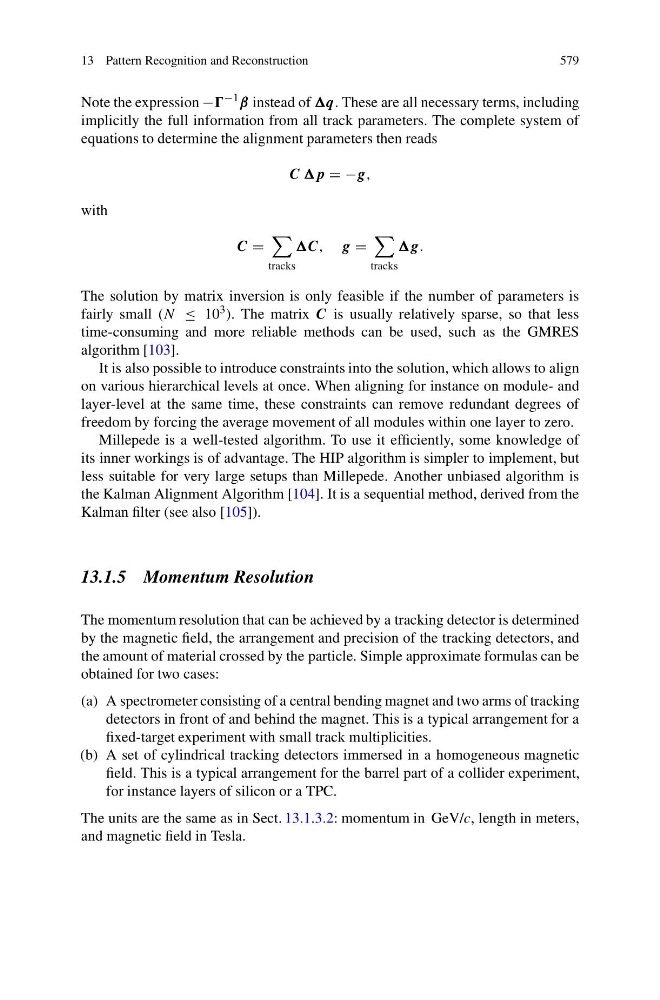
Note the expression −
−1 β instead of q. These are all necessary terms, including
implicitly the full information from all track parameters. The complete system of
equations to determine the alignment parameters then reads
C Cp = −g,
with
C =
tracks
C, g =
tracks
g.
The solution by matrix inversion is only feasible if the number of parameters is
fairly small (N ≤ 10 3 ). The matrix C is usually relatively sparse, so that less
time-consuming and more reliable methods can be used, such as the GMRES
algorithm [103].
It is also possible to introduce constraints into the solution, which allows to align
on various hierarchical levels at once. When aligning for instance on module- and
layer-level at the same time, these constraints can remove redundant degrees of
freedom by forcing the average movement of all modules within one layer to zero.
Millepede is a well-tested algorithm. To use it efficiently, some knowledge of
its inner workings is of advantage. The HIP algorithm is simpler to implement, but
less suitable for very large setups than Millepede. Another unbiased algorithm is
the Kalman Alignment Algorithm [104]. It is a sequential method, derived from the
Kalman filter (see also [105]).
13.1.5 Momentum Resolution
The momentum resolution that can be achieved by a tracking detector is determined
by the magnetic field, the arrangement and precision of the tracking detectors, and
the amount of material crossed by the particle. Simple approximate formulas can be
obtained for two cases:
(a) A spectrometer consisting of a central bending magnet and two arms of tracking
detectors in front of and behind the magnet. This is a typical arrangement for a
fixed-target experiment with small track multiplicities.
(b) A set of cylindrical tracking detectors immersed in a homogeneous magnetic
field. This is a typical arrangement for the barrel part of a collider experiment,
for instance layers of silicon or a TPC.
The units are the same as in Sect. 13.1.3.2: momentum in GeV/c, length in meters,
and magnetic field in Tesla.
579
Note the expression −
−1 β instead of q. These are all necessary terms, including
implicitly the full information from all track parameters. The complete system of
equations to determine the alignment parameters then reads
C Cp = −g,
with
C =
tracks
C, g =
tracks
g.
The solution by matrix inversion is only feasible if the number of parameters is
fairly small (N ≤ 10 3 ). The matrix C is usually relatively sparse, so that less
time-consuming and more reliable methods can be used, such as the GMRES
algorithm [103].
It is also possible to introduce constraints into the solution, which allows to align
on various hierarchical levels at once. When aligning for instance on module- and
layer-level at the same time, these constraints can remove redundant degrees of
freedom by forcing the average movement of all modules within one layer to zero.
Millepede is a well-tested algorithm. To use it efficiently, some knowledge of
its inner workings is of advantage. The HIP algorithm is simpler to implement, but
less suitable for very large setups than Millepede. Another unbiased algorithm is
the Kalman Alignment Algorithm [104]. It is a sequential method, derived from the
Kalman filter (see also [105]).
13.1.5 Momentum Resolution
The momentum resolution that can be achieved by a tracking detector is determined
by the magnetic field, the arrangement and precision of the tracking detectors, and
the amount of material crossed by the particle. Simple approximate formulas can be
obtained for two cases:
(a) A spectrometer consisting of a central bending magnet and two arms of tracking
detectors in front of and behind the magnet. This is a typical arrangement for a
fixed-target experiment with small track multiplicities.
(b) A set of cylindrical tracking detectors immersed in a homogeneous magnetic
field. This is a typical arrangement for the barrel part of a collider experiment,
for instance layers of silicon or a TPC.
The units are the same as in Sect. 13.1.3.2: momentum in GeV/c, length in meters,
and magnetic field in Tesla.