

578
R. Frühwirth et al.
with
˘
d i = d i ( ˘
q, ˘
p i ), i = p i − ˘
p i , D pi =
∂d i
∂p i
˘
q, ˘
p i
.
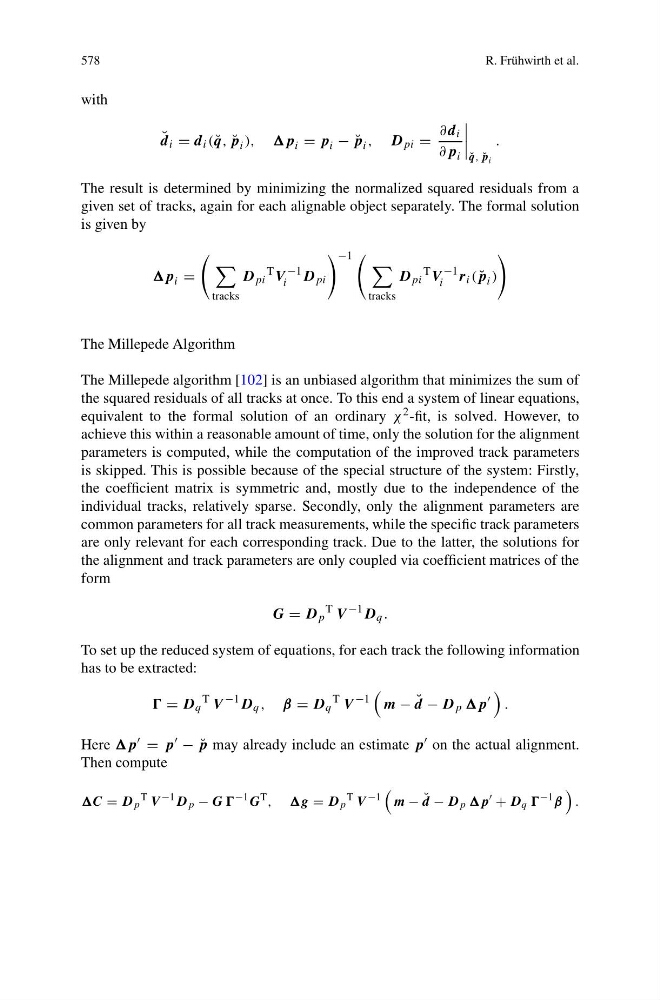
The result is determined by minimizing the normalized squared residuals from a
given set of tracks, again for each alignable object separately. The formal solution
is given by
i =
tracks
D pi
T V
−1
i D pi
−1
tracks
D pi
T V
−1
i r i ( ˘
p i )
The Millepede Algorithm
The Millepede algorithm [102] is an unbiased algorithm that minimizes the sum of
the squared residuals of all tracks at once. To this end a system of linear equations,
equivalent to the formal solution of an ordinary χ 2 -fit, is solved. However, to
achieve this within a reasonable amount of time, only the solution for the alignment
parameters is computed, while the computation of the improved track parameters
is skipped. This is possible because of the special structure of the system: Firstly,
the coefficient matrix is symmetric and, mostly due to the independence of the
individual tracks, relatively sparse. Secondly, only the alignment parameters are
common parameters for all track measurements, while the specific track parameters
are only relevant for each corresponding track. Due to the latter, the solutions for
the alignment and track parameters are only coupled via coefficient matrices of the
form
G = D p
T V
−1 D q .
To set up the reduced system of equations, for each track the following information
has to be extracted:
= D q
T V
−1 D q , β = D q
T V
−1
m − ˘
d − D p
.
Here = p − ˘
p may already include an estimate p on the actual alignment.
Then compute
= D p
T V
−1 D p − G G
−1 G
T , = D p
T V
−1
m − ˘
d − D p
+ D q
−1 β
.
R. Frühwirth et al.
with
˘
d i = d i ( ˘
q, ˘
p i ), i = p i − ˘
p i , D pi =
∂d i
∂p i
˘
q, ˘
p i
.
The result is determined by minimizing the normalized squared residuals from a
given set of tracks, again for each alignable object separately. The formal solution
is given by
i =
tracks
D pi
T V
−1
i D pi
−1
tracks
D pi
T V
−1
i r i ( ˘
p i )
The Millepede Algorithm
The Millepede algorithm [102] is an unbiased algorithm that minimizes the sum of
the squared residuals of all tracks at once. To this end a system of linear equations,
equivalent to the formal solution of an ordinary χ 2 -fit, is solved. However, to
achieve this within a reasonable amount of time, only the solution for the alignment
parameters is computed, while the computation of the improved track parameters
is skipped. This is possible because of the special structure of the system: Firstly,
the coefficient matrix is symmetric and, mostly due to the independence of the
individual tracks, relatively sparse. Secondly, only the alignment parameters are
common parameters for all track measurements, while the specific track parameters
are only relevant for each corresponding track. Due to the latter, the solutions for
the alignment and track parameters are only coupled via coefficient matrices of the
form
G = D p
T V
−1 D q .
To set up the reduced system of equations, for each track the following information
has to be extracted:
= D q
T V
−1 D q , β = D q
T V
−1
m − ˘
d − D p
.
Here = p − ˘
p may already include an estimate p on the actual alignment.
Then compute
= D p
T V
−1 D p − G G
−1 G
T , = D p
T V
−1
m − ˘
d − D p
+ D q
−1 β
.