

13 Pattern Recognition and Reconstruction
569
The moments can be used for a Gaussian representation of bremsstrahlung as an
additional process noise in the Kalman filter (see Sect. 13.1.3.4). As this is a very
crude approximation, more sophisticated methods have been developed that take
into account the actual shape of the distribution. One of them is the Gaussiansum filter [49, 50], see Sect. 13.1.3.5. A computationally less intensive approach
is described in [51].
13.1.3.4 Estimation Methods
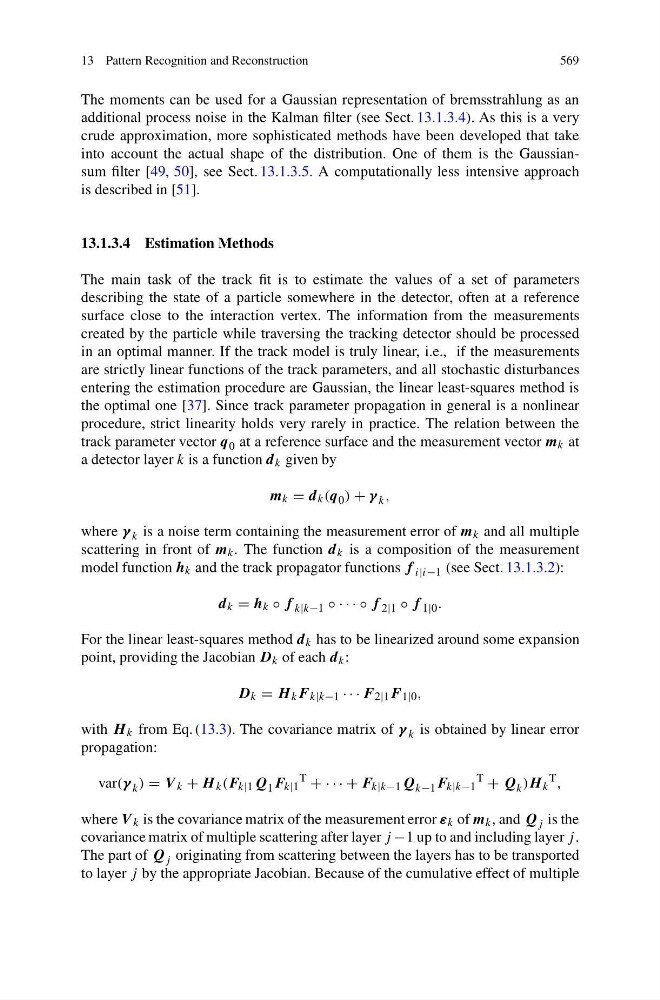
The main task of the track fit is to estimate the values of a set of parameters
describing the state of a particle somewhere in the detector, often at a reference
surface close to the interaction vertex. The information from the measurements
created by the particle while traversing the tracking detector should be processed
in an optimal manner. If the track model is truly linear, i.e., if the measurements
are strictly linear functions of the track parameters, and all stochastic disturbances
entering the estimation procedure are Gaussian, the linear least-squares method is
the optimal one [37]. Since track parameter propagation in general is a nonlinear
procedure, strict linearity holds very rarely in practice. The relation between the
track parameter vector q 0 at a reference surface and the measurement vector m k at
a detector layer k is a function d k given by
m k = d k (q 0 ) + γ k ,
where γ k is a noise term containing the measurement error of m k and all multiple
scattering in front of m k . The function d k is a composition of the measurement
model function h k and the track propagator functions f i|i−1 (see Sect. 13.1.3.2):
d k = h k ◦ f k|k−1 ◦ · · · ◦ f 2|1 ◦ f 1|0 .
For the linear least-squares method d k has to be linearized around some expansion
point, providing the Jacobian D k of each d k :
D k = H k F k|k−1 · · · F 2|1 F 1|0 ,
with H k from Eq. (13.3). The covariance matrix of γ k is obtained by linear error
propagation:
var(γ k ) = V k + H k (F k|1 Q 1 F k|1
T
+ · · · + F k|k−1 Q k−1 F k|k−1
T
+ Q k )H k
T ,
where V k is the covariance matrix of the measurement error ε k of m k , and Q j is the
covariance matrix of multiple scattering after layer j −1 up to and including layer j .
The part of Q j originating from scattering between the layers has to be transported
to layer j by the appropriate Jacobian. Because of the cumulative effect of multiple
569
The moments can be used for a Gaussian representation of bremsstrahlung as an
additional process noise in the Kalman filter (see Sect. 13.1.3.4). As this is a very
crude approximation, more sophisticated methods have been developed that take
into account the actual shape of the distribution. One of them is the Gaussiansum filter [49, 50], see Sect. 13.1.3.5. A computationally less intensive approach
is described in [51].
13.1.3.4 Estimation Methods
The main task of the track fit is to estimate the values of a set of parameters
describing the state of a particle somewhere in the detector, often at a reference
surface close to the interaction vertex. The information from the measurements
created by the particle while traversing the tracking detector should be processed
in an optimal manner. If the track model is truly linear, i.e., if the measurements
are strictly linear functions of the track parameters, and all stochastic disturbances
entering the estimation procedure are Gaussian, the linear least-squares method is
the optimal one [37]. Since track parameter propagation in general is a nonlinear
procedure, strict linearity holds very rarely in practice. The relation between the
track parameter vector q 0 at a reference surface and the measurement vector m k at
a detector layer k is a function d k given by
m k = d k (q 0 ) + γ k ,
where γ k is a noise term containing the measurement error of m k and all multiple
scattering in front of m k . The function d k is a composition of the measurement
model function h k and the track propagator functions f i|i−1 (see Sect. 13.1.3.2):
d k = h k ◦ f k|k−1 ◦ · · · ◦ f 2|1 ◦ f 1|0 .
For the linear least-squares method d k has to be linearized around some expansion
point, providing the Jacobian D k of each d k :
D k = H k F k|k−1 · · · F 2|1 F 1|0 ,
with H k from Eq. (13.3). The covariance matrix of γ k is obtained by linear error
propagation:
var(γ k ) = V k + H k (F k|1 Q 1 F k|1
T
+ · · · + F k|k−1 Q k−1 F k|k−1
T
+ Q k )H k
T ,
where V k is the covariance matrix of the measurement error ε k of m k , and Q j is the
covariance matrix of multiple scattering after layer j −1 up to and including layer j .
The part of Q j originating from scattering between the layers has to be transported
to layer j by the appropriate Jacobian. Because of the cumulative effect of multiple