

568
R. Frühwirth et al.
Energy Loss
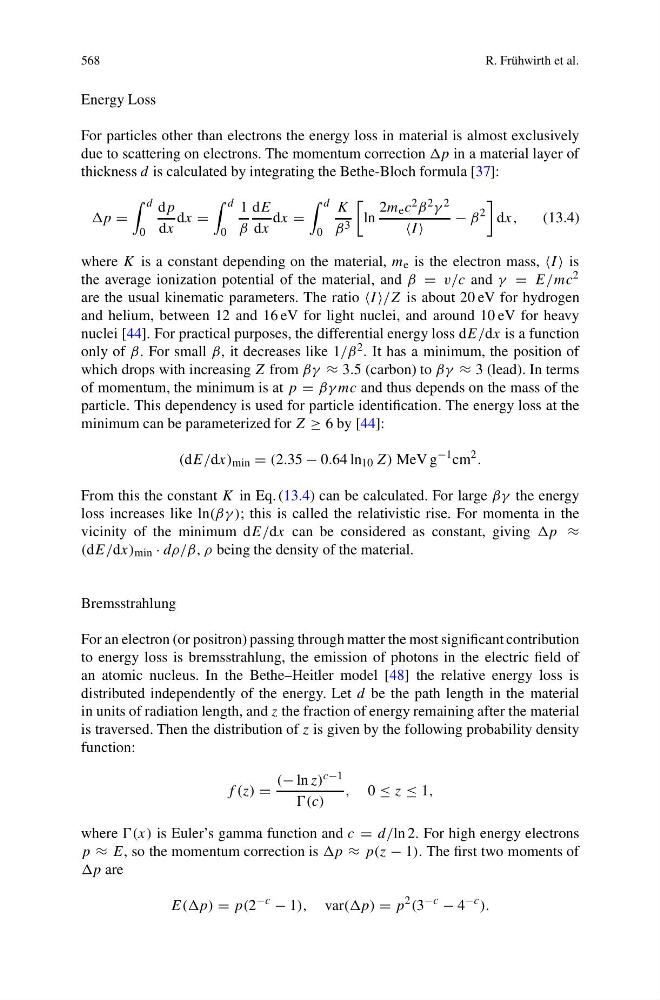
For particles other than electrons the energy loss in material is almost exclusively
due to scattering on electrons. The momentum correction p in a material layer of
thickness d is calculated by integrating the Bethe-Bloch formula [37]:
=
d
0
dp
dx
dx =
d
0
1
β
dE
dx
dx =
d
0
K
β 3
ln
2m e c 2 β 2 γ 2
− β
2
dx,
(13.4)
where K is a constant depending on the material, m e is the electron mass, is
the average ionization potential of the material, and β = v/c and γ = E/mc 2
are the usual kinematic parameters. The ratio /Z is about 20 eV for hydrogen
and helium, between 12 and 16 eV for light nuclei, and around 10 eV for heavy
nuclei [44]. For practical purposes, the differential energy loss dE/dx is a function
only of β. For small β, it decreases like 1/β 2 . It has a minimum, the position of
which drops with increasing Z from βγ ≈ 3.5 (carbon) to βγ ≈ 3 (lead). In terms
of momentum, the minimum is at p = βγ mc and thus depends on the mass of the
particle. This dependency is used for particle identification. The energy loss at the
minimum can be parameterized for Z ≥ 6 by [44]:
(dE/dx) min = (2.35 − 0.64 ln 10 Z) MeV g
−1 cm
2 .
From this the constant K in Eq. (13.4) can be calculated. For large βγ the energy
loss increases like ln(βγ ); this is called the relativistic rise. For momenta in the
vicinity of the minimum dE/dx can be considered as constant, giving ≈
(dE/dx) min · dρ/β, ρ being the density of the material.
Bremsstrahlung
For an electron (or positron) passing through matter the most significant contribution
to energy loss is bremsstrahlung, the emission of photons in the electric field of
an atomic nucleus. In the Bethe–Heitler model [48] the relative energy loss is
distributed independently of the energy. Let d be the path length in the material
in units of radiation length, and z the fraction of energy remaining after the material
is traversed. Then the distribution of z is given by the following probability density
function:
f (z) =
(− ln z) c−1
, 0 ≤ z ≤ 1,
where (x) is Euler’s gamma function and c = d/ln 2. For high energy electrons
p ≈ E, so the momentum correction is ≈ p(z − 1). The first two moments of
p are
E((p) = p(2
−c
− 1), var((p) = p
2 (3
−c
− 4
−c ).
R. Frühwirth et al.
Energy Loss
For particles other than electrons the energy loss in material is almost exclusively
due to scattering on electrons. The momentum correction p in a material layer of
thickness d is calculated by integrating the Bethe-Bloch formula [37]:
=
d
0
dp
dx
dx =
d
0
1
β
dE
dx
dx =
d
0
K
β 3
ln
2m e c 2 β 2 γ 2
− β
2
dx,
(13.4)
where K is a constant depending on the material, m e is the electron mass, is
the average ionization potential of the material, and β = v/c and γ = E/mc 2
are the usual kinematic parameters. The ratio /Z is about 20 eV for hydrogen
and helium, between 12 and 16 eV for light nuclei, and around 10 eV for heavy
nuclei [44]. For practical purposes, the differential energy loss dE/dx is a function
only of β. For small β, it decreases like 1/β 2 . It has a minimum, the position of
which drops with increasing Z from βγ ≈ 3.5 (carbon) to βγ ≈ 3 (lead). In terms
of momentum, the minimum is at p = βγ mc and thus depends on the mass of the
particle. This dependency is used for particle identification. The energy loss at the
minimum can be parameterized for Z ≥ 6 by [44]:
(dE/dx) min = (2.35 − 0.64 ln 10 Z) MeV g
−1 cm
2 .
From this the constant K in Eq. (13.4) can be calculated. For large βγ the energy
loss increases like ln(βγ ); this is called the relativistic rise. For momenta in the
vicinity of the minimum dE/dx can be considered as constant, giving ≈
(dE/dx) min · dρ/β, ρ being the density of the material.
Bremsstrahlung
For an electron (or positron) passing through matter the most significant contribution
to energy loss is bremsstrahlung, the emission of photons in the electric field of
an atomic nucleus. In the Bethe–Heitler model [48] the relative energy loss is
distributed independently of the energy. Let d be the path length in the material
in units of radiation length, and z the fraction of energy remaining after the material
is traversed. Then the distribution of z is given by the following probability density
function:
f (z) =
(− ln z) c−1
, 0 ≤ z ≤ 1,
where (x) is Euler’s gamma function and c = d/ln 2. For high energy electrons
p ≈ E, so the momentum correction is ≈ p(z − 1). The first two moments of
p are
E((p) = p(2
−c
− 1), var((p) = p
2 (3
−c
− 4
−c ).