

10 Signal Processing for Particle Detectors
469
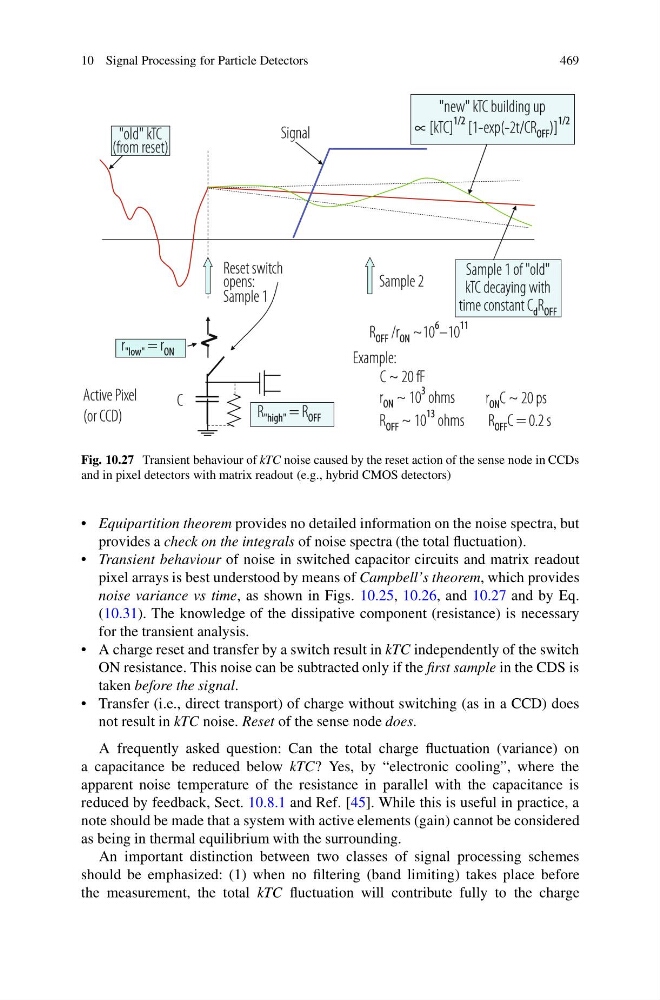
Fig. 10.27 Transient behaviour of kTC noise caused by the reset action of the sense node in CCDs
and in pixel detectors with matrix readout (e.g., hybrid CMOS detectors)
• Equipartition theorem provides no detailed information on the noise spectra, but
provides a check on the integrals of noise spectra (the total fluctuation).
• Transient behaviour of noise in switched capacitor circuits and matrix readout
pixel arrays is best understood by means of Campbell’s theorem, which provides
noise variance vs time, as shown in Figs. 10.25, 10.26, and 10.27 and by Eq.
(10.31). The knowledge of the dissipative component (resistance) is necessary
for the transient analysis.
• A charge reset and transfer by a switch result in kTC independently of the switch
ON resistance. This noise can be subtracted only if the first sample in the CDS is
taken before the signal.
• Transfer (i.e., direct transport) of charge without switching (as in a CCD) does
not result in kTC noise. Reset of the sense node does.
A frequently asked question: Can the total charge fluctuation (variance) on
a capacitance be reduced below kTC? Yes, by “electronic cooling”, where the
apparent noise temperature of the resistance in parallel with the capacitance is
reduced by feedback, Sect. 10.8.1 and Ref. [45]. While this is useful in practice, a
note should be made that a system with active elements (gain) cannot be considered
as being in thermal equilibrium with the surrounding.
An important distinction between two classes of signal processing schemes
should be emphasized: (1) when no filtering (band limiting) takes place before
the measurement, the total kTC fluctuation will contribute fully to the charge
469
Fig. 10.27 Transient behaviour of kTC noise caused by the reset action of the sense node in CCDs
and in pixel detectors with matrix readout (e.g., hybrid CMOS detectors)
• Equipartition theorem provides no detailed information on the noise spectra, but
provides a check on the integrals of noise spectra (the total fluctuation).
• Transient behaviour of noise in switched capacitor circuits and matrix readout
pixel arrays is best understood by means of Campbell’s theorem, which provides
noise variance vs time, as shown in Figs. 10.25, 10.26, and 10.27 and by Eq.
(10.31). The knowledge of the dissipative component (resistance) is necessary
for the transient analysis.
• A charge reset and transfer by a switch result in kTC independently of the switch
ON resistance. This noise can be subtracted only if the first sample in the CDS is
taken before the signal.
• Transfer (i.e., direct transport) of charge without switching (as in a CCD) does
not result in kTC noise. Reset of the sense node does.
A frequently asked question: Can the total charge fluctuation (variance) on
a capacitance be reduced below kTC? Yes, by “electronic cooling”, where the
apparent noise temperature of the resistance in parallel with the capacitance is
reduced by feedback, Sect. 10.8.1 and Ref. [45]. While this is useful in practice, a
note should be made that a system with active elements (gain) cannot be considered
as being in thermal equilibrium with the surrounding.
An important distinction between two classes of signal processing schemes
should be emphasized: (1) when no filtering (band limiting) takes place before
the measurement, the total kTC fluctuation will contribute fully to the charge