

10 Signal Processing for Particle Detectors
457
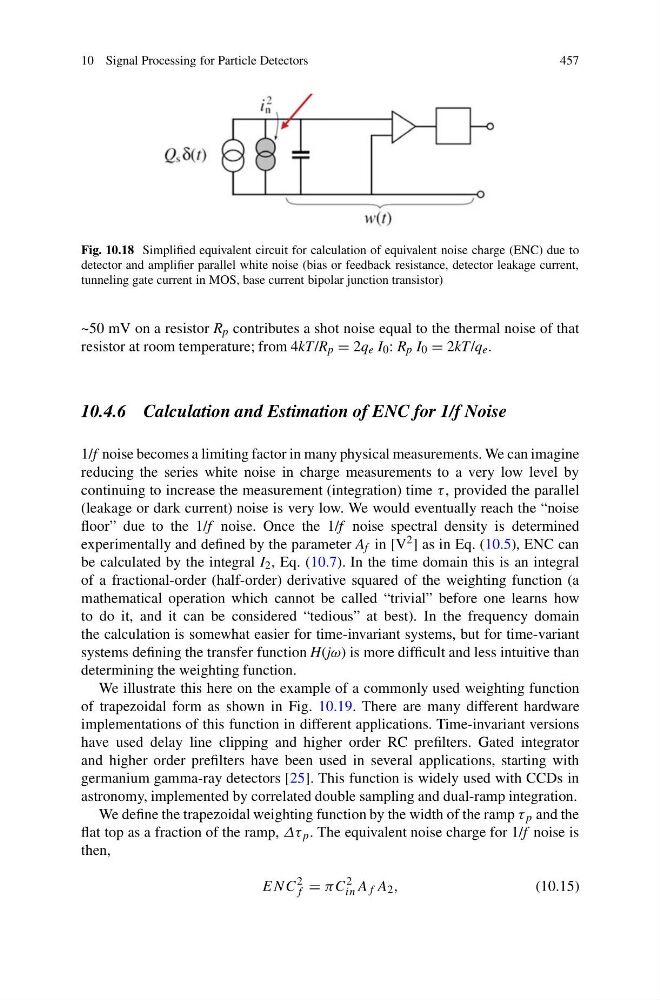
Fig. 10.18 Simplified equivalent circuit for calculation of equivalent noise charge (ENC) due to
detector and amplifier parallel white noise (bias or feedback resistance, detector leakage current,
tunneling gate current in MOS, base current bipolar junction transistor)
~50 mV on a resistor R p contributes a shot noise equal to the thermal noise of that
resistor at room temperature; from 4kT/R p = 2q e I 0 : R p I 0 = 2kT/q e .
10.4.6 Calculation and Estimation of ENC for 1/f Noise
1/f noise becomes a limiting factor in many physical measurements. We can imagine
reducing the series white noise in charge measurements to a very low level by
continuing to increase the measurement (integration) time τ , provided the parallel
(leakage or dark current) noise is very low. We would eventually reach the “noise
floor” due to the 1/f noise. Once the 1/f noise spectral density is determined
experimentally and defined by the parameter A f in [V 2 ] as in Eq. (10.5), ENC can
be calculated by the integral I 2 , Eq. (10.7). In the time domain this is an integral
of a fractional-order (half-order) derivative squared of the weighting function (a
mathematical operation which cannot be called “trivial” before one learns how
to do it, and it can be considered “tedious” at best). In the frequency domain
the calculation is somewhat easier for time-invariant systems, but for time-variant
systems defining the transfer function H(jω) is more difficult and less intuitive than
determining the weighting function.
We illustrate this here on the example of a commonly used weighting function
of trapezoidal form as shown in Fig. 10.19. There are many different hardware
implementations of this function in different applications. Time-invariant versions
have used delay line clipping and higher order RC prefilters. Gated integrator
and higher order prefilters have been used in several applications, starting with
germanium gamma-ray detectors [25]. This function is widely used with CCDs in
astronomy, implemented by correlated double sampling and dual-ramp integration.
We define the trapezoidal weighting function by the width of the ramp τ p and the
flat top as a fraction of the ramp, Δτ p . The equivalent noise charge for 1/f noise is
then,
ENC
2
f = πC
2
in A f A 2 ,
(10.15)
457
Fig. 10.18 Simplified equivalent circuit for calculation of equivalent noise charge (ENC) due to
detector and amplifier parallel white noise (bias or feedback resistance, detector leakage current,
tunneling gate current in MOS, base current bipolar junction transistor)
~50 mV on a resistor R p contributes a shot noise equal to the thermal noise of that
resistor at room temperature; from 4kT/R p = 2q e I 0 : R p I 0 = 2kT/q e .
10.4.6 Calculation and Estimation of ENC for 1/f Noise
1/f noise becomes a limiting factor in many physical measurements. We can imagine
reducing the series white noise in charge measurements to a very low level by
continuing to increase the measurement (integration) time τ , provided the parallel
(leakage or dark current) noise is very low. We would eventually reach the “noise
floor” due to the 1/f noise. Once the 1/f noise spectral density is determined
experimentally and defined by the parameter A f in [V 2 ] as in Eq. (10.5), ENC can
be calculated by the integral I 2 , Eq. (10.7). In the time domain this is an integral
of a fractional-order (half-order) derivative squared of the weighting function (a
mathematical operation which cannot be called “trivial” before one learns how
to do it, and it can be considered “tedious” at best). In the frequency domain
the calculation is somewhat easier for time-invariant systems, but for time-variant
systems defining the transfer function H(jω) is more difficult and less intuitive than
determining the weighting function.
We illustrate this here on the example of a commonly used weighting function
of trapezoidal form as shown in Fig. 10.19. There are many different hardware
implementations of this function in different applications. Time-invariant versions
have used delay line clipping and higher order RC prefilters. Gated integrator
and higher order prefilters have been used in several applications, starting with
germanium gamma-ray detectors [25]. This function is widely used with CCDs in
astronomy, implemented by correlated double sampling and dual-ramp integration.
We define the trapezoidal weighting function by the width of the ramp τ p and the
flat top as a fraction of the ramp, Δτ p . The equivalent noise charge for 1/f noise is
then,
ENC
2
f = πC
2
in A f A 2 ,
(10.15)