

456
V. Radeka
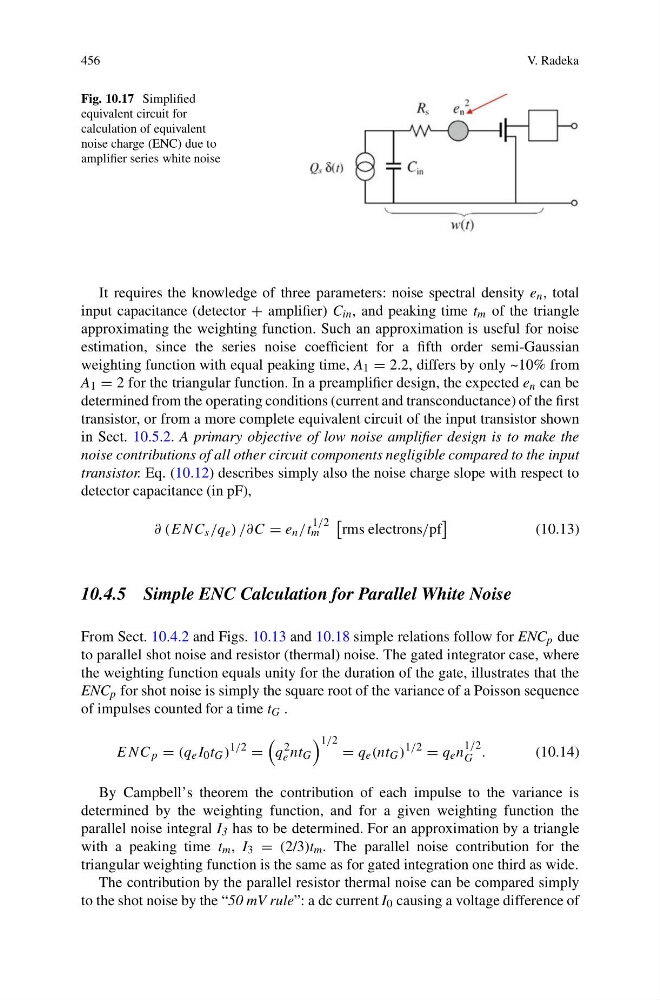
Fig. 10.17 Simplified
equivalent circuit for
calculation of equivalent
noise charge (ENC) due to
amplifier series white noise
It requires the knowledge of three parameters: noise spectral density e n , total
input capacitance (detector + amplifier) C in , and peaking time t m of the triangle
approximating the weighting function. Such an approximation is useful for noise
estimation, since the series noise coefficient for a fifth order semi-Gaussian
weighting function with equal peaking time, A 1 = 2.2, differs by only ~10% from
A 1 = 2 for the triangular function. In a preamplifier design, the expected e n can be
determined from the operating conditions (current and transconductance) of the first
transistor, or from a more complete equivalent circuit of the input transistor shown
in Sect. 10.5.2. A primary objective of low noise amplifier design is to make the
noise contributions of all other circuit components negligible compared to the input
transistor. Eq. (10.12) describes simply also the noise charge slope with respect to
detector capacitance (in pF),
∂ (ENC s /q e ) /∂C = e n /t
1/2
m
rms electrons/pf
(10.13)
10.4.5 Simple ENC Calculation for Parallel White Noise
From Sect. 10.4.2 and Figs. 10.13 and 10.18 simple relations follow for ENC p due
to parallel shot noise and resistor (thermal) noise. The gated integrator case, where
the weighting function equals unity for the duration of the gate, illustrates that the
ENC p for shot noise is simply the square root of the variance of a Poisson sequence
of impulses counted for a time t G .
ENC p = (q e I 0 t G )
1/2
=
q
2
e nt G
1/2 = q e (nt G )
1/2
= q e n
1/2
G .
(10.14)
By Campbell’s theorem the contribution of each impulse to the variance is
determined by the weighting function, and for a given weighting function the
parallel noise integral I 3 has to be determined. For an approximation by a triangle
with a peaking time t m , I 3 = (2/3)t m . The parallel noise contribution for the
triangular weighting function is the same as for gated integration one third as wide.
The contribution by the parallel resistor thermal noise can be compared simply
to the shot noise by the “50 mV rule”: a dc current I 0 causing a voltage difference of
V. Radeka
Fig. 10.17 Simplified
equivalent circuit for
calculation of equivalent
noise charge (ENC) due to
amplifier series white noise
It requires the knowledge of three parameters: noise spectral density e n , total
input capacitance (detector + amplifier) C in , and peaking time t m of the triangle
approximating the weighting function. Such an approximation is useful for noise
estimation, since the series noise coefficient for a fifth order semi-Gaussian
weighting function with equal peaking time, A 1 = 2.2, differs by only ~10% from
A 1 = 2 for the triangular function. In a preamplifier design, the expected e n can be
determined from the operating conditions (current and transconductance) of the first
transistor, or from a more complete equivalent circuit of the input transistor shown
in Sect. 10.5.2. A primary objective of low noise amplifier design is to make the
noise contributions of all other circuit components negligible compared to the input
transistor. Eq. (10.12) describes simply also the noise charge slope with respect to
detector capacitance (in pF),
∂ (ENC s /q e ) /∂C = e n /t
1/2
m
rms electrons/pf
(10.13)
10.4.5 Simple ENC Calculation for Parallel White Noise
From Sect. 10.4.2 and Figs. 10.13 and 10.18 simple relations follow for ENC p due
to parallel shot noise and resistor (thermal) noise. The gated integrator case, where
the weighting function equals unity for the duration of the gate, illustrates that the
ENC p for shot noise is simply the square root of the variance of a Poisson sequence
of impulses counted for a time t G .
ENC p = (q e I 0 t G )
1/2
=
q
2
e nt G
1/2 = q e (nt G )
1/2
= q e n
1/2
G .
(10.14)
By Campbell’s theorem the contribution of each impulse to the variance is
determined by the weighting function, and for a given weighting function the
parallel noise integral I 3 has to be determined. For an approximation by a triangle
with a peaking time t m , I 3 = (2/3)t m . The parallel noise contribution for the
triangular weighting function is the same as for gated integration one third as wide.
The contribution by the parallel resistor thermal noise can be compared simply
to the shot noise by the “50 mV rule”: a dc current I 0 causing a voltage difference of