

10 Signal Processing for Particle Detectors
455
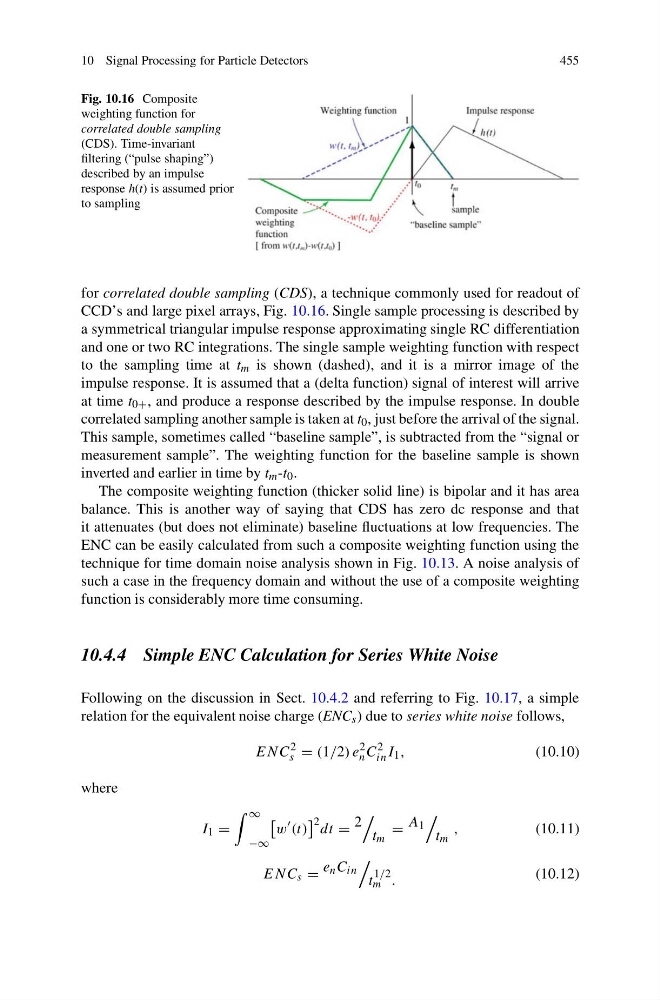
Fig. 10.16 Composite
weighting function for
correlated double sampling
(CDS). Time-invariant
filtering (“pulse shaping”)
described by an impulse
response h(t) is assumed prior
to sampling
for correlated double sampling (CDS), a technique commonly used for readout of
CCD’s and large pixel arrays, Fig. 10.16. Single sample processing is described by
a symmetrical triangular impulse response approximating single RC differentiation
and one or two RC integrations. The single sample weighting function with respect
to the sampling time at t m is shown (dashed), and it is a mirror image of the
impulse response. It is assumed that a (delta function) signal of interest will arrive
at time t 0+ , and produce a response described by the impulse response. In double
correlated sampling another sample is taken at t 0 , just before the arrival of the signal.
This sample, sometimes called “baseline sample”, is subtracted from the “signal or
measurement sample”. The weighting function for the baseline sample is shown
inverted and earlier in time by t m -t 0 .
The composite weighting function (thicker solid line) is bipolar and it has area
balance. This is another way of saying that CDS has zero dc response and that
it attenuates (but does not eliminate) baseline fluctuations at low frequencies. The
ENC can be easily calculated from such a composite weighting function using the
technique for time domain noise analysis shown in Fig. 10.13. A noise analysis of
such a case in the frequency domain and without the use of a composite weighting
function is considerably more time consuming.
10.4.4 Simple ENC Calculation for Series White Noise
Following on the discussion in Sect. 10.4.2 and referring to Fig. 10.17, a simple
relation for the equivalent noise charge (ENC s ) due to series white noise follows,
ENC
2
s = (1/2) e
2
n C
2
in I 1 ,
(10.10)
where
I 1 =
∞
−∞
w
(t)
2 dt = 2
t m
= A 1
t m
,
(10.11)
ENC s = e n C in
t
1/2
m .
(10.12)
455
Fig. 10.16 Composite
weighting function for
correlated double sampling
(CDS). Time-invariant
filtering (“pulse shaping”)
described by an impulse
response h(t) is assumed prior
to sampling
for correlated double sampling (CDS), a technique commonly used for readout of
CCD’s and large pixel arrays, Fig. 10.16. Single sample processing is described by
a symmetrical triangular impulse response approximating single RC differentiation
and one or two RC integrations. The single sample weighting function with respect
to the sampling time at t m is shown (dashed), and it is a mirror image of the
impulse response. It is assumed that a (delta function) signal of interest will arrive
at time t 0+ , and produce a response described by the impulse response. In double
correlated sampling another sample is taken at t 0 , just before the arrival of the signal.
This sample, sometimes called “baseline sample”, is subtracted from the “signal or
measurement sample”. The weighting function for the baseline sample is shown
inverted and earlier in time by t m -t 0 .
The composite weighting function (thicker solid line) is bipolar and it has area
balance. This is another way of saying that CDS has zero dc response and that
it attenuates (but does not eliminate) baseline fluctuations at low frequencies. The
ENC can be easily calculated from such a composite weighting function using the
technique for time domain noise analysis shown in Fig. 10.13. A noise analysis of
such a case in the frequency domain and without the use of a composite weighting
function is considerably more time consuming.
10.4.4 Simple ENC Calculation for Series White Noise
Following on the discussion in Sect. 10.4.2 and referring to Fig. 10.17, a simple
relation for the equivalent noise charge (ENC s ) due to series white noise follows,
ENC
2
s = (1/2) e
2
n C
2
in I 1 ,
(10.10)
where
I 1 =
∞
−∞
w
(t)
2 dt = 2
t m
= A 1
t m
,
(10.11)
ENC s = e n C in
t
1/2
m .
(10.12)