

454
V. Radeka
10.4.3 Weighting Function
The concept of weighting function is very useful for time domain noise analysis of
time variant, sampled and switched systems. The role of “pulse shaping,” “signal
filtering,” or “signal processing” is to minimize the measurement error with respect
to the noise, various baseline offsets and fluctuations, and at high counting rates
to minimize the effects of pulse overlap or pileup. The term “pulse shaping”
implies that the amplifier-filter system is time invariant. In such a system the
system parameters do not vary during the measurement and a single measurement
of amplitude or time is performed. Such a system is described completely by its
impulse response.
In signal filtering, we also use time-variant methods, such as capacitor switching
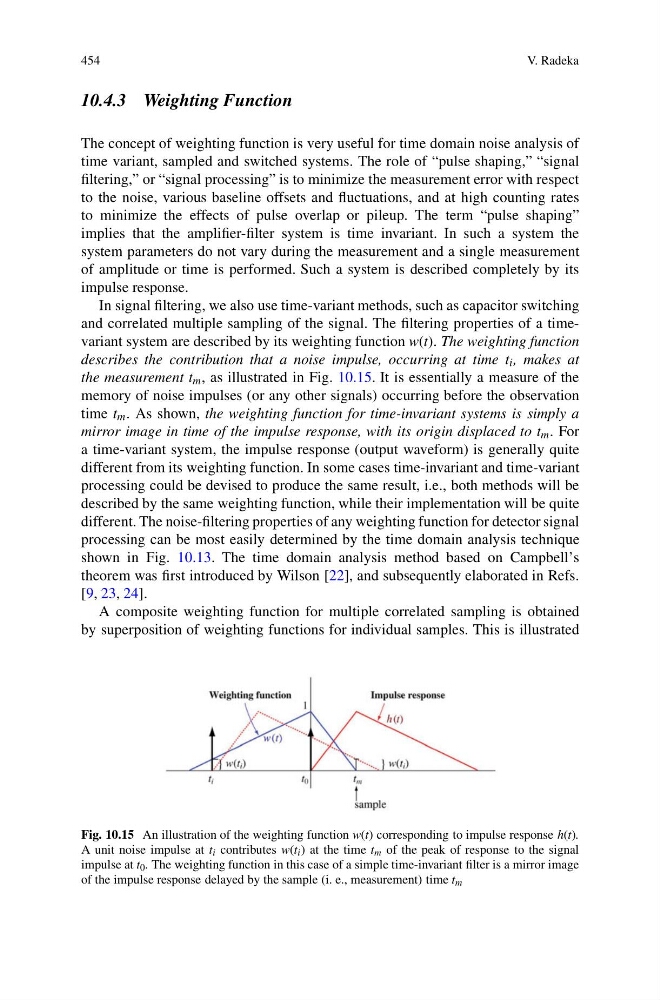
and correlated multiple sampling of the signal. The filtering properties of a timevariant system are described by its weighting function w(t). The weighting function
describes the contribution that a noise impulse, occurring at time t i , makes at
the measurement t m , as illustrated in Fig. 10.15. It is essentially a measure of the
memory of noise impulses (or any other signals) occurring before the observation
time t m . As shown, the weighting function for time-invariant systems is simply a
mirror image in time of the impulse response, with its origin displaced to t m . For
a time-variant system, the impulse response (output waveform) is generally quite
different from its weighting function. In some cases time-invariant and time-variant
processing could be devised to produce the same result, i.e., both methods will be
described by the same weighting function, while their implementation will be quite
different. The noise-filtering properties of any weighting function for detector signal
processing can be most easily determined by the time domain analysis technique
shown in Fig. 10.13. The time domain analysis method based on Campbell’s
theorem was first introduced by Wilson [22], and subsequently elaborated in Refs.
[9, 23, 24].
A composite weighting function for multiple correlated sampling is obtained
by superposition of weighting functions for individual samples. This is illustrated
Fig. 10.15 An illustration of the weighting function w(t) corresponding to impulse response h(t).
A unit noise impulse at t i contributes w(t i ) at the time t m of the peak of response to the signal
impulse at t 0 . The weighting function in this case of a simple time-invariant filter is a mirror image
of the impulse response delayed by the sample (i. e., measurement) time t m
V. Radeka
10.4.3 Weighting Function
The concept of weighting function is very useful for time domain noise analysis of
time variant, sampled and switched systems. The role of “pulse shaping,” “signal
filtering,” or “signal processing” is to minimize the measurement error with respect
to the noise, various baseline offsets and fluctuations, and at high counting rates
to minimize the effects of pulse overlap or pileup. The term “pulse shaping”
implies that the amplifier-filter system is time invariant. In such a system the
system parameters do not vary during the measurement and a single measurement
of amplitude or time is performed. Such a system is described completely by its
impulse response.
In signal filtering, we also use time-variant methods, such as capacitor switching
and correlated multiple sampling of the signal. The filtering properties of a timevariant system are described by its weighting function w(t). The weighting function
describes the contribution that a noise impulse, occurring at time t i , makes at
the measurement t m , as illustrated in Fig. 10.15. It is essentially a measure of the
memory of noise impulses (or any other signals) occurring before the observation
time t m . As shown, the weighting function for time-invariant systems is simply a
mirror image in time of the impulse response, with its origin displaced to t m . For
a time-variant system, the impulse response (output waveform) is generally quite
different from its weighting function. In some cases time-invariant and time-variant
processing could be devised to produce the same result, i.e., both methods will be
described by the same weighting function, while their implementation will be quite
different. The noise-filtering properties of any weighting function for detector signal
processing can be most easily determined by the time domain analysis technique
shown in Fig. 10.13. The time domain analysis method based on Campbell’s
theorem was first introduced by Wilson [22], and subsequently elaborated in Refs.
[9, 23, 24].
A composite weighting function for multiple correlated sampling is obtained
by superposition of weighting functions for individual samples. This is illustrated
Fig. 10.15 An illustration of the weighting function w(t) corresponding to impulse response h(t).
A unit noise impulse at t i contributes w(t i ) at the time t m of the peak of response to the signal
impulse at t 0 . The weighting function in this case of a simple time-invariant filter is a mirror image
of the impulse response delayed by the sample (i. e., measurement) time t m