

458
V. Radeka
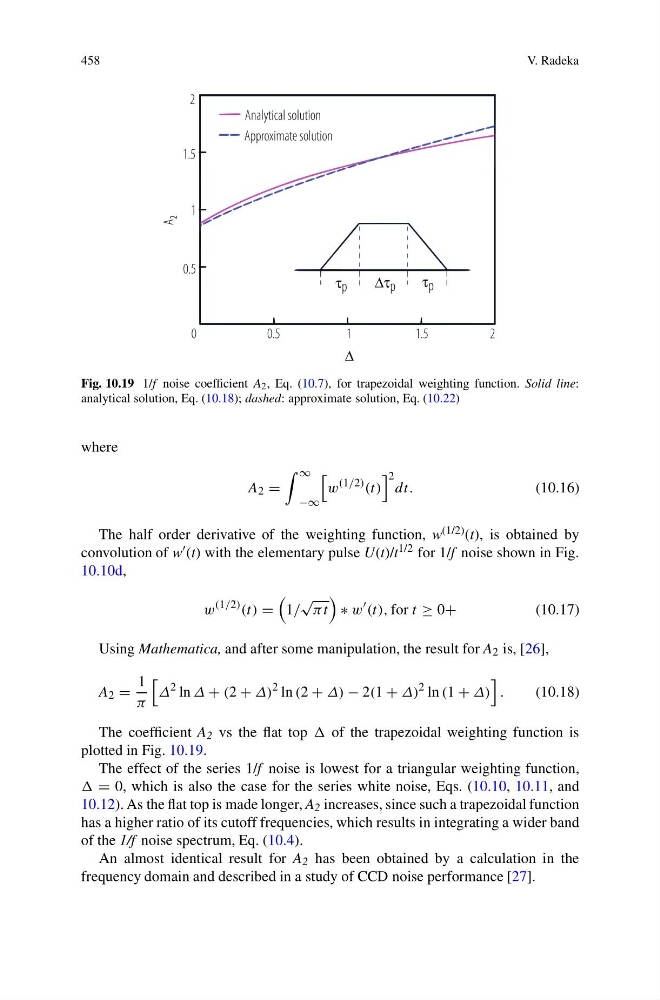
Fig. 10.19 1/f noise coefficient A 2 , Eq. (10.7), for trapezoidal weighting function. Solid line:
analytical solution, Eq. (10.18); dashed: approximate solution, Eq. (10.22)
where
A 2 =
∞
−∞
w
(1/2) (t)
2
dt.
(10.16)
The half order derivative of the weighting function, w (1/2) (t), is obtained by
convolution of w (t) with the elementary pulse U(t)/t 1/2 for 1/f noise shown in Fig.
10.10d,
w
(1/2) (t) =
1/
√
πt
∗ w
(t), for t ≥ 0+
(10.17)
Using Mathematica, and after some manipulation, the result for A 2 is, [26],
A 2 =
1
π
Δ
2 ln Δ + (2 + Δ)
2 ln (2 + Δ) − 2(1 + Δ)
2 ln (1 + Δ)
.
(10.18)
The coefficient A 2 vs the flat top of the trapezoidal weighting function is
plotted in Fig. 10.19.
The effect of the series 1/f noise is lowest for a triangular weighting function,
= 0, which is also the case for the series white noise, Eqs. (10.10, 10.11, and
10.12). As the flat top is made longer, A 2 increases, since such a trapezoidal function
has a higher ratio of its cutoff frequencies, which results in integrating a wider band
of the 1/f noise spectrum, Eq. (10.4).
An almost identical result for A 2 has been obtained by a calculation in the
frequency domain and described in a study of CCD noise performance [27].
V. Radeka
Fig. 10.19 1/f noise coefficient A 2 , Eq. (10.7), for trapezoidal weighting function. Solid line:
analytical solution, Eq. (10.18); dashed: approximate solution, Eq. (10.22)
where
A 2 =
∞
−∞
w
(1/2) (t)
2
dt.
(10.16)
The half order derivative of the weighting function, w (1/2) (t), is obtained by
convolution of w (t) with the elementary pulse U(t)/t 1/2 for 1/f noise shown in Fig.
10.10d,
w
(1/2) (t) =
1/
√
πt
∗ w
(t), for t ≥ 0+
(10.17)
Using Mathematica, and after some manipulation, the result for A 2 is, [26],
A 2 =
1
π
Δ
2 ln Δ + (2 + Δ)
2 ln (2 + Δ) − 2(1 + Δ)
2 ln (1 + Δ)
.
(10.18)
The coefficient A 2 vs the flat top of the trapezoidal weighting function is
plotted in Fig. 10.19.
The effect of the series 1/f noise is lowest for a triangular weighting function,
= 0, which is also the case for the series white noise, Eqs. (10.10, 10.11, and
10.12). As the flat top is made longer, A 2 increases, since such a trapezoidal function
has a higher ratio of its cutoff frequencies, which results in integrating a wider band
of the 1/f noise spectrum, Eq. (10.4).
An almost identical result for A 2 has been obtained by a calculation in the
frequency domain and described in a study of CCD noise performance [27].