

2 The Interaction of Radiation with Matter
37
K
1
L
2
L
3
L
V
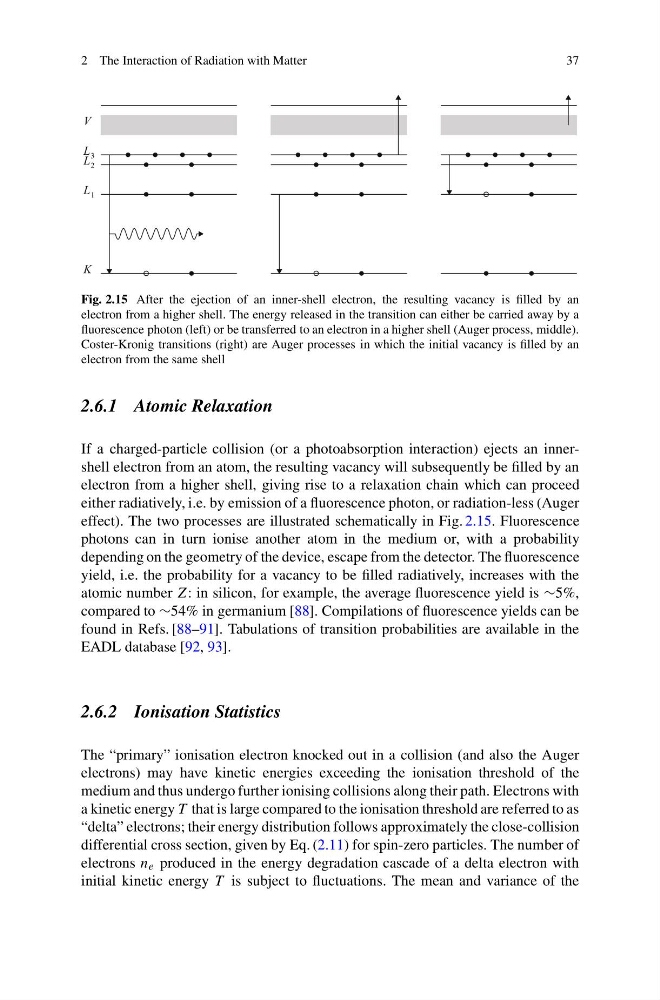
Fig. 2.15 After the ejection of an inner-shell electron, the resulting vacancy is filled by an
electron from a higher shell. The energy released in the transition can either be carried away by a
fluorescence photon (left) or be transferred to an electron in a higher shell (Auger process, middle).
Coster-Kronig transitions (right) are Auger processes in which the initial vacancy is filled by an
electron from the same shell
2.6.1 Atomic Relaxation
If a charged-particle collision (or a photoabsorption interaction) ejects an innershell electron from an atom, the resulting vacancy will subsequently be filled by an
electron from a higher shell, giving rise to a relaxation chain which can proceed
either radiatively, i.e. by emission of a fluorescence photon, or radiation-less (Auger
effect). The two processes are illustrated schematically in Fig. 2.15. Fluorescence
photons can in turn ionise another atom in the medium or, with a probability
depending on the geometry of the device, escape from the detector. The fluorescence
yield, i.e. the probability for a vacancy to be filled radiatively, increases with the
atomic number Z: in silicon, for example, the average fluorescence yield is ∼5%,
compared to ∼54% in germanium [88]. Compilations of fluorescence yields can be
found in Refs. [88–91]. Tabulations of transition probabilities are available in the
EADL database [92, 93].
2.6.2 Ionisation Statistics
The “primary” ionisation electron knocked out in a collision (and also the Auger
electrons) may have kinetic energies exceeding the ionisation threshold of the
medium and thus undergo further ionising collisions along their path. Electrons with
a kinetic energy T that is large compared to the ionisation threshold are referred to as
“delta” electrons; their energy distribution follows approximately the close-collision
differential cross section, given by Eq. (2.11) for spin-zero particles. The number of
electrons n e produced in the energy degradation cascade of a delta electron with
initial kinetic energy T is subject to fluctuations. The mean and variance of the
37
K
1
L
2
L
3
L
V
Fig. 2.15 After the ejection of an inner-shell electron, the resulting vacancy is filled by an
electron from a higher shell. The energy released in the transition can either be carried away by a
fluorescence photon (left) or be transferred to an electron in a higher shell (Auger process, middle).
Coster-Kronig transitions (right) are Auger processes in which the initial vacancy is filled by an
electron from the same shell
2.6.1 Atomic Relaxation
If a charged-particle collision (or a photoabsorption interaction) ejects an innershell electron from an atom, the resulting vacancy will subsequently be filled by an
electron from a higher shell, giving rise to a relaxation chain which can proceed
either radiatively, i.e. by emission of a fluorescence photon, or radiation-less (Auger
effect). The two processes are illustrated schematically in Fig. 2.15. Fluorescence
photons can in turn ionise another atom in the medium or, with a probability
depending on the geometry of the device, escape from the detector. The fluorescence
yield, i.e. the probability for a vacancy to be filled radiatively, increases with the
atomic number Z: in silicon, for example, the average fluorescence yield is ∼5%,
compared to ∼54% in germanium [88]. Compilations of fluorescence yields can be
found in Refs. [88–91]. Tabulations of transition probabilities are available in the
EADL database [92, 93].
2.6.2 Ionisation Statistics
The “primary” ionisation electron knocked out in a collision (and also the Auger
electrons) may have kinetic energies exceeding the ionisation threshold of the
medium and thus undergo further ionising collisions along their path. Electrons with
a kinetic energy T that is large compared to the ionisation threshold are referred to as
“delta” electrons; their energy distribution follows approximately the close-collision
differential cross section, given by Eq. (2.11) for spin-zero particles. The number of
electrons n e produced in the energy degradation cascade of a delta electron with
initial kinetic energy T is subject to fluctuations. The mean and variance of the