

450
V. Radeka
1/|f | noise is one of the fractal processes, and its waveform preserves the
same features independently of the time scale [16]. Another expression of this is
independence of the measurement variance on the time scale of the measurement
as long as the ratio of the high frequency and the low frequency cutoffs remains
constant. As the bandpass moves along the frequency spectrum the spectral density
integral (i.e., the measurement variance),
σ
2
∝
f h
f l
df
f
= ln
f h
f l
(10.4)
remains constant for f h /f l = const. In detector pulse processing it is well known
that the contribution of 1/|f| noise to the equivalent noise charge (ENC) remains
independent of the shaping time, as will be shown in the following Sect. 10.4.2.
Physical mechanisms of 1/f noise are discussed in Ref. [21].
10.4 Noise in Charge Measurements
10.4.1 Sources of Noise in Charge Amplifiers
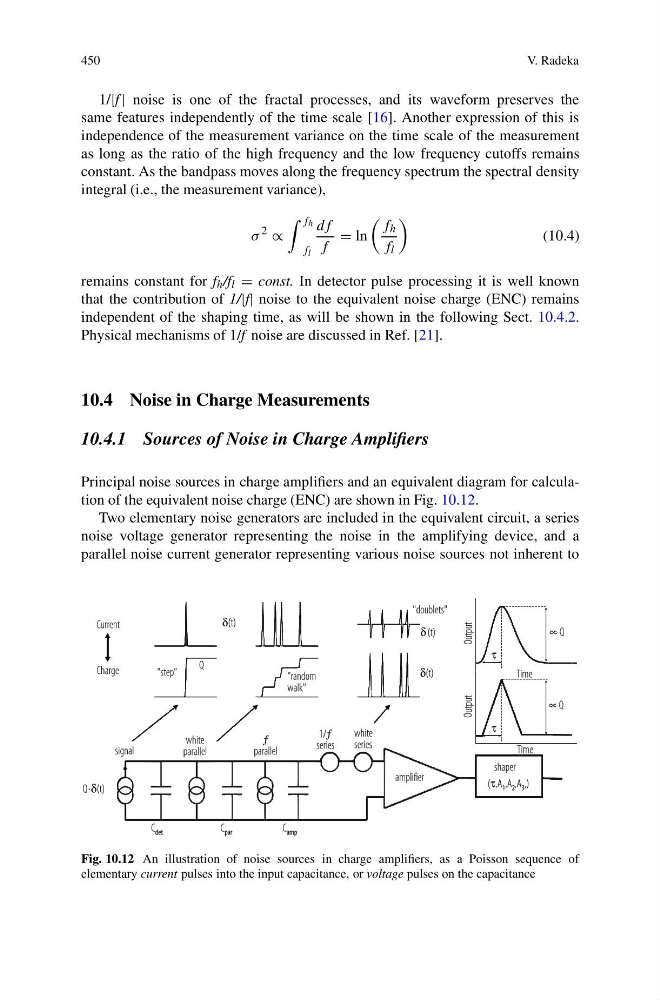
Principal noise sources in charge amplifiers and an equivalent diagram for calculation of the equivalent noise charge (ENC) are shown in Fig. 10.12.
Two elementary noise generators are included in the equivalent circuit, a series
noise voltage generator representing the noise in the amplifying device, and a
parallel noise current generator representing various noise sources not inherent to
Fig. 10.12 An illustration of noise sources in charge amplifiers, as a Poisson sequence of
elementary current pulses into the input capacitance, or voltage pulses on the capacitance
V. Radeka
1/|f | noise is one of the fractal processes, and its waveform preserves the
same features independently of the time scale [16]. Another expression of this is
independence of the measurement variance on the time scale of the measurement
as long as the ratio of the high frequency and the low frequency cutoffs remains
constant. As the bandpass moves along the frequency spectrum the spectral density
integral (i.e., the measurement variance),
σ
2
∝
f h
f l
df
f
= ln
f h
f l
(10.4)
remains constant for f h /f l = const. In detector pulse processing it is well known
that the contribution of 1/|f| noise to the equivalent noise charge (ENC) remains
independent of the shaping time, as will be shown in the following Sect. 10.4.2.
Physical mechanisms of 1/f noise are discussed in Ref. [21].
10.4 Noise in Charge Measurements
10.4.1 Sources of Noise in Charge Amplifiers
Principal noise sources in charge amplifiers and an equivalent diagram for calculation of the equivalent noise charge (ENC) are shown in Fig. 10.12.
Two elementary noise generators are included in the equivalent circuit, a series
noise voltage generator representing the noise in the amplifying device, and a
parallel noise current generator representing various noise sources not inherent to
Fig. 10.12 An illustration of noise sources in charge amplifiers, as a Poisson sequence of
elementary current pulses into the input capacitance, or voltage pulses on the capacitance