

10 Signal Processing for Particle Detectors
449
10.3.3 Random Telegraph Noise and 1/f Noise
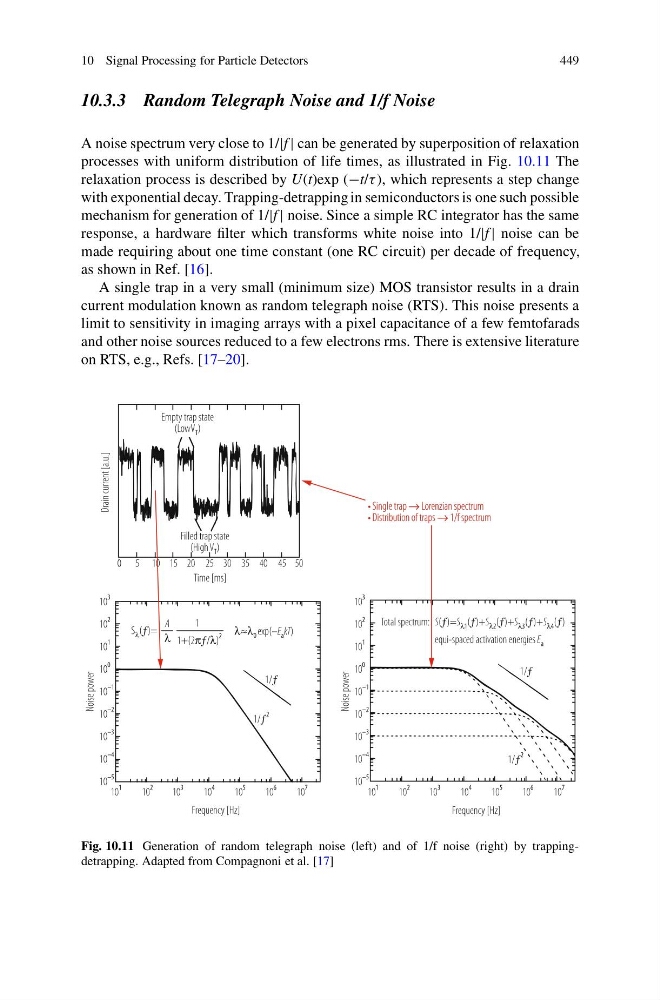
A noise spectrum very close to 1/|f | can be generated by superposition of relaxation
processes with uniform distribution of life times, as illustrated in Fig. 10.11 The
relaxation process is described by U(t)exp (−t/τ ), which represents a step change
with exponential decay. Trapping-detrapping in semiconductors is one such possible
mechanism for generation of 1/|f | noise. Since a simple RC integrator has the same
response, a hardware filter which transforms white noise into 1/|f | noise can be
made requiring about one time constant (one RC circuit) per decade of frequency,
as shown in Ref. [16].
A single trap in a very small (minimum size) MOS transistor results in a drain
current modulation known as random telegraph noise (RTS). This noise presents a
limit to sensitivity in imaging arrays with a pixel capacitance of a few femtofarads
and other noise sources reduced to a few electrons rms. There is extensive literature
on RTS, e.g., Refs. [17–20].
Fig. 10.11 Generation of random telegraph noise (left) and of 1/f noise (right) by trappingdetrapping. Adapted from Compagnoni et al. [17]
449
10.3.3 Random Telegraph Noise and 1/f Noise
A noise spectrum very close to 1/|f | can be generated by superposition of relaxation
processes with uniform distribution of life times, as illustrated in Fig. 10.11 The
relaxation process is described by U(t)exp (−t/τ ), which represents a step change
with exponential decay. Trapping-detrapping in semiconductors is one such possible
mechanism for generation of 1/|f | noise. Since a simple RC integrator has the same
response, a hardware filter which transforms white noise into 1/|f | noise can be
made requiring about one time constant (one RC circuit) per decade of frequency,
as shown in Ref. [16].
A single trap in a very small (minimum size) MOS transistor results in a drain
current modulation known as random telegraph noise (RTS). This noise presents a
limit to sensitivity in imaging arrays with a pixel capacitance of a few femtofarads
and other noise sources reduced to a few electrons rms. There is extensive literature
on RTS, e.g., Refs. [17–20].
Fig. 10.11 Generation of random telegraph noise (left) and of 1/f noise (right) by trappingdetrapping. Adapted from Compagnoni et al. [17]