

448
V. Radeka
10.3.2 A Model for Generation of Noise Spectra
Almost any noise spectrum can be generated from a random sequence of impulses
(i.e., white noise with “infinite bandwidth”) by using an appropriate filter, as
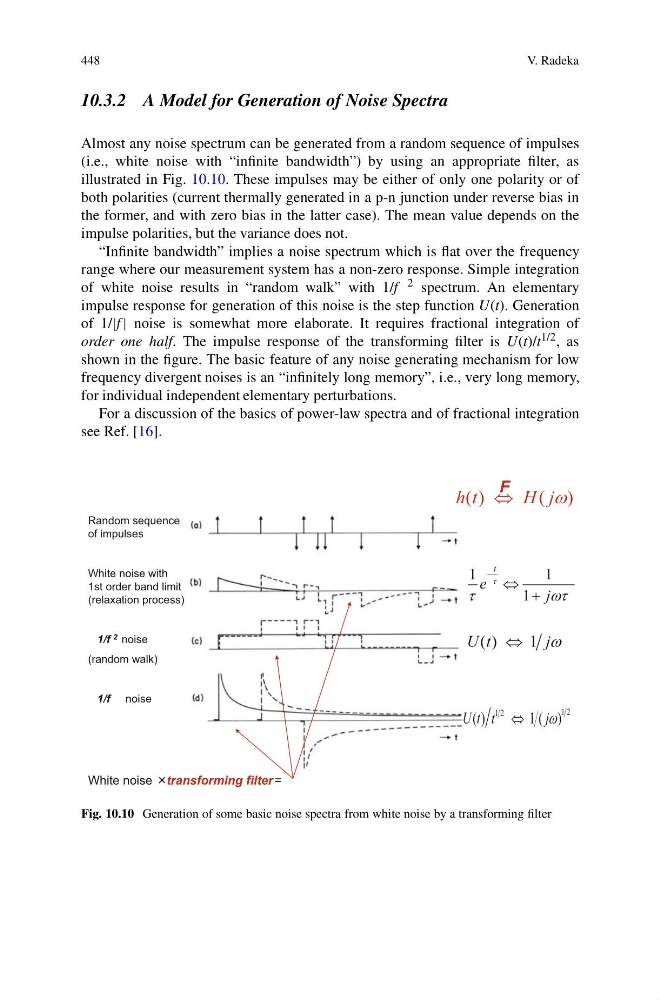
illustrated in Fig. 10.10. These impulses may be either of only one polarity or of
both polarities (current thermally generated in a p-n junction under reverse bias in
the former, and with zero bias in the latter case). The mean value depends on the
impulse polarities, but the variance does not.
“Infinite bandwidth” implies a noise spectrum which is flat over the frequency
range where our measurement system has a non-zero response. Simple integration
of white noise results in “random walk” with 1/f 2 spectrum. An elementary
impulse response for generation of this noise is the step function U(t). Generation
of 1/|f | noise is somewhat more elaborate. It requires fractional integration of
order one half. The impulse response of the transforming filter is U(t)/t 1/2 , as
shown in the figure. The basic feature of any noise generating mechanism for low
frequency divergent noises is an “infinitely long memory”, i.e., very long memory,
for individual independent elementary perturbations.
For a discussion of the basics of power-law spectra and of fractional integration
see Ref. [16].
1
1
1
t
e
j
τ
τ
ω τ
− ⇔ +
( )
1
U t
jω
⇔
1 2
1 2
( )
1 ( )
U t t
jω
⇔
Random sequence
of impulses
White noise with
1st order band limit
(relaxation process)
1/f 2 noise
(random walk)
1/f noise
( )
( )
h t
H jω
⇔
F
White noise 㽢transforming filter =
Fig. 10.10 Generation of some basic noise spectra from white noise by a transforming filter
V. Radeka
10.3.2 A Model for Generation of Noise Spectra
Almost any noise spectrum can be generated from a random sequence of impulses
(i.e., white noise with “infinite bandwidth”) by using an appropriate filter, as
illustrated in Fig. 10.10. These impulses may be either of only one polarity or of
both polarities (current thermally generated in a p-n junction under reverse bias in
the former, and with zero bias in the latter case). The mean value depends on the
impulse polarities, but the variance does not.
“Infinite bandwidth” implies a noise spectrum which is flat over the frequency
range where our measurement system has a non-zero response. Simple integration
of white noise results in “random walk” with 1/f 2 spectrum. An elementary
impulse response for generation of this noise is the step function U(t). Generation
of 1/|f | noise is somewhat more elaborate. It requires fractional integration of
order one half. The impulse response of the transforming filter is U(t)/t 1/2 , as
shown in the figure. The basic feature of any noise generating mechanism for low
frequency divergent noises is an “infinitely long memory”, i.e., very long memory,
for individual independent elementary perturbations.
For a discussion of the basics of power-law spectra and of fractional integration
see Ref. [16].
1
1
1
t
e
j
τ
τ
ω τ
− ⇔ +
( )
1
U t
jω
⇔
1 2
1 2
( )
1 ( )
U t t
jω
⇔
Random sequence
of impulses
White noise with
1st order band limit
(relaxation process)
1/f 2 noise
(random walk)
1/f noise
( )
( )
h t
H jω
⇔
F
White noise 㽢transforming filter =
Fig. 10.10 Generation of some basic noise spectra from white noise by a transforming filter