

10 Signal Processing for Particle Detectors
451
amplification (detector leakage current noise, parallel resistor noise, etc.). Both
types of noise are assumed to have a white spectrum. Two forms of presentation in
terms of a sequence of random pulses are shown, as charge (or voltage) at the input
of the amplifier, and as a current injected into the input capacitance (comprised of
the detector + amplifier parasitic capacitances). The presentation of the series noise
in terms of a current into the detector input is the derivative of the charge (voltage)
representation. The sequence of voltage impulses representing the amplifier series
noise thus corresponds to an equivalent sequence of current doublets (derivatives of
delta function) injected at the detector. The parallel noise is by its origin a current
source in parallel with the detector, and it is presented by a sequence of impulses
(delta functions). It is this difference in the location of the two white noise sources
with respect to the detector capacitance that makes their apparent noise spectra and
their effect on the measurement quite different. ENC due to the former is inversely
proportional to the square root of the peaking time, and proportional to it due to the
latter. The series 1/|f | noise contribution to ENC is independent of the peaking time,
as indicated in Fig. 10.14. The 1/|f | noise due to a dissipative dielectric depends
on the dielectric loss factor tan(δ), as will be discussed in Sect. 10.4.7. It can be
significant with detector-amplifier connections on glass fibre circuit boards.
10.4.2 Equivalent Noise Charge (ENC) Calculations
Calculation of equivalent noise charge (ENC) for a signal processing chain
described by a weighting function w(t) is summarized in the following.
The noise calculation is performed in the time domain by using Campbell’s
theorem Eq. (10.3), that is by superposition of effects of all random current impulses
illustrated in Fig. 10.12. The weighting function is normalized to unity so that
the definition of ENC is the noise charge which produces an output of the same
magnitude as an impulse signal of equal charge. For calculation of ENC due to the
series voltage noise, we will use the representation in terms of an equivalent current
generator connected in parallel with the detector. This requires differentiation of
the sequence of voltage impulses. Each resulting doublet C in δ (t) acting upon the
weighting function w(t) produces by convolution C in w (t). The equivalent noise
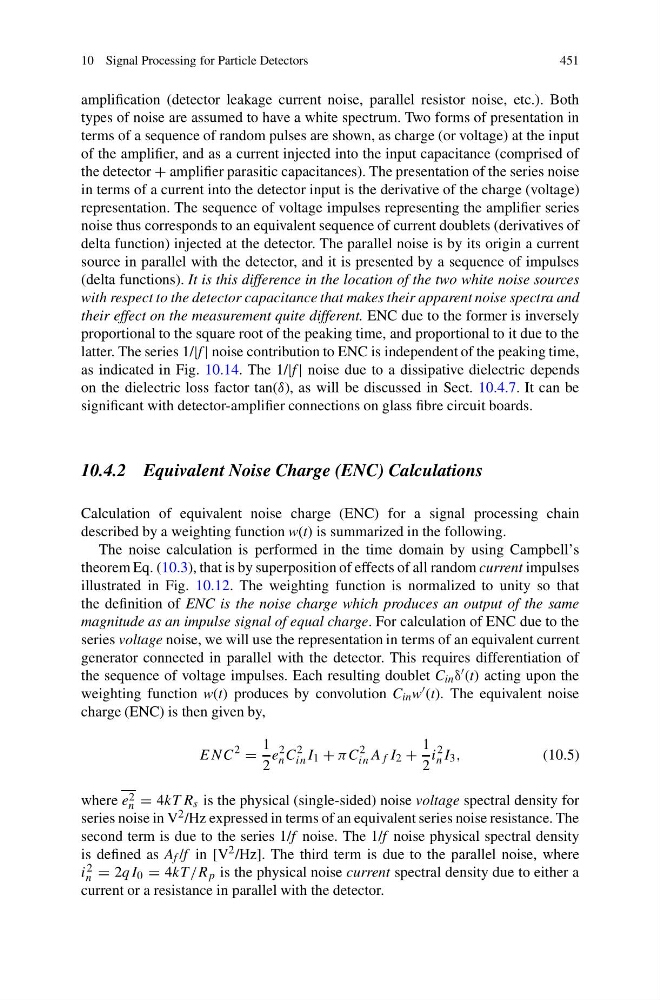
charge (ENC) is then given by,
ENC
2
=
1
2
e
2
n C
2
in I 1 + πC
2
in A f I 2 +
1
2
i
2
n I 3 ,
(10.5)
where e 2
n = 4kT R s is the physical (single-sided) noise voltage spectral density for
series noise in V 2 /Hz expressed in terms of an equivalent series noise resistance. The
second term is due to the series 1/f noise. The 1/f noise physical spectral density
is defined as A f /f in [V 2 /Hz]. The third term is due to the parallel noise, where
i 2
n = 2qI 0 = 4kT /R p is the physical noise current spectral density due to either a
current or a resistance in parallel with the detector.
451
amplification (detector leakage current noise, parallel resistor noise, etc.). Both
types of noise are assumed to have a white spectrum. Two forms of presentation in
terms of a sequence of random pulses are shown, as charge (or voltage) at the input
of the amplifier, and as a current injected into the input capacitance (comprised of
the detector + amplifier parasitic capacitances). The presentation of the series noise
in terms of a current into the detector input is the derivative of the charge (voltage)
representation. The sequence of voltage impulses representing the amplifier series
noise thus corresponds to an equivalent sequence of current doublets (derivatives of
delta function) injected at the detector. The parallel noise is by its origin a current
source in parallel with the detector, and it is presented by a sequence of impulses
(delta functions). It is this difference in the location of the two white noise sources
with respect to the detector capacitance that makes their apparent noise spectra and
their effect on the measurement quite different. ENC due to the former is inversely
proportional to the square root of the peaking time, and proportional to it due to the
latter. The series 1/|f | noise contribution to ENC is independent of the peaking time,
as indicated in Fig. 10.14. The 1/|f | noise due to a dissipative dielectric depends
on the dielectric loss factor tan(δ), as will be discussed in Sect. 10.4.7. It can be
significant with detector-amplifier connections on glass fibre circuit boards.
10.4.2 Equivalent Noise Charge (ENC) Calculations
Calculation of equivalent noise charge (ENC) for a signal processing chain
described by a weighting function w(t) is summarized in the following.
The noise calculation is performed in the time domain by using Campbell’s
theorem Eq. (10.3), that is by superposition of effects of all random current impulses
illustrated in Fig. 10.12. The weighting function is normalized to unity so that
the definition of ENC is the noise charge which produces an output of the same
magnitude as an impulse signal of equal charge. For calculation of ENC due to the
series voltage noise, we will use the representation in terms of an equivalent current
generator connected in parallel with the detector. This requires differentiation of
the sequence of voltage impulses. Each resulting doublet C in δ (t) acting upon the
weighting function w(t) produces by convolution C in w (t). The equivalent noise
charge (ENC) is then given by,
ENC
2
=
1
2
e
2
n C
2
in I 1 + πC
2
in A f I 2 +
1
2
i
2
n I 3 ,
(10.5)
where e 2
n = 4kT R s is the physical (single-sided) noise voltage spectral density for
series noise in V 2 /Hz expressed in terms of an equivalent series noise resistance. The
second term is due to the series 1/f noise. The 1/f noise physical spectral density
is defined as A f /f in [V 2 /Hz]. The third term is due to the parallel noise, where
i 2
n = 2qI 0 = 4kT /R p is the physical noise current spectral density due to either a
current or a resistance in parallel with the detector.