

424
A. Ariga et al.
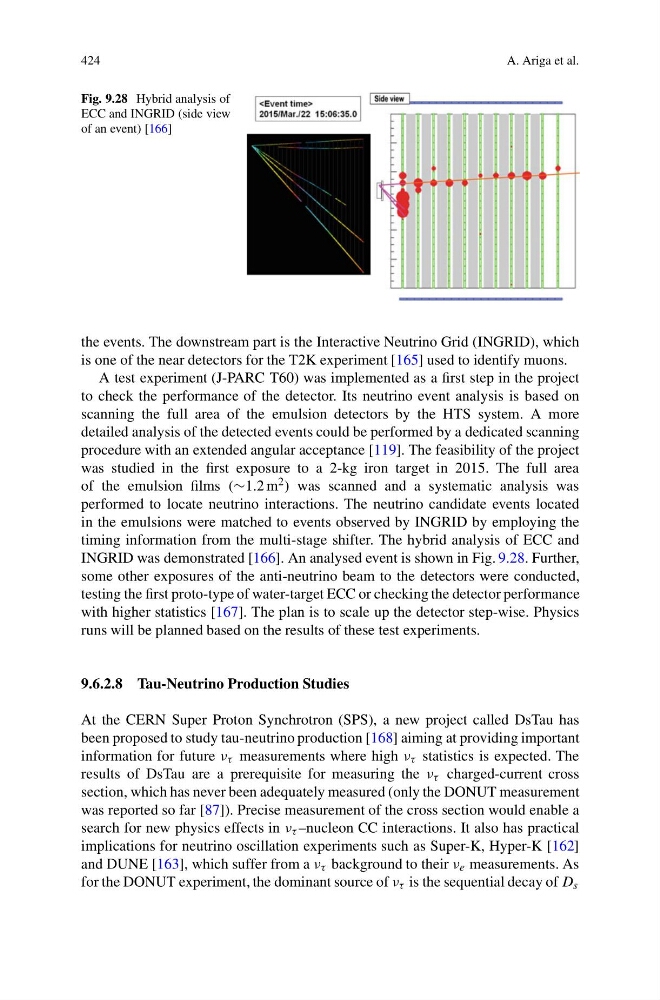
Fig. 9.28 Hybrid analysis of
ECC and INGRID (side view
of an event) [166]
the events. The downstream part is the Interactive Neutrino Grid (INGRID), which
is one of the near detectors for the T2K experiment [165] used to identify muons.
A test experiment (J-PARC T60) was implemented as a first step in the project
to check the performance of the detector. Its neutrino event analysis is based on
scanning the full area of the emulsion detectors by the HTS system. A more
detailed analysis of the detected events could be performed by a dedicated scanning
procedure with an extended angular acceptance [119]. The feasibility of the project
was studied in the first exposure to a 2-kg iron target in 2015. The full area
of the emulsion films (∼1.2 m 2 ) was scanned and a systematic analysis was
performed to locate neutrino interactions. The neutrino candidate events located
in the emulsions were matched to events observed by INGRID by employing the
timing information from the multi-stage shifter. The hybrid analysis of ECC and
INGRID was demonstrated [166]. An analysed event is shown in Fig. 9.28. Further,
some other exposures of the anti-neutrino beam to the detectors were conducted,
testing the first proto-type of water-target ECC or checking the detector performance
with higher statistics [167]. The plan is to scale up the detector step-wise. Physics
runs will be planned based on the results of these test experiments.
9.6.2.8 Tau-Neutrino Production Studies
At the CERN Super Proton Synchrotron (SPS), a new project called DsTau has
been proposed to study tau-neutrino production [168] aiming at providing important
information for future ν τ measurements where high ν τ statistics is expected. The
results of DsTau are a prerequisite for measuring the ν τ charged-current cross
section, which has never been adequately measured (only the DONUT measurement
was reported so far [87]). Precise measurement of the cross section would enable a
search for new physics effects in ν τ –nucleon CC interactions. It also has practical
implications for neutrino oscillation experiments such as Super-K, Hyper-K [162]
and DUNE [163], which suffer from a ν τ background to their ν e measurements. As
for the DONUT experiment, the dominant source of ν τ is the sequential decay of D s
A. Ariga et al.
Fig. 9.28 Hybrid analysis of
ECC and INGRID (side view
of an event) [166]
the events. The downstream part is the Interactive Neutrino Grid (INGRID), which
is one of the near detectors for the T2K experiment [165] used to identify muons.
A test experiment (J-PARC T60) was implemented as a first step in the project
to check the performance of the detector. Its neutrino event analysis is based on
scanning the full area of the emulsion detectors by the HTS system. A more
detailed analysis of the detected events could be performed by a dedicated scanning
procedure with an extended angular acceptance [119]. The feasibility of the project
was studied in the first exposure to a 2-kg iron target in 2015. The full area
of the emulsion films (∼1.2 m 2 ) was scanned and a systematic analysis was
performed to locate neutrino interactions. The neutrino candidate events located
in the emulsions were matched to events observed by INGRID by employing the
timing information from the multi-stage shifter. The hybrid analysis of ECC and
INGRID was demonstrated [166]. An analysed event is shown in Fig. 9.28. Further,
some other exposures of the anti-neutrino beam to the detectors were conducted,
testing the first proto-type of water-target ECC or checking the detector performance
with higher statistics [167]. The plan is to scale up the detector step-wise. Physics
runs will be planned based on the results of these test experiments.
9.6.2.8 Tau-Neutrino Production Studies
At the CERN Super Proton Synchrotron (SPS), a new project called DsTau has
been proposed to study tau-neutrino production [168] aiming at providing important
information for future ν τ measurements where high ν τ statistics is expected. The
results of DsTau are a prerequisite for measuring the ν τ charged-current cross
section, which has never been adequately measured (only the DONUT measurement
was reported so far [87]). Precise measurement of the cross section would enable a
search for new physics effects in ν τ –nucleon CC interactions. It also has practical
implications for neutrino oscillation experiments such as Super-K, Hyper-K [162]
and DUNE [163], which suffer from a ν τ background to their ν e measurements. As
for the DONUT experiment, the dominant source of ν τ is the sequential decay of D s