

9 Nuclear Emulsions
425
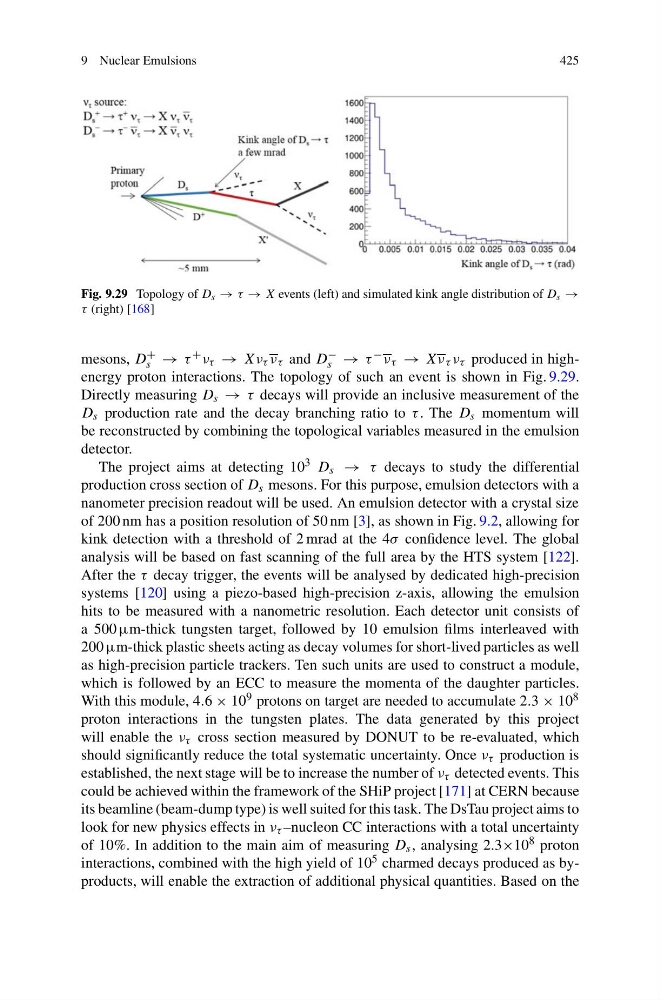
Fig. 9.29 Topology of D s → τ → X events (left) and simulated kink angle distribution of D s →
τ (right) [168]
mesons, D +
s → τ + ν τ → Xν τ ν τ and D −
s → τ − ν τ → Xν τ ν τ produced in highenergy proton interactions. The topology of such an event is shown in Fig. 9.29.
Directly measuring D s → τ decays will provide an inclusive measurement of the
D s production rate and the decay branching ratio to τ . The D s momentum will
be reconstructed by combining the topological variables measured in the emulsion
detector.
The project aims at detecting 10 3 D s → τ decays to study the differential
production cross section of D s mesons. For this purpose, emulsion detectors with a
nanometer precision readout will be used. An emulsion detector with a crystal size
of 200 nm has a position resolution of 50 nm [3], as shown in Fig. 9.2, allowing for
kink detection with a threshold of 2 mrad at the 4σ confidence level. The global
analysis will be based on fast scanning of the full area by the HTS system [122].
After the τ decay trigger, the events will be analysed by dedicated high-precision
systems [120] using a piezo-based high-precision z-axis, allowing the emulsion
hits to be measured with a nanometric resolution. Each detector unit consists of
a 500 μm-thick tungsten target, followed by 10 emulsion films interleaved with
200 μm-thick plastic sheets acting as decay volumes for short-lived particles as well
as high-precision particle trackers. Ten such units are used to construct a module,
which is followed by an ECC to measure the momenta of the daughter particles.
With this module, 4.6 × 10 9 protons on target are needed to accumulate 2.3 × 10 8
proton interactions in the tungsten plates. The data generated by this project
will enable the ν τ cross section measured by DONUT to be re-evaluated, which
should significantly reduce the total systematic uncertainty. Once ν τ production is
established, the next stage will be to increase the number of ν τ detected events. This
could be achieved within the framework of the SHiP project [171] at CERN because
its beamline (beam-dump type) is well suited for this task. The DsTau project aims to
look for new physics effects in ν τ –nucleon CC interactions with a total uncertainty
of 10%. In addition to the main aim of measuring D s , analysing 2.3×10 8 proton
interactions, combined with the high yield of 10 5 charmed decays produced as byproducts, will enable the extraction of additional physical quantities. Based on the
425
Fig. 9.29 Topology of D s → τ → X events (left) and simulated kink angle distribution of D s →
τ (right) [168]
mesons, D +
s → τ + ν τ → Xν τ ν τ and D −
s → τ − ν τ → Xν τ ν τ produced in highenergy proton interactions. The topology of such an event is shown in Fig. 9.29.
Directly measuring D s → τ decays will provide an inclusive measurement of the
D s production rate and the decay branching ratio to τ . The D s momentum will
be reconstructed by combining the topological variables measured in the emulsion
detector.
The project aims at detecting 10 3 D s → τ decays to study the differential
production cross section of D s mesons. For this purpose, emulsion detectors with a
nanometer precision readout will be used. An emulsion detector with a crystal size
of 200 nm has a position resolution of 50 nm [3], as shown in Fig. 9.2, allowing for
kink detection with a threshold of 2 mrad at the 4σ confidence level. The global
analysis will be based on fast scanning of the full area by the HTS system [122].
After the τ decay trigger, the events will be analysed by dedicated high-precision
systems [120] using a piezo-based high-precision z-axis, allowing the emulsion
hits to be measured with a nanometric resolution. Each detector unit consists of
a 500 μm-thick tungsten target, followed by 10 emulsion films interleaved with
200 μm-thick plastic sheets acting as decay volumes for short-lived particles as well
as high-precision particle trackers. Ten such units are used to construct a module,
which is followed by an ECC to measure the momenta of the daughter particles.
With this module, 4.6 × 10 9 protons on target are needed to accumulate 2.3 × 10 8
proton interactions in the tungsten plates. The data generated by this project
will enable the ν τ cross section measured by DONUT to be re-evaluated, which
should significantly reduce the total systematic uncertainty. Once ν τ production is
established, the next stage will be to increase the number of ν τ detected events. This
could be achieved within the framework of the SHiP project [171] at CERN because
its beamline (beam-dump type) is well suited for this task. The DsTau project aims to
look for new physics effects in ν τ –nucleon CC interactions with a total uncertainty
of 10%. In addition to the main aim of measuring D s , analysing 2.3×10 8 proton
interactions, combined with the high yield of 10 5 charmed decays produced as byproducts, will enable the extraction of additional physical quantities. Based on the