

9 Nuclear Emulsions
423
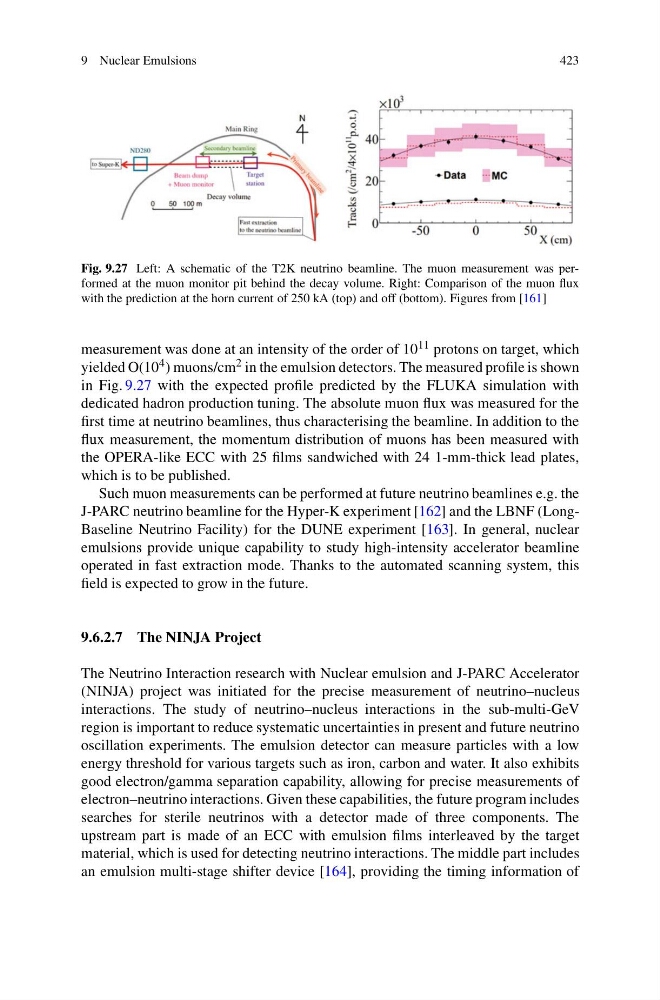
Fig. 9.27 Left: A schematic of the T2K neutrino beamline. The muon measurement was performed at the muon monitor pit behind the decay volume. Right: Comparison of the muon flux
with the prediction at the horn current of 250 kA (top) and off (bottom). Figures from [161]
measurement was done at an intensity of the order of 10 11 protons on target, which
yielded O(10 4 ) muons/cm 2 in the emulsion detectors. The measured profile is shown
in Fig. 9.27 with the expected profile predicted by the FLUKA simulation with
dedicated hadron production tuning. The absolute muon flux was measured for the
first time at neutrino beamlines, thus characterising the beamline. In addition to the
flux measurement, the momentum distribution of muons has been measured with
the OPERA-like ECC with 25 films sandwiched with 24 1-mm-thick lead plates,
which is to be published.
Such muon measurements can be performed at future neutrino beamlines e.g. the
J-PARC neutrino beamline for the Hyper-K experiment [162] and the LBNF (LongBaseline Neutrino Facility) for the DUNE experiment [163]. In general, nuclear
emulsions provide unique capability to study high-intensity accelerator beamline
operated in fast extraction mode. Thanks to the automated scanning system, this
field is expected to grow in the future.
9.6.2.7 The NINJA Project
The Neutrino Interaction research with Nuclear emulsion and J-PARC Accelerator
(NINJA) project was initiated for the precise measurement of neutrino–nucleus
interactions. The study of neutrino–nucleus interactions in the sub-multi-GeV
region is important to reduce systematic uncertainties in present and future neutrino
oscillation experiments. The emulsion detector can measure particles with a low
energy threshold for various targets such as iron, carbon and water. It also exhibits
good electron/gamma separation capability, allowing for precise measurements of
electron–neutrino interactions. Given these capabilities, the future program includes
searches for sterile neutrinos with a detector made of three components. The
upstream part is made of an ECC with emulsion films interleaved by the target
material, which is used for detecting neutrino interactions. The middle part includes
an emulsion multi-stage shifter device [164], providing the timing information of
423
Fig. 9.27 Left: A schematic of the T2K neutrino beamline. The muon measurement was performed at the muon monitor pit behind the decay volume. Right: Comparison of the muon flux
with the prediction at the horn current of 250 kA (top) and off (bottom). Figures from [161]
measurement was done at an intensity of the order of 10 11 protons on target, which
yielded O(10 4 ) muons/cm 2 in the emulsion detectors. The measured profile is shown
in Fig. 9.27 with the expected profile predicted by the FLUKA simulation with
dedicated hadron production tuning. The absolute muon flux was measured for the
first time at neutrino beamlines, thus characterising the beamline. In addition to the
flux measurement, the momentum distribution of muons has been measured with
the OPERA-like ECC with 25 films sandwiched with 24 1-mm-thick lead plates,
which is to be published.
Such muon measurements can be performed at future neutrino beamlines e.g. the
J-PARC neutrino beamline for the Hyper-K experiment [162] and the LBNF (LongBaseline Neutrino Facility) for the DUNE experiment [163]. In general, nuclear
emulsions provide unique capability to study high-intensity accelerator beamline
operated in fast extraction mode. Thanks to the automated scanning system, this
field is expected to grow in the future.
9.6.2.7 The NINJA Project
The Neutrino Interaction research with Nuclear emulsion and J-PARC Accelerator
(NINJA) project was initiated for the precise measurement of neutrino–nucleus
interactions. The study of neutrino–nucleus interactions in the sub-multi-GeV
region is important to reduce systematic uncertainties in present and future neutrino
oscillation experiments. The emulsion detector can measure particles with a low
energy threshold for various targets such as iron, carbon and water. It also exhibits
good electron/gamma separation capability, allowing for precise measurements of
electron–neutrino interactions. Given these capabilities, the future program includes
searches for sterile neutrinos with a detector made of three components. The
upstream part is made of an ECC with emulsion films interleaved by the target
material, which is used for detecting neutrino interactions. The middle part includes
an emulsion multi-stage shifter device [164], providing the timing information of