

422
A. Ariga et al.
Atomic number
0
10
20
30
40
50
60
70
80
90 100
Average multiplicity
0
0.5
1
1.5
2
2.5
3
3.5
FTFP
CHIPS
FLUKA
Data
Minimum ionizing
Atomic number
0
10
20
30
40
50
60
70
80
90 100
Average multiplicity
0
0.5
1
1.5
2
2.5
3
3.5
FTFP
CHIPS
FLUKA
Data
Heavily ionizing
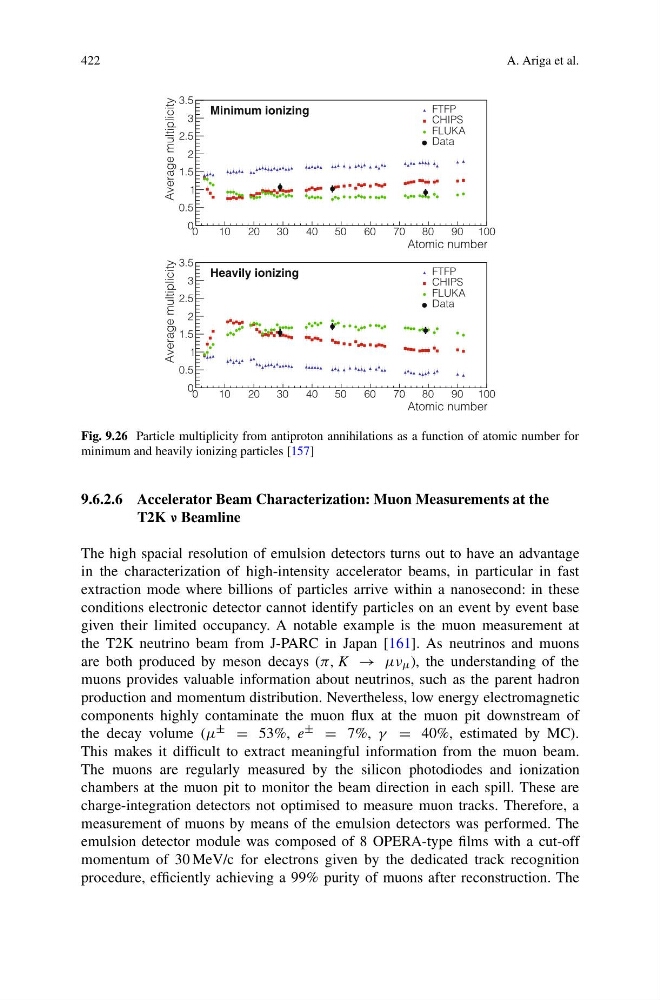
Fig. 9.26 Particle multiplicity from antiproton annihilations as a function of atomic number for
minimum and heavily ionizing particles [157]
9.6.2.6 Accelerator Beam Characterization: Muon Measurements at the
T2K ν Beamline
The high spacial resolution of emulsion detectors turns out to have an advantage
in the characterization of high-intensity accelerator beams, in particular in fast
extraction mode where billions of particles arrive within a nanosecond: in these
conditions electronic detector cannot identify particles on an event by event base
given their limited occupancy. A notable example is the muon measurement at
the T2K neutrino beam from J-PARC in Japan [161]. As neutrinos and muons
are both produced by meson decays (π, K → μν μ ), the understanding of the
muons provides valuable information about neutrinos, such as the parent hadron
production and momentum distribution. Nevertheless, low energy electromagnetic
components highly contaminate the muon flux at the muon pit downstream of
the decay volume (μ ± = 53%, e ± = 7%, γ = 40%, estimated by MC).
This makes it difficult to extract meaningful information from the muon beam.
The muons are regularly measured by the silicon photodiodes and ionization
chambers at the muon pit to monitor the beam direction in each spill. These are
charge-integration detectors not optimised to measure muon tracks. Therefore, a
measurement of muons by means of the emulsion detectors was performed. The
emulsion detector module was composed of 8 OPERA-type films with a cut-off
momentum of 30 MeV/c for electrons given by the dedicated track recognition
procedure, efficiently achieving a 99% purity of muons after reconstruction. The
A. Ariga et al.
Atomic number
0
10
20
30
40
50
60
70
80
90 100
Average multiplicity
0
0.5
1
1.5
2
2.5
3
3.5
FTFP
CHIPS
FLUKA
Data
Minimum ionizing
Atomic number
0
10
20
30
40
50
60
70
80
90 100
Average multiplicity
0
0.5
1
1.5
2
2.5
3
3.5
FTFP
CHIPS
FLUKA
Data
Heavily ionizing
Fig. 9.26 Particle multiplicity from antiproton annihilations as a function of atomic number for
minimum and heavily ionizing particles [157]
9.6.2.6 Accelerator Beam Characterization: Muon Measurements at the
T2K ν Beamline
The high spacial resolution of emulsion detectors turns out to have an advantage
in the characterization of high-intensity accelerator beams, in particular in fast
extraction mode where billions of particles arrive within a nanosecond: in these
conditions electronic detector cannot identify particles on an event by event base
given their limited occupancy. A notable example is the muon measurement at
the T2K neutrino beam from J-PARC in Japan [161]. As neutrinos and muons
are both produced by meson decays (π, K → μν μ ), the understanding of the
muons provides valuable information about neutrinos, such as the parent hadron
production and momentum distribution. Nevertheless, low energy electromagnetic
components highly contaminate the muon flux at the muon pit downstream of
the decay volume (μ ± = 53%, e ± = 7%, γ = 40%, estimated by MC).
This makes it difficult to extract meaningful information from the muon beam.
The muons are regularly measured by the silicon photodiodes and ionization
chambers at the muon pit to monitor the beam direction in each spill. These are
charge-integration detectors not optimised to measure muon tracks. Therefore, a
measurement of muons by means of the emulsion detectors was performed. The
emulsion detector module was composed of 8 OPERA-type films with a cut-off
momentum of 30 MeV/c for electrons given by the dedicated track recognition
procedure, efficiently achieving a 99% purity of muons after reconstruction. The