

9 Nuclear Emulsions
417
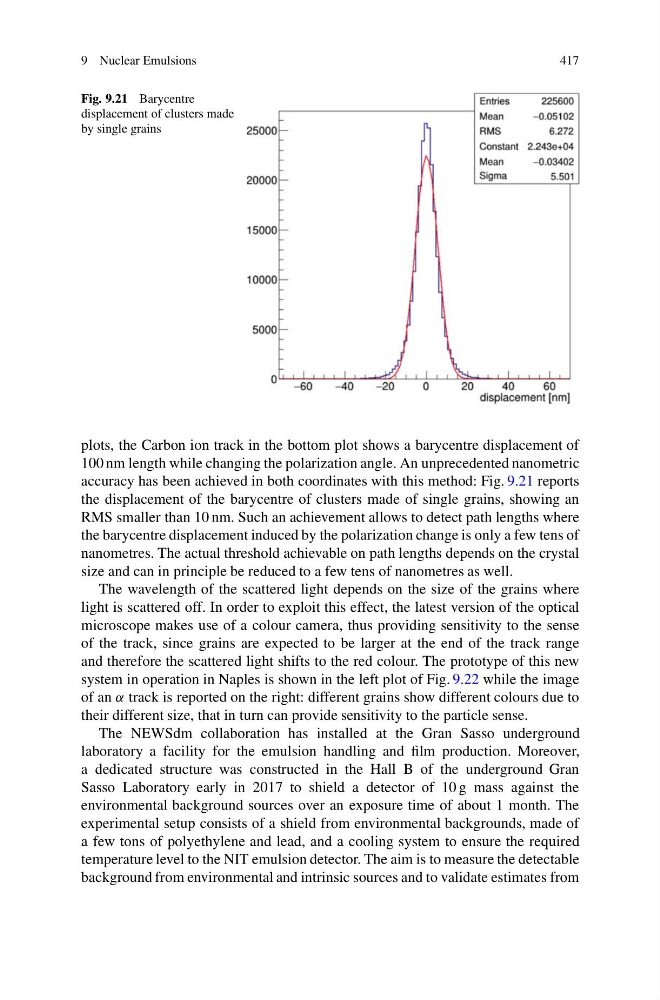
Fig. 9.21 Barycentre
displacement of clusters made
by single grains
plots, the Carbon ion track in the bottom plot shows a barycentre displacement of
100 nm length while changing the polarization angle. An unprecedented nanometric
accuracy has been achieved in both coordinates with this method: Fig. 9.21 reports
the displacement of the barycentre of clusters made of single grains, showing an
RMS smaller than 10 nm. Such an achievement allows to detect path lengths where
the barycentre displacement induced by the polarization change is only a few tens of
nanometres. The actual threshold achievable on path lengths depends on the crystal
size and can in principle be reduced to a few tens of nanometres as well.
The wavelength of the scattered light depends on the size of the grains where
light is scattered off. In order to exploit this effect, the latest version of the optical
microscope makes use of a colour camera, thus providing sensitivity to the sense
of the track, since grains are expected to be larger at the end of the track range
and therefore the scattered light shifts to the red colour. The prototype of this new
system in operation in Naples is shown in the left plot of Fig. 9.22 while the image
of an α track is reported on the right: different grains show different colours due to
their different size, that in turn can provide sensitivity to the particle sense.
The NEWSdm collaboration has installed at the Gran Sasso underground
laboratory a facility for the emulsion handling and film production. Moreover,
a dedicated structure was constructed in the Hall B of the underground Gran
Sasso Laboratory early in 2017 to shield a detector of 10 g mass against the
environmental background sources over an exposure time of about 1 month. The
experimental setup consists of a shield from environmental backgrounds, made of
a few tons of polyethylene and lead, and a cooling system to ensure the required
temperature level to the NIT emulsion detector. The aim is to measure the detectable
background from environmental and intrinsic sources and to validate estimates from
417
Fig. 9.21 Barycentre
displacement of clusters made
by single grains
plots, the Carbon ion track in the bottom plot shows a barycentre displacement of
100 nm length while changing the polarization angle. An unprecedented nanometric
accuracy has been achieved in both coordinates with this method: Fig. 9.21 reports
the displacement of the barycentre of clusters made of single grains, showing an
RMS smaller than 10 nm. Such an achievement allows to detect path lengths where
the barycentre displacement induced by the polarization change is only a few tens of
nanometres. The actual threshold achievable on path lengths depends on the crystal
size and can in principle be reduced to a few tens of nanometres as well.
The wavelength of the scattered light depends on the size of the grains where
light is scattered off. In order to exploit this effect, the latest version of the optical
microscope makes use of a colour camera, thus providing sensitivity to the sense
of the track, since grains are expected to be larger at the end of the track range
and therefore the scattered light shifts to the red colour. The prototype of this new
system in operation in Naples is shown in the left plot of Fig. 9.22 while the image
of an α track is reported on the right: different grains show different colours due to
their different size, that in turn can provide sensitivity to the particle sense.
The NEWSdm collaboration has installed at the Gran Sasso underground
laboratory a facility for the emulsion handling and film production. Moreover,
a dedicated structure was constructed in the Hall B of the underground Gran
Sasso Laboratory early in 2017 to shield a detector of 10 g mass against the
environmental background sources over an exposure time of about 1 month. The
experimental setup consists of a shield from environmental backgrounds, made of
a few tons of polyethylene and lead, and a cooling system to ensure the required
temperature level to the NIT emulsion detector. The aim is to measure the detectable
background from environmental and intrinsic sources and to validate estimates from