

416
A. Ariga et al.
spherical shape. The shape analysis with an elliptical fit is indeed the first approach
to select signal. In order to simulate the effect of a WIMP-induced nuclear recoil
and to measure the efficiency and the resolution of the new optical prototype, a test
beam with low velocity ions was performed. Kr ion beams with energies of 200
and 400 keV [143] and C ion beams with energies of 60, 80 and 100 keV were used.
Silver grains belonging to the tracks appear as a single cluster. An elliptical fit of the
cluster shape allows a clear separation between fog grains and signal tracks [144].
The second analysis step at the microscope makes use of the plasmon resonance effect occurring when nanometric silver grains are dispersed in a dielectric
medium [145]. The polarization dependence of the resonance frequencies strongly
reflects the shape anisotropy and can be used to infer the presence of non-spherical
nanometric silver grains within a cluster made of several grains. NEWSdm is using
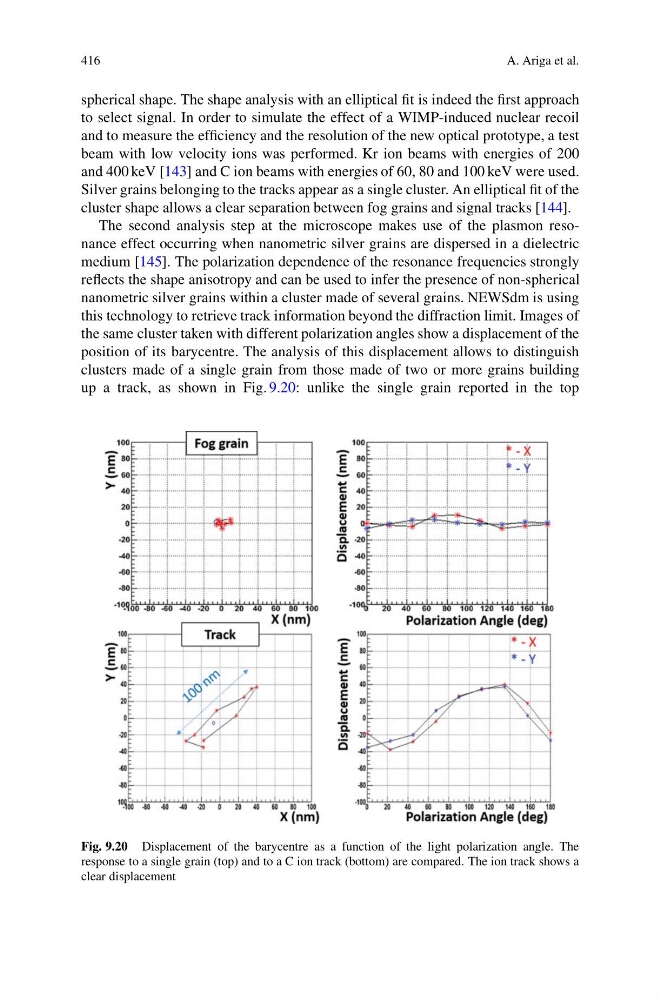
this technology to retrieve track information beyond the diffraction limit. Images of
the same cluster taken with different polarization angles show a displacement of the
position of its barycentre. The analysis of this displacement allows to distinguish
clusters made of a single grain from those made of two or more grains building
up a track, as shown in Fig. 9.20: unlike the single grain reported in the top
Fig. 9.20 Displacement of the barycentre as a function of the light polarization angle. The
response to a single grain (top) and to a C ion track (bottom) are compared. The ion track shows a
clear displacement
A. Ariga et al.
spherical shape. The shape analysis with an elliptical fit is indeed the first approach
to select signal. In order to simulate the effect of a WIMP-induced nuclear recoil
and to measure the efficiency and the resolution of the new optical prototype, a test
beam with low velocity ions was performed. Kr ion beams with energies of 200
and 400 keV [143] and C ion beams with energies of 60, 80 and 100 keV were used.
Silver grains belonging to the tracks appear as a single cluster. An elliptical fit of the
cluster shape allows a clear separation between fog grains and signal tracks [144].
The second analysis step at the microscope makes use of the plasmon resonance effect occurring when nanometric silver grains are dispersed in a dielectric
medium [145]. The polarization dependence of the resonance frequencies strongly
reflects the shape anisotropy and can be used to infer the presence of non-spherical
nanometric silver grains within a cluster made of several grains. NEWSdm is using
this technology to retrieve track information beyond the diffraction limit. Images of
the same cluster taken with different polarization angles show a displacement of the
position of its barycentre. The analysis of this displacement allows to distinguish
clusters made of a single grain from those made of two or more grains building
up a track, as shown in Fig. 9.20: unlike the single grain reported in the top
Fig. 9.20 Displacement of the barycentre as a function of the light polarization angle. The
response to a single grain (top) and to a C ion track (bottom) are compared. The ion track shows a
clear displacement