

9 Nuclear Emulsions
411
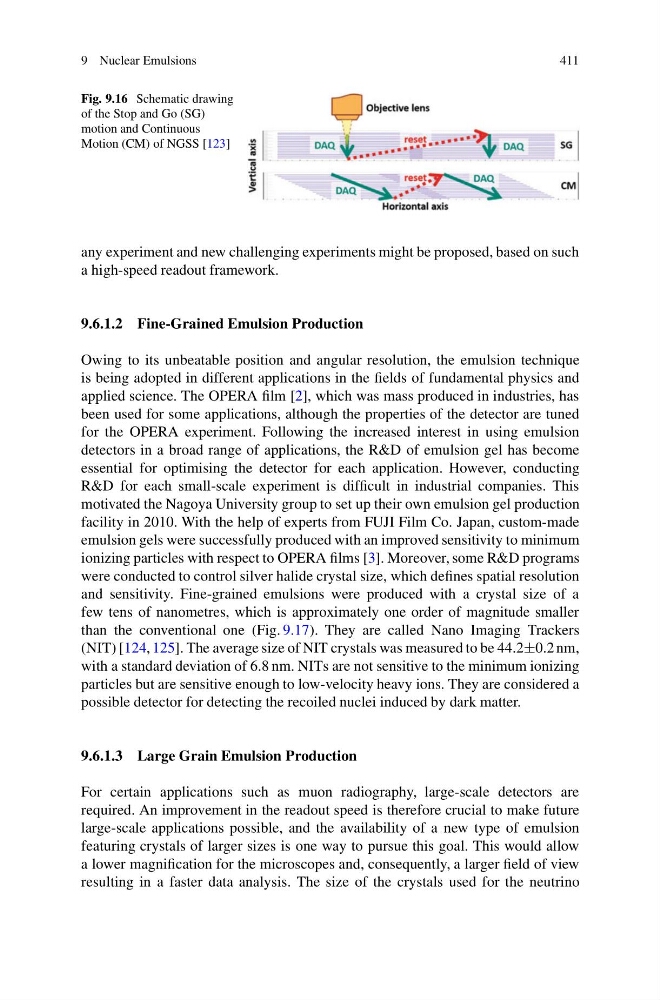
Fig. 9.16 Schematic drawing
of the Stop and Go (SG)
motion and Continuous
Motion (CM) of NGSS [123]
any experiment and new challenging experiments might be proposed, based on such
a high-speed readout framework.
9.6.1.2 Fine-Grained Emulsion Production
Owing to its unbeatable position and angular resolution, the emulsion technique
is being adopted in different applications in the fields of fundamental physics and
applied science. The OPERA film [2], which was mass produced in industries, has
been used for some applications, although the properties of the detector are tuned
for the OPERA experiment. Following the increased interest in using emulsion
detectors in a broad range of applications, the R&D of emulsion gel has become
essential for optimising the detector for each application. However, conducting
R&D for each small-scale experiment is difficult in industrial companies. This
motivated the Nagoya University group to set up their own emulsion gel production
facility in 2010. With the help of experts from FUJI Film Co. Japan, custom-made
emulsion gels were successfully produced with an improved sensitivity to minimum
ionizing particles with respect to OPERA films [3]. Moreover, some R&D programs
were conducted to control silver halide crystal size, which defines spatial resolution
and sensitivity. Fine-grained emulsions were produced with a crystal size of a
few tens of nanometres, which is approximately one order of magnitude smaller
than the conventional one (Fig. 9.17). They are called Nano Imaging Trackers
(NIT) [124, 125]. The average size of NIT crystals was measured to be 44.2±0.2 nm,
with a standard deviation of 6.8 nm. NITs are not sensitive to the minimum ionizing
particles but are sensitive enough to low-velocity heavy ions. They are considered a
possible detector for detecting the recoiled nuclei induced by dark matter.
9.6.1.3 Large Grain Emulsion Production
For certain applications such as muon radiography, large-scale detectors are
required. An improvement in the readout speed is therefore crucial to make future
large-scale applications possible, and the availability of a new type of emulsion
featuring crystals of larger sizes is one way to pursue this goal. This would allow
a lower magnification for the microscopes and, consequently, a larger field of view
resulting in a faster data analysis. The size of the crystals used for the neutrino
411
Fig. 9.16 Schematic drawing
of the Stop and Go (SG)
motion and Continuous
Motion (CM) of NGSS [123]
any experiment and new challenging experiments might be proposed, based on such
a high-speed readout framework.
9.6.1.2 Fine-Grained Emulsion Production
Owing to its unbeatable position and angular resolution, the emulsion technique
is being adopted in different applications in the fields of fundamental physics and
applied science. The OPERA film [2], which was mass produced in industries, has
been used for some applications, although the properties of the detector are tuned
for the OPERA experiment. Following the increased interest in using emulsion
detectors in a broad range of applications, the R&D of emulsion gel has become
essential for optimising the detector for each application. However, conducting
R&D for each small-scale experiment is difficult in industrial companies. This
motivated the Nagoya University group to set up their own emulsion gel production
facility in 2010. With the help of experts from FUJI Film Co. Japan, custom-made
emulsion gels were successfully produced with an improved sensitivity to minimum
ionizing particles with respect to OPERA films [3]. Moreover, some R&D programs
were conducted to control silver halide crystal size, which defines spatial resolution
and sensitivity. Fine-grained emulsions were produced with a crystal size of a
few tens of nanometres, which is approximately one order of magnitude smaller
than the conventional one (Fig. 9.17). They are called Nano Imaging Trackers
(NIT) [124, 125]. The average size of NIT crystals was measured to be 44.2±0.2 nm,
with a standard deviation of 6.8 nm. NITs are not sensitive to the minimum ionizing
particles but are sensitive enough to low-velocity heavy ions. They are considered a
possible detector for detecting the recoiled nuclei induced by dark matter.
9.6.1.3 Large Grain Emulsion Production
For certain applications such as muon radiography, large-scale detectors are
required. An improvement in the readout speed is therefore crucial to make future
large-scale applications possible, and the availability of a new type of emulsion
featuring crystals of larger sizes is one way to pursue this goal. This would allow
a lower magnification for the microscopes and, consequently, a larger field of view
resulting in a faster data analysis. The size of the crystals used for the neutrino