

410
A. Ariga et al.
fastest readout system at present. Conventional systems were using a field of view
(FOV) of 0.12 mm × 0.12 mm (S-UTS) or 0.3 mm × 0.4 mm (ESS). HTS makes
use of the custom made objective lens with a large FOV of 5.1 mm × 5.1 mm and
a magnification of 12.1. The optical path is divided into six, correspondingly the
image is projected on six “mosaic camera modules” as also schematically drawn in
Fig. 9.14. Each mosaic camera module consists of 12 2.2-Mpixel image sensors. In
total, 72 image sensors work in parallel to build the large FOV. The raw image data
throughput from 72 image sensors amounts to 48 GBytes/s, which is then processed
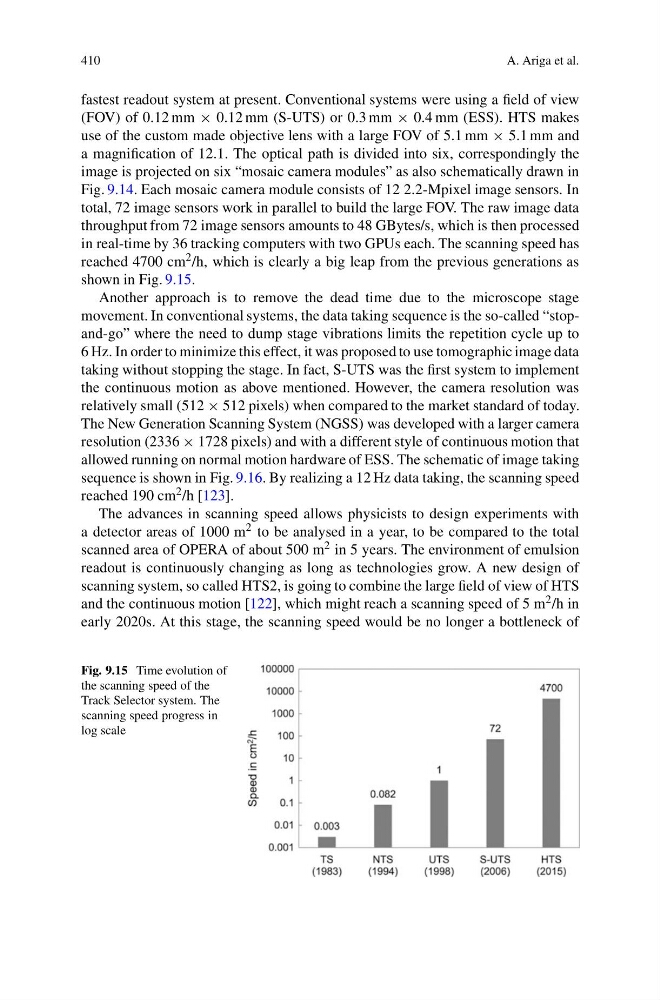
in real-time by 36 tracking computers with two GPUs each. The scanning speed has
reached 4700 cm 2 /h, which is clearly a big leap from the previous generations as
shown in Fig. 9.15.
Another approach is to remove the dead time due to the microscope stage
movement. In conventional systems, the data taking sequence is the so-called “stopand-go” where the need to dump stage vibrations limits the repetition cycle up to
6 Hz. In order to minimize this effect, it was proposed to use tomographic image data
taking without stopping the stage. In fact, S-UTS was the first system to implement
the continuous motion as above mentioned. However, the camera resolution was
relatively small (512 × 512 pixels) when compared to the market standard of today.
The New Generation Scanning System (NGSS) was developed with a larger camera
resolution (2336 × 1728 pixels) and with a different style of continuous motion that
allowed running on normal motion hardware of ESS. The schematic of image taking
sequence is shown in Fig. 9.16. By realizing a 12 Hz data taking, the scanning speed
reached 190 cm 2 /h [123].
The advances in scanning speed allows physicists to design experiments with
a detector areas of 1000 m 2 to be analysed in a year, to be compared to the total
scanned area of OPERA of about 500 m 2 in 5 years. The environment of emulsion
readout is continuously changing as long as technologies grow. A new design of
scanning system, so called HTS2, is going to combine the large field of view of HTS
and the continuous motion [122], which might reach a scanning speed of 5 m 2 /h in
early 2020s. At this stage, the scanning speed would be no longer a bottleneck of
Fig. 9.15 Time evolution of
the scanning speed of the
Track Selector system. The
scanning speed progress in
log scale
A. Ariga et al.
fastest readout system at present. Conventional systems were using a field of view
(FOV) of 0.12 mm × 0.12 mm (S-UTS) or 0.3 mm × 0.4 mm (ESS). HTS makes
use of the custom made objective lens with a large FOV of 5.1 mm × 5.1 mm and
a magnification of 12.1. The optical path is divided into six, correspondingly the
image is projected on six “mosaic camera modules” as also schematically drawn in
Fig. 9.14. Each mosaic camera module consists of 12 2.2-Mpixel image sensors. In
total, 72 image sensors work in parallel to build the large FOV. The raw image data
throughput from 72 image sensors amounts to 48 GBytes/s, which is then processed
in real-time by 36 tracking computers with two GPUs each. The scanning speed has
reached 4700 cm 2 /h, which is clearly a big leap from the previous generations as
shown in Fig. 9.15.
Another approach is to remove the dead time due to the microscope stage
movement. In conventional systems, the data taking sequence is the so-called “stopand-go” where the need to dump stage vibrations limits the repetition cycle up to
6 Hz. In order to minimize this effect, it was proposed to use tomographic image data
taking without stopping the stage. In fact, S-UTS was the first system to implement
the continuous motion as above mentioned. However, the camera resolution was
relatively small (512 × 512 pixels) when compared to the market standard of today.
The New Generation Scanning System (NGSS) was developed with a larger camera
resolution (2336 × 1728 pixels) and with a different style of continuous motion that
allowed running on normal motion hardware of ESS. The schematic of image taking
sequence is shown in Fig. 9.16. By realizing a 12 Hz data taking, the scanning speed
reached 190 cm 2 /h [123].
The advances in scanning speed allows physicists to design experiments with
a detector areas of 1000 m 2 to be analysed in a year, to be compared to the total
scanned area of OPERA of about 500 m 2 in 5 years. The environment of emulsion
readout is continuously changing as long as technologies grow. A new design of
scanning system, so called HTS2, is going to combine the large field of view of HTS
and the continuous motion [122], which might reach a scanning speed of 5 m 2 /h in
early 2020s. At this stage, the scanning speed would be no longer a bottleneck of
Fig. 9.15 Time evolution of
the scanning speed of the
Track Selector system. The
scanning speed progress in
log scale