

9 Nuclear Emulsions
409
9.6.1 The State-of-the-Art Emulsion Technology
9.6.1.1 High-Performance Scanning Systems
Improvements of scanning systems in speed and quality are continuously progressing. One of the recent breakthrough was the appearance of GPGPU (General
Purpose Graphic Processing Unit, or simply GPU). Up to the systems for OPERA,
either FPGAs or CPUs were employed for image processing and track reconstruction. The FPGA has a big computing power, but also difficulties in implementing
sophisticated algorithms and in flexibility. The CPU can process complicated
algorithms but is limited in computing capability. On the other hand, the GPU
provides both computing power and flexibility.
The effort to implement GPUs for scanning systems started soon after the release
of CUDA [118], and it has quickly become the “standard” in the scanning system
development nowadays. The early works were aiming at improving the angular
acceptance in track reconstruction which was limited by the lack of computing
power for online processing. The previously mentioned S-UTS, the scanning system
for OPERA, could recognize tracks with their angle within 30 ◦ with respect to the
normal of the film surface. This angular acceptance is equivalent to 14% of the entire
solid angle. An extension of the S-UTS algorithm was translated into the GPU code,
which reconstructed tracks up to 72 ◦ (68%) with a reasonable processing time [119].
In parallel, new algorithms suitable for parallel processing were developed to extend
the track reconstruction to almost the entire 4π solid angle [120, 121], which finally
allowed to fully exploit the 3D tracking capability of nuclear emulsion. Examples
of applications of such systems will be discussed further below.
In the data acquisition, there are two complementary ways for the fast readout of
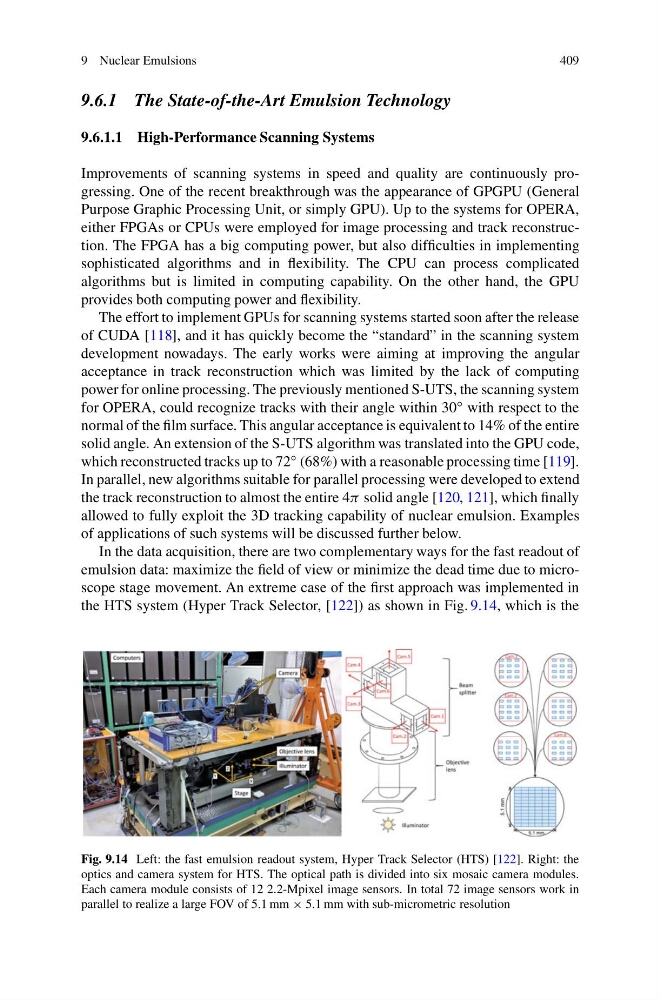
emulsion data: maximize the field of view or minimize the dead time due to microscope stage movement. An extreme case of the first approach was implemented in
the HTS system (Hyper Track Selector, [122]) as shown in Fig. 9.14, which is the
Fig. 9.14 Left: the fast emulsion readout system, Hyper Track Selector (HTS) [122]. Right: the
optics and camera system for HTS. The optical path is divided into six mosaic camera modules.
Each camera module consists of 12 2.2-Mpixel image sensors. In total 72 image sensors work in
parallel to realize a large FOV of 5.1 mm × 5.1 mm with sub-micrometric resolution
409
9.6.1 The State-of-the-Art Emulsion Technology
9.6.1.1 High-Performance Scanning Systems
Improvements of scanning systems in speed and quality are continuously progressing. One of the recent breakthrough was the appearance of GPGPU (General
Purpose Graphic Processing Unit, or simply GPU). Up to the systems for OPERA,
either FPGAs or CPUs were employed for image processing and track reconstruction. The FPGA has a big computing power, but also difficulties in implementing
sophisticated algorithms and in flexibility. The CPU can process complicated
algorithms but is limited in computing capability. On the other hand, the GPU
provides both computing power and flexibility.
The effort to implement GPUs for scanning systems started soon after the release
of CUDA [118], and it has quickly become the “standard” in the scanning system
development nowadays. The early works were aiming at improving the angular
acceptance in track reconstruction which was limited by the lack of computing
power for online processing. The previously mentioned S-UTS, the scanning system
for OPERA, could recognize tracks with their angle within 30 ◦ with respect to the
normal of the film surface. This angular acceptance is equivalent to 14% of the entire
solid angle. An extension of the S-UTS algorithm was translated into the GPU code,
which reconstructed tracks up to 72 ◦ (68%) with a reasonable processing time [119].
In parallel, new algorithms suitable for parallel processing were developed to extend
the track reconstruction to almost the entire 4π solid angle [120, 121], which finally
allowed to fully exploit the 3D tracking capability of nuclear emulsion. Examples
of applications of such systems will be discussed further below.
In the data acquisition, there are two complementary ways for the fast readout of
emulsion data: maximize the field of view or minimize the dead time due to microscope stage movement. An extreme case of the first approach was implemented in
the HTS system (Hyper Track Selector, [122]) as shown in Fig. 9.14, which is the
Fig. 9.14 Left: the fast emulsion readout system, Hyper Track Selector (HTS) [122]. Right: the
optics and camera system for HTS. The optical path is divided into six mosaic camera modules.
Each camera module consists of 12 2.2-Mpixel image sensors. In total 72 image sensors work in
parallel to realize a large FOV of 5.1 mm × 5.1 mm with sub-micrometric resolution