

408
A. Ariga et al.
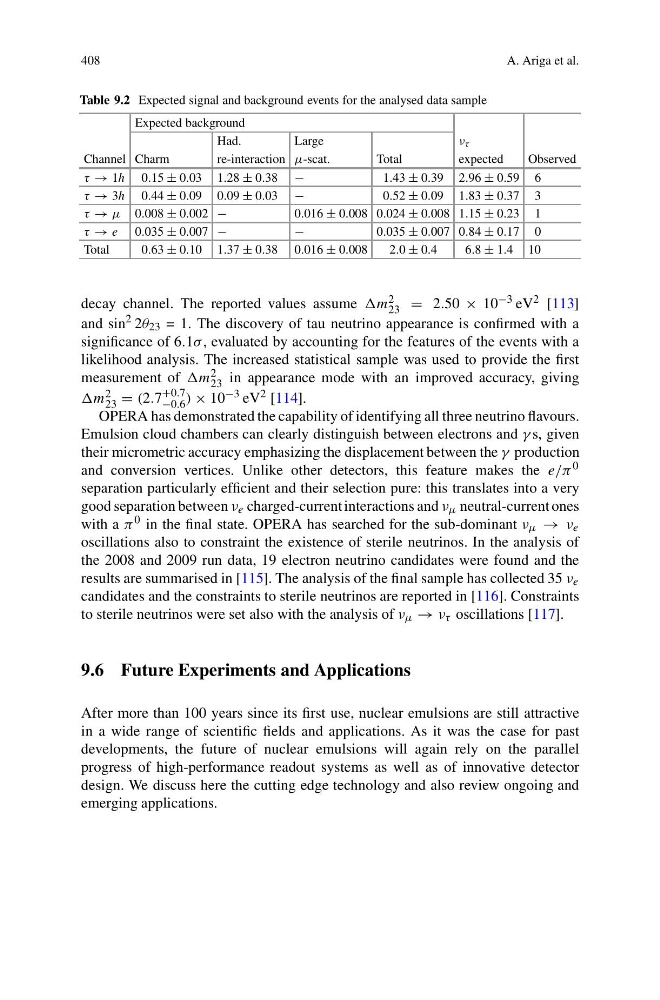
Table 9.2 Expected signal and background events for the analysed data sample
Expected background
Had.
Large
ν τ
Channel Charm
re-interaction μ-scat.
Total
expected
Observed
τ → 1h 0.15 ± 0.03 1.28 ± 0.38 −
1.43 ± 0.39 2.96 ± 0.59 6
τ → 3h 0.44 ± 0.09 0.09 ± 0.03 −
0.52 ± 0.09 1.83 ± 0.37 3
τ → μ 0.008 ± 0.002 −
0.016 ± 0.008 0.024 ± 0.008 1.15 ± 0.23 1
τ → e 0.035 ± 0.007 −
−
0.035 ± 0.007 0.84 ± 0.17 0
Total
0.63 ± 0.10 1.37 ± 0.38 0.016 ± 0.008
2.0 ± 0.4
6.8 ± 1.4 10
decay channel. The reported values assume 2
23 = 2.50 × 10 −3 eV 2 [113]
and sin
2 2θ 23 = 1. The discovery of tau neutrino appearance is confirmed with a
significance of 6.1σ , evaluated by accounting for the features of the events with a
likelihood analysis. The increased statistical sample was used to provide the first
measurement of 2
23 in appearance mode with an improved accuracy, giving
2
23 = (2.7
+0.7
−0.6 ) × 10 −3 eV 2 [114].
OPERA has demonstrated the capability of identifying all three neutrino flavours.
Emulsion cloud chambers can clearly distinguish between electrons and γ s, given
their micrometric accuracy emphasizing the displacement between the γ production
and conversion vertices. Unlike other detectors, this feature makes the e/π 0
separation particularly efficient and their selection pure: this translates into a very
good separation between ν e charged-current interactions and ν μ neutral-current ones
with a π 0 in the final state. OPERA has searched for the sub-dominant ν μ → ν e
oscillations also to constraint the existence of sterile neutrinos. In the analysis of
the 2008 and 2009 run data, 19 electron neutrino candidates were found and the
results are summarised in [115]. The analysis of the final sample has collected 35 ν e
candidates and the constraints to sterile neutrinos are reported in [116]. Constraints
to sterile neutrinos were set also with the analysis of ν μ → ν τ oscillations [117].
9.6 Future Experiments and Applications
After more than 100 years since its first use, nuclear emulsions are still attractive
in a wide range of scientific fields and applications. As it was the case for past
developments, the future of nuclear emulsions will again rely on the parallel
progress of high-performance readout systems as well as of innovative detector
design. We discuss here the cutting edge technology and also review ongoing and
emerging applications.
A. Ariga et al.
Table 9.2 Expected signal and background events for the analysed data sample
Expected background
Had.
Large
ν τ
Channel Charm
re-interaction μ-scat.
Total
expected
Observed
τ → 1h 0.15 ± 0.03 1.28 ± 0.38 −
1.43 ± 0.39 2.96 ± 0.59 6
τ → 3h 0.44 ± 0.09 0.09 ± 0.03 −
0.52 ± 0.09 1.83 ± 0.37 3
τ → μ 0.008 ± 0.002 −
0.016 ± 0.008 0.024 ± 0.008 1.15 ± 0.23 1
τ → e 0.035 ± 0.007 −
−
0.035 ± 0.007 0.84 ± 0.17 0
Total
0.63 ± 0.10 1.37 ± 0.38 0.016 ± 0.008
2.0 ± 0.4
6.8 ± 1.4 10
decay channel. The reported values assume 2
23 = 2.50 × 10 −3 eV 2 [113]
and sin
2 2θ 23 = 1. The discovery of tau neutrino appearance is confirmed with a
significance of 6.1σ , evaluated by accounting for the features of the events with a
likelihood analysis. The increased statistical sample was used to provide the first
measurement of 2
23 in appearance mode with an improved accuracy, giving
2
23 = (2.7
+0.7
−0.6 ) × 10 −3 eV 2 [114].
OPERA has demonstrated the capability of identifying all three neutrino flavours.
Emulsion cloud chambers can clearly distinguish between electrons and γ s, given
their micrometric accuracy emphasizing the displacement between the γ production
and conversion vertices. Unlike other detectors, this feature makes the e/π 0
separation particularly efficient and their selection pure: this translates into a very
good separation between ν e charged-current interactions and ν μ neutral-current ones
with a π 0 in the final state. OPERA has searched for the sub-dominant ν μ → ν e
oscillations also to constraint the existence of sterile neutrinos. In the analysis of
the 2008 and 2009 run data, 19 electron neutrino candidates were found and the
results are summarised in [115]. The analysis of the final sample has collected 35 ν e
candidates and the constraints to sterile neutrinos are reported in [116]. Constraints
to sterile neutrinos were set also with the analysis of ν μ → ν τ oscillations [117].
9.6 Future Experiments and Applications
After more than 100 years since its first use, nuclear emulsions are still attractive
in a wide range of scientific fields and applications. As it was the case for past
developments, the future of nuclear emulsions will again rely on the parallel
progress of high-performance readout systems as well as of innovative detector
design. We discuss here the cutting edge technology and also review ongoing and
emerging applications.