

2 The Interaction of Radiation with Matter
27
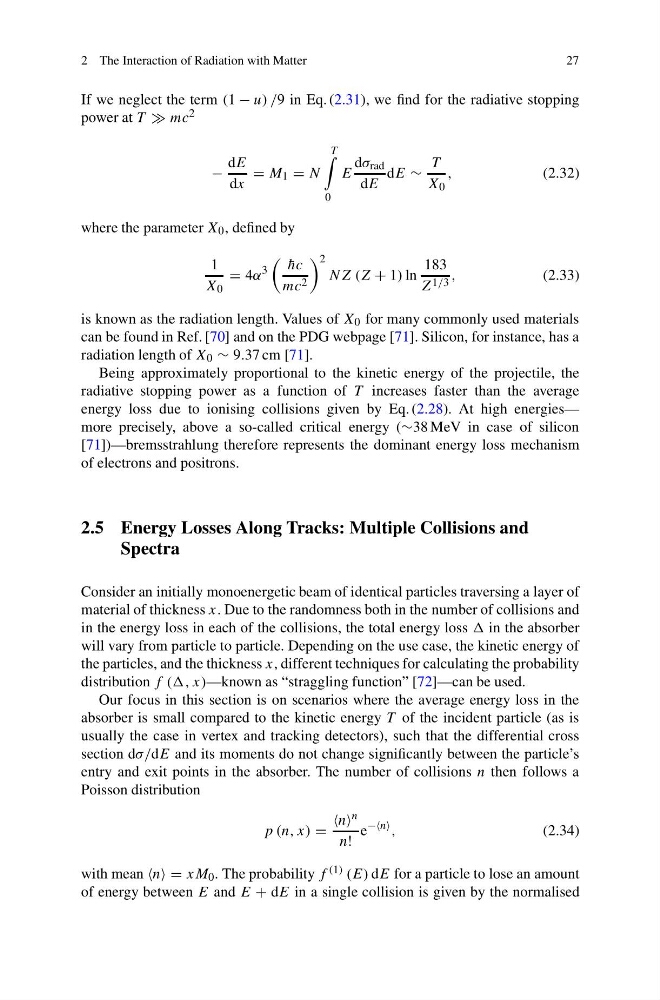
If we neglect the term (1 − u) /9 in Eq. (2.31), we find for the radiative stopping
power at T mc 2
−
dE
dx
= M 1 = N
T
0
E
dσ rad
dE
dE ∼
T
X 0
,
(2.32)
where the parameter X 0 , defined by
1
X 0
= 4α
3
¯
hc
mc 2
2
NZ (Z + 1) ln
183
Z 1/3 ,
(2.33)
is known as the radiation length. Values of X 0 for many commonly used materials
can be found in Ref. [70] and on the PDG webpage [71]. Silicon, for instance, has a
radiation length of X 0 ∼ 9.37 cm [71].
Being approximately proportional to the kinetic energy of the projectile, the
radiative stopping power as a function of T increases faster than the average
energy loss due to ionising collisions given by Eq. (2.28). At high energies—
more precisely, above a so-called critical energy (∼38 MeV in case of silicon
[71])—bremsstrahlung therefore represents the dominant energy loss mechanism
of electrons and positrons.
2.5 Energy Losses Along Tracks: Multiple Collisions and
Spectra
Consider an initially monoenergetic beam of identical particles traversing a layer of
material of thickness x. Due to the randomness both in the number of collisions and
in the energy loss in each of the collisions, the total energy loss in the absorber
will vary from particle to particle. Depending on the use case, the kinetic energy of
the particles, and the thickness x, different techniques for calculating the probability
distribution f (, x)—known as “straggling function” [72]—can be used.
Our focus in this section is on scenarios where the average energy loss in the
absorber is small compared to the kinetic energy T of the incident particle (as is
usually the case in vertex and tracking detectors), such that the differential cross
section dσ/dE and its moments do not change significantly between the particle’s
entry and exit points in the absorber. The number of collisions n then follows a
Poisson distribution
p (n, x) =
n
n!
e
−−n ,
(2.34)
with mean = xM 0 . The probability f (1) (E) dE for a particle to lose an amount
of energy between E and E + dE in a single collision is given by the normalised
27
If we neglect the term (1 − u) /9 in Eq. (2.31), we find for the radiative stopping
power at T mc 2
−
dE
dx
= M 1 = N
T
0
E
dσ rad
dE
dE ∼
T
X 0
,
(2.32)
where the parameter X 0 , defined by
1
X 0
= 4α
3
¯
hc
mc 2
2
NZ (Z + 1) ln
183
Z 1/3 ,
(2.33)
is known as the radiation length. Values of X 0 for many commonly used materials
can be found in Ref. [70] and on the PDG webpage [71]. Silicon, for instance, has a
radiation length of X 0 ∼ 9.37 cm [71].
Being approximately proportional to the kinetic energy of the projectile, the
radiative stopping power as a function of T increases faster than the average
energy loss due to ionising collisions given by Eq. (2.28). At high energies—
more precisely, above a so-called critical energy (∼38 MeV in case of silicon
[71])—bremsstrahlung therefore represents the dominant energy loss mechanism
of electrons and positrons.
2.5 Energy Losses Along Tracks: Multiple Collisions and
Spectra
Consider an initially monoenergetic beam of identical particles traversing a layer of
material of thickness x. Due to the randomness both in the number of collisions and
in the energy loss in each of the collisions, the total energy loss in the absorber
will vary from particle to particle. Depending on the use case, the kinetic energy of
the particles, and the thickness x, different techniques for calculating the probability
distribution f (, x)—known as “straggling function” [72]—can be used.
Our focus in this section is on scenarios where the average energy loss in the
absorber is small compared to the kinetic energy T of the incident particle (as is
usually the case in vertex and tracking detectors), such that the differential cross
section dσ/dE and its moments do not change significantly between the particle’s
entry and exit points in the absorber. The number of collisions n then follows a
Poisson distribution
p (n, x) =
n
n!
e
−−n ,
(2.34)
with mean = xM 0 . The probability f (1) (E) dE for a particle to lose an amount
of energy between E and E + dE in a single collision is given by the normalised